Cemiplimab (Libtayo®) 力汰瘤 濃縮輸注液專業版
發布日期:2025-12-02
目錄
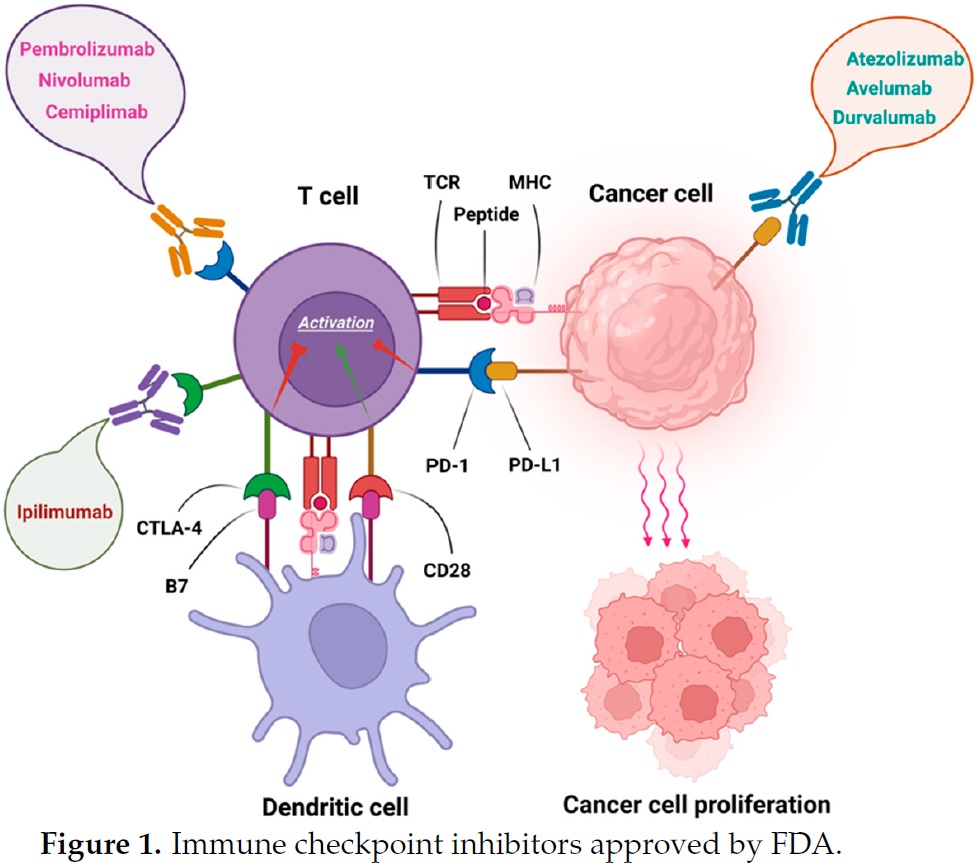
免疫檢查點抑制劑 (Immune Checkpoint Inhibitors) 的發展歷史與里程碑1, 2, 3
1990年代,CTLA-4與PD-1 分別被兩位免疫學家James Allison 和 Tasuku Honjo發現其與自體免疫及腫瘤治療的關聯性。
2011年,首個免疫檢查點藥物CTLA-4 抑制劑-ipilimumab被FDA核准使用於轉移性黑色素瘤的治療。
2014年,PD-1抑制劑如pembrolizumab和nivolumab陸續獲得FDA批准於治療黑色素瘤二線治療與非鱗狀非小細胞肺癌。
2016年,首個PD-L1抑制劑如Atezolizumab獲得FDA批准使用於轉移性泌尿上皮癌治療。
2021年,PD-1抑制劑 pembrolizumab 獲准用於早期癌症術後輔助療法(如腎細胞癌)。
2022年,首個新免疫檢查點藥物LAG-3抑制劑relatlimab,與nivolumab的合併療法獲准FDA核可使用於無法切除或轉移性黑色素瘤。
同一年,PD-1抑制劑與CTLA-4 抑制劑的特殊組合療法,第一線第一線 durvalumab 聯合單劑 tremelimumab (STRIDE regimen),能有效改善無法切除或轉移性肝癌病人整體存活率。至今成為此類病人的一線選擇之一。
常見適應症4, 5, 6, 7, 8 (FDA於2018年9月核准上市)
用於治療不適合接受治癒性手術或治癒性放射治療的轉移性皮膚鱗狀細胞癌 (mCSCC) 或局部晚期皮膚鱗狀細胞癌 (laCSCC) 之成人病人。(無TFDA適應症)
先前曾接受過 Hedgehog 路徑抑制劑治療,或不適合使用 Hedgehog 路徑抑制劑之局部晚期或轉移性基底細胞癌 (laBCC 或 mBCC) 的成人病人。(無TFDA適應症)
單一療法用於第一線治療有PD-L1表現 (tumor proportion score [TPS] ≥ 50%) 且無EGFR、ALK或ROS 1 基因異常之局部晚期(且不適合手術切除或接受根除性化學放射治療)或轉移性非小細胞肺癌 (NSCLC) 成人病人。
| US FDA 適應症 |
試驗設計/適用病人 | 試驗結果 | 用法劑量 |
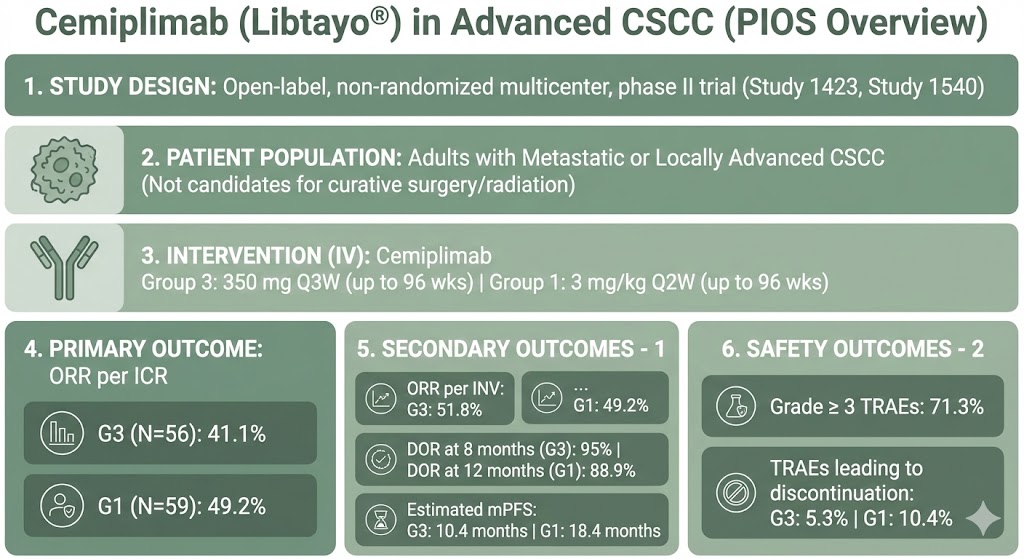
Adult pts with metastatic CSCC or locally advanced CSCC who are not candidates for curative surgery or curative radiation. (study 1423, NCT02383212 & Study 1540 NCT02760498) Ref: J Immunother Cancer. 2020 Jun;8(1):e000775. |
Open-label, non-randomized multicenter, phase II trial. Adults pts with invasive CSCC. (56 pts in group 3; 59 pts in group 1) |
(Median f/u in G3: 8.1 months; in G1: 16.5 months) ORR per ICR (G3): 41.1% ORR per ICR (G1): 49.2% ORR per INV (G3): 51.8% ORR per INV (G1): 49.2% DOR at 8 months (G3): 95% DOR at 12 months (G1): 88.9% Estimated mPFS (G3): 10.4 months Estimated mPFS (G1): 18.4 months Grade ≥ 3 TRAEs: 71.3%. TRAEs leading to discontinuation: 5.3% (G3); 10.4% (G1) |
Group 3: cemiplimab 350 mg IV Q3W for up to 54 weeks, with the option to extend to 96 weeks. Group 1: cemiplimab 3 mg/kg IV Q2W for up to 96 weeks. |
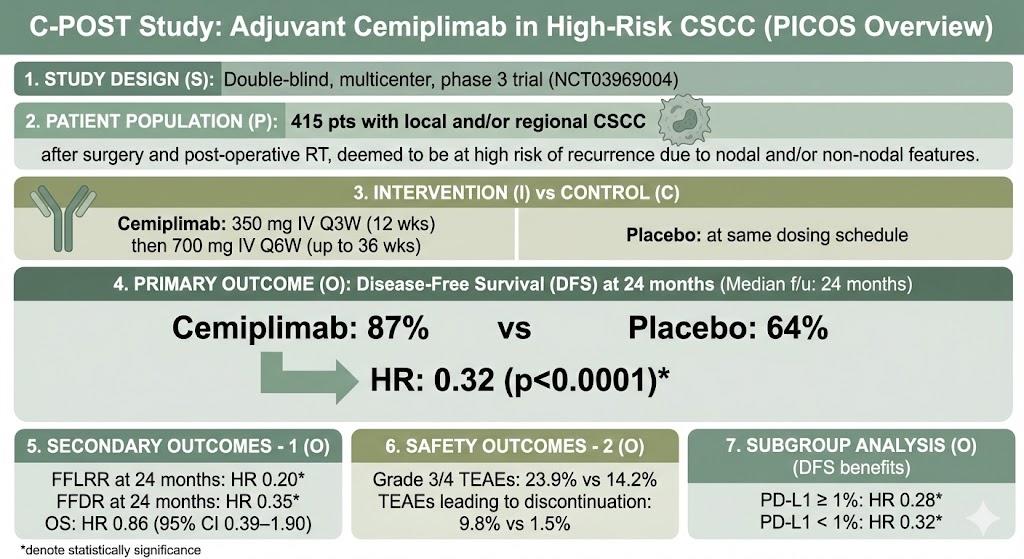
Adjuvant treatment of adult pts with CSCC at high risk of recurrence after surgery and radiation. (C-POST study, NCT03969004) Ref: N Engl J Med . 2025 Aug 21;393(8):774-785. |
Double-blind, multicenter, phase III trial. 415 pts with local and/or regional CSCC, after surgery and post-operative RT, deemed to be at high risk of recurrence due to nodal (extracapsular extension with largest node ≥ 2 cm or ≥,3 involved LNs) and/or non-nodal (in-transit metastases, T4 lesion, perineural invasion, or locally recurrent tumor with ≥1 additional risk feature) (1:1; cemiplimab vs placebo) |
(Median f/u: 24 months) DFS at 24 months: 87% vs 64% (HR: 0.32; p,0.0001)* FFLRR at 24 months: HR 0.20; 95% CI 0.09–0.40)* FFDR at 24 months: HR 0.35; 0.17–0.72* OS: HR 0.86 (95% CI 0.39–1.90) Grade 3/4 TEAEs: 23.9% vs 14.2% TEAEs leading to discontinuation: 9.8% vs 1.5% [Subgroup analysis] DFS benefits in pts with tumoral PDL1≥1% (HR 0.28; 95%CI 0.15–0.52; n=309)* and <1% (HR 0.32; 0.12–0.86; n=85)* |
Cemiplimab 350 mg IV Q3W for 12 weeks, then 700 mg IV Q6W up to 36 weeks. Vs Placebo at same dosing schedule. |
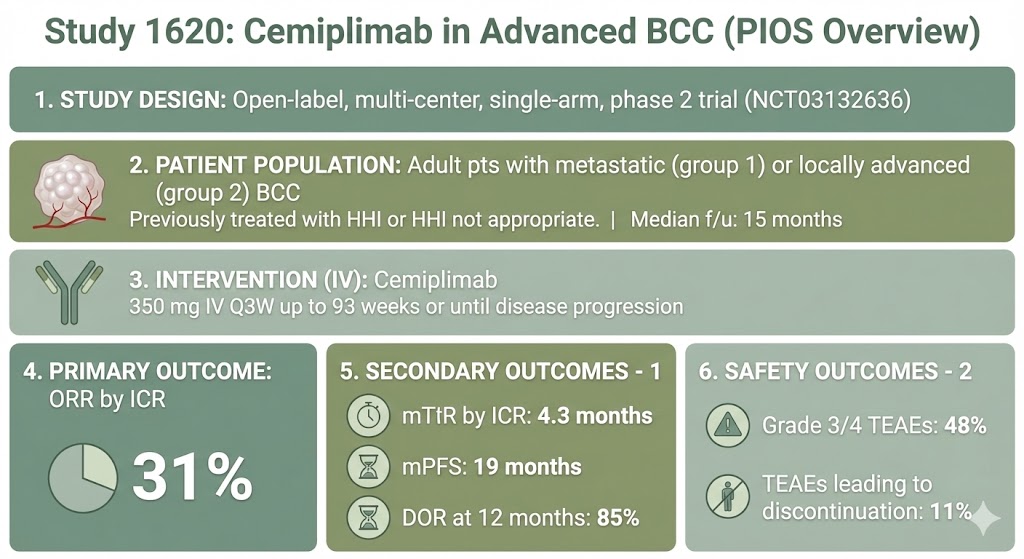
Adult pts with locally advanced or metastatic BCC, with previously treated with a HHI or for whom a hedgehog pathway inhibitor is not appropriate. (Study 1620, NCT03132636) Ref: Lancet Oncol . 2021 Jun;22(6):848-857. |
Open-label, multi-center, single-arm, phase II trial. Adults pts with metastatic BCC (group 1) or locally advanced BCC (group 2) who had progressed on or were intolerant to previous HHI therapy. |
(Median f/u: 15 months) ORR by ICR: 31%, CR: 6% mTTR by ICR: 4.3 months mPFS: 19 months estimated OS at 2 years: 80% DOR at 12 months: 85% Grade 3/4 TEAEs: 48% TEAEs leading to discontinuation: 11% |
Cemiplimab 350 mg IV Q3W up to 93 weeks or until disease progression |
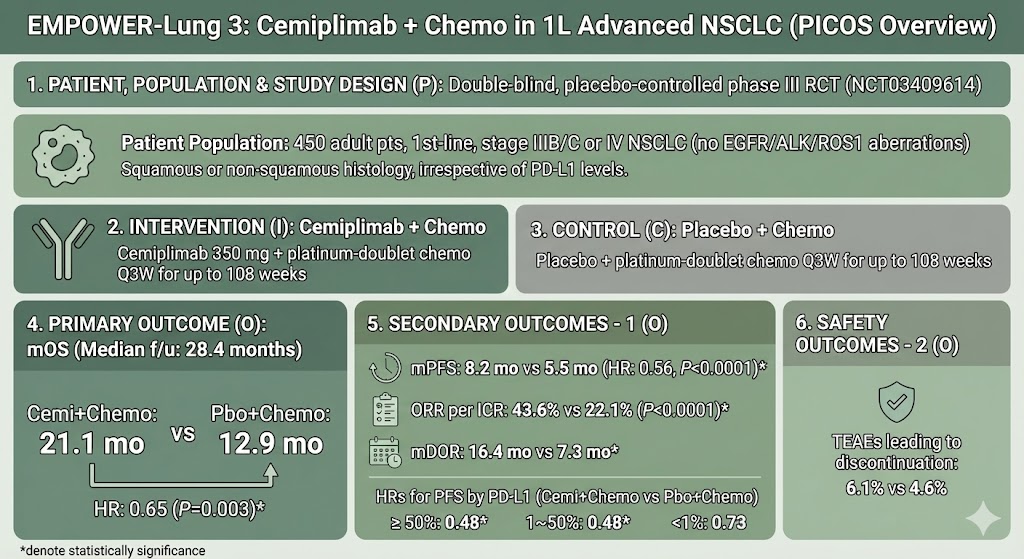
First‐line, adult pts with NSCLC with no EGFR, ALK or ROS1 aberrations, and locally advanced not candidates for surgical resection or definitive chemoradiation or metastatic, in combination with platinum‐based chemotherapy (EMPOWER-Lung 3, NCT03409614) Ref: J Thorac Oncol . 2023 Jun;18(6):755-768. |
Double-blind, placebo-controlled phase III RCT. 450 pts with stage IIIB/C or IV NSCLC without EGFR, ALK, or ROS1 aberrations, with either squamous or nonsquamous histology, irrespective of PD-L1 levels. (2:1, cemiplimab plus chemotherapy vs chemotherapy alone) |
(Median f/u: 28.4 months) mOS: 21.1 months vs 12.9 months (HR: 0.65, P=0.003)* mPFS: 8.2 months vs 5.5 months (HR: 0.56, P<0.0001)* ORR per ICR: 43.6% vs 22.1% (P<0.0001)* mDOR: 16.4 months vs 7.3 months* No significant difference in 2-year PFS between different histology group. HRs for PFS for PD-L1 ≥ 50%; 1~50%; and <1%: 0.48*; 0.48*; 0.73. TEAEs leading to discontinuation: 6.1% vs 4.6%. |
Histology-specific platinum-doublet chemotherapy, with cemiplimab 350 mg or placebo Q3W for up to 108 weeks. |
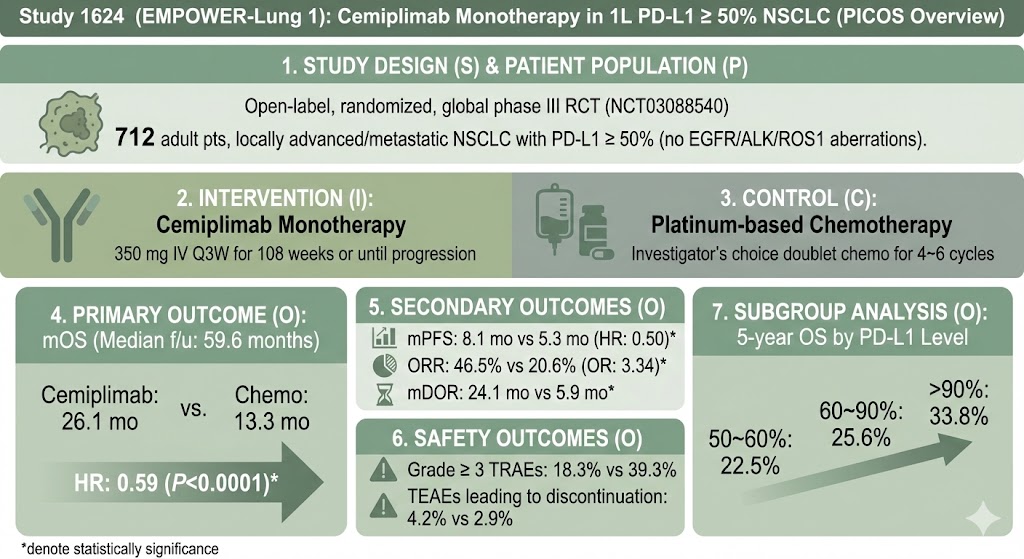
First-line, adult pts with NSCLC, PD-L1 TPS ≥50% as determined by an FDA-approved test, with no EGFR, ALK or ROS1 aberrations, and locally advanced not candidates for surgical resection or definitive chemoradiation or metastatic. (Study 1624, NCT03088540) Ref: Lancet. 2021 Feb 13;397(10274):592-604. |
Open-label, randomized, global phase III RCT 712 adult pts with locally advanced and metastatic NSCLC with PD-L1≥ 50%, without EGFR, ALK, or ROS1 aberrations. (1:1; cemiplimab versus investigator’s choice of platinum-based chemotherapy) |
(Median f/u: 59.6 months) mOS: 26.1 months vs 13.3 months (HR: 0.59; P<0.0001)* mPFS: 8.1 months vs 5.3 months (HR: 0.50; P<0.0001)* ORR: 46.5% vs 20.6% (OR: 3.34, P<0.0001)* mDOR: 24.1 months vs 5.9 months* [Subgroup analysis] 5-year OS in PD-L1 50~60%; 60~90%, >90%: 22.5%; 25.6%; 33.8%. Grade ≥ 3 TRAEs: 18.3% vs 39.3% TEAEs leading to discontinuation: 4.2% vs 2.9%. |
Cemiplimab 350 mg IV Q3W for 108 weeks or until disease progression, or investigator’s choice of platinum-based doublet chemotherapy for 4~6 cycles. |
試驗評論:
|
|||
BCC: Basal Cell Carcinoma; CSCC: cutaneous squamous cell carcinoma; DFS: disease-free survival; DOR: duration of response; FFDR: freedom from distant recurrence; FFLRR: freedom from local-regional recurrence; HHI: hedgehog pathway inhibitor; ICR: independent central review; INV: investigator review; mTTR: median time to response; NSCLC: non-small cell lung cancer; PD-L1: programmed death-ligand 1; OS: overall survival; ORR: objective response rate; TEAEs: treatment-emergent adverse events.
致吐性及骨髓方面副作用9
致吐性:低度致吐性 (10~30%的病人會有嘔吐副作用)
血液學方面副作用:貧血 (15%;3/4 級:1.4%);淋巴球減少 (6%;3/4 級:2.9~3%)。
注意事項及常見副作用 9
常見副作用 (≥15%) 包括:疲累、肌肉骨骼疼痛、皮疹、搔癢、腹瀉、貧血。
其他各系統副作用如下:
全身性副作用:疲累 (14~50%;3/4 級:1.1~4.3%)、水腫 (10%;3/4 級:0.7%)
皮膚方面副作用:紅疹 (15~37%;3/4 級:0.7~2%)、搔癢 (16~22%;3/4 級:0~0.5%)、日光性角化症 (10%)
骨骼肌肉方面作用:肌肉骨骼疼痛 (26~36%;3/4 級:0.6~2.9%)
腸胃道方面副作用:腹瀉 (26~33%;3/4 級:1.1~4.3%)、噁心 (13~21%;3/4 級:0~0.7%)、便祕 (12~13%;3/4 級:0.7~1.1%)、嘔吐 (11%;3/4 級:0.6%)、腹痛 (12%;3/4 級:1.4%)
心血管方面副作用:出血 (18%;3/4 級:0.7%)、高血壓 (17%;3/4 級:9%)
感染方面副作用:上呼吸道感染 (14~22%;3/4 級:0~1.1%)、皮膚感染 (11%;3/4 級:4.5%)、泌尿道感染 (13%;3/4 級:2.2%)、肺炎 (11%;3/4 級:5%)
呼吸系統與胸腔方面副作用: 咳嗽 (11~12%)、呼吸困難 (14%)
代謝性與內分泌副作用:降低食慾 (11~14%;3/4 級:0.6~1.4%)、甲狀腺功能低下 (12%;3/4 級:0.5%)
腎臟與泌尿道方面副作用:急性腎臟衰竭 (14%)
神經系統副作用:頭痛 (10~13%;3/4 級:0~1.4%)、頭暈 (10~12%)、周邊神經病變 (11%)
實驗室數值異常:低血鈉 (3/4 級:2.9~4.9%)、低血磷 (3/4 級:4.1%)、高血鈣 (3/4 級:2.0%)、低血鉀 (3/4 級:1.5%)、凝血酶原時間延長 (3/4 級:2.9%)、白蛋白低下 (3/4 級:1~1.2%)、ALT上升 (3/4 級:3.9%)、AST上升 (3/4 級:1.5~3%)、ALP上升 (3/4 級:1.5%)
註釋:當癌症藥物進行臨床試驗時,所收載的副作用,包括:藥物本身的副作用、原本疾病表現的症狀,或是當下併用的其他藥物的可能副作用。
藥物副作用的定義是由美國癌症研究院制訂的常見毒性標準 (Common Terminology Criteria for Adverse Events, CTCAE),常使用來描述病人接受化學治療後,所發生器官毒性的嚴重度分級。毒性分級由器官系統的特別分類,分為輕微 (1級)、中級 (2級)、嚴重 (3級)、致命 (4級)或死亡 (5級)。當發生3級以上的副作用時,需醫療介入處理且進行劑量調整或停藥;若發生4級情形,大多需要住院介入醫療處理。
給藥方式9
將藥罐溶液以NS, D5W稀釋後輸注使用,每次緩慢輸注30分鐘。須注意輸注反應。
各適應症下的給藥時程:
| 適應症 | Cemiplimab給藥劑量 | 療程長度 |
|---|---|---|
| Adults with mCSCC or laCSCC | 350 mg Q3W | 直到疾病進展或不可耐受之毒性或至24個月。 |
| Adjuvant therapy for adults with CSSS at high risk of recurrence after surgery and radiation | 350 mg Q3W for 12 weeks, followed by 700 mg Q6W or 350 mg Q3W | 直到疾病進展或不可耐受之毒性或至48週。 |
| Adults with laBCC or mBCC | 350 mg Q3W | 直到疾病進展或不可耐受之毒性或至24個月。 |
| Adults with NSCLC | 350 mg Q3W | 直到疾病進展或不可耐受之毒性。 |
CSCC: cutaneous squamous cell carcinoma; La: locally advanced; m: metastatic; NSCLC: non-small cell lung cancer.
劑量調整9
腎功能不全調整:
對於輕度至重度腎功能不全病人:無須調整劑量。
肝功能不全調整:
對於輕度至中度肝功能不全病人 (T-bil < 3倍正常上限值與任何ALT):無須調整劑量。
對於重度肝功能不全病人 (T-bil > 3倍正常上限值):此類病人之藥動學數據尚未被研究。
對不良反應的調整與處理:
| 副作用 | 嚴重程度 | 處理方式與劑量調整 |
|---|---|---|
| 免疫相關肺炎 | 第二級 |
|
| 第三至四級 |
|
|
| 免疫相關腸道炎 | 第二至三級 |
|
| 第四級 |
|
|
| 免疫相關肝炎且確定非癌症肝臟轉移 | AST/ALT上升至3~8倍正常上限值、或T-bil上升至1.5~3倍正常上限值 |
|
| AST/ALT上升至8倍正常上限值以上、或T-bil上升至3倍正常上限值以上 |
|
|
| 免疫相關肝炎但有癌症肝臟轉移 | AST/ALT基礎值為1~3倍正常上限值但上升到5~10倍正常上限值、AST/ALT基礎值為3~5倍正常上限值但上升到8~10倍正常上限值 |
|
| AST/ALT上升至10倍正常上限值以上、或T-bil上升至3倍正常上限值以上 |
|
|
| 內分泌病變 | 第三或第四級 |
|
| 腎炎或腎功能不全 | 第二或第三級血肌酸酐上升 |
|
| 第四級肌酸酐酸上升 |
|
|
| 剝落性皮膚炎 | 懷疑SJS, TEN或DRESS |
|
| 確診SJS, TEN或DRESS |
|
|
| 心包膜炎 | 第二至四級 |
|
| 神經相關毒性 | 第二級 |
|
| 第三或第四級 |
|
|
| 輸注反應 | 第一或第二級 |
|
| 第三或第四級 |
|
DRESS=Drug Rash with Eosinophilia and Systemic Symptoms. SJS=Stevens-Johnson Syndrome, TEN=toxic epidermal necrolysis,.
對藥物交互作用之劑量調整:詳見下方<藥物交互作用>
警告/注意事項與不良反應9
常見副作用的發生比率與型態:
| 副作用 | 臨床表現/徵象 | 臨床表現發生比率、型態與建議監測 |
| 嚴重與致命性免疫相關副作用 (irAE) | 肺炎 (非感染性):呼吸困難、胸悶胸痛、乾咳 |
|
| 腸道炎:水瀉、腹痛、脫水症狀如低血壓 |
|
|
| 肝炎:腹痛、噁心嘔吐、AST/ALT/T-bil上升、食慾下降、茶色尿 |
|
|
| 腎上腺功能不全:疲累、體重下降、低血壓、頭暈 |
|
|
| 腦下垂體炎:頭痛、畏光、視野受損 |
|
|
| 甲狀腺炎 |
|
|
| 甲狀腺機能亢進 |
|
|
| 甲狀腺機能低下 |
|
|
| 第一型糖尿病,可能以糖尿病酮酸血症表現 |
|
|
| 腎炎或腎功能下降:寡尿、血尿、下肢水腫 |
|
|
| 皮膚相關不良反應:紅疹、搔癢、乾皮症 |
|
|
| 其他免疫不良反應:心肌炎、心包膜炎、血管炎、重症肌無力、格林-巴利症候群、神經癱瘓、葡萄膜炎、虹膜炎、胰臟炎、肌炎等 |
|
|
| 輸注反應 | 噁心、發燒、打冷顫、嘔吐 |
|
| 異體血液幹細胞移植之併發症 | (按照移植相關併發症而異) |
|
irAEs: immune-related adverse events.
對胎兒的影響:
基於動物試驗與藥理機轉,本藥可能引導免疫相關之排斥反應,造成孕期胎兒死亡之可能。對於具生育可能之女性,服藥期間與停藥後四個月內均需做好避孕措施。對哺乳的影響:
目前尚無本藥乳汁分布之數據。建議服藥期間與停藥後四個月內須避免哺乳。對生育能力的影響:
目前尚無本藥對於人類生育力影響之數據。根據動物試驗之結果,本藥對於公猴與母猴的生育能力指標沒有影響。
藥物交互作用9
本藥主要經蛋白酶分解。
本藥並未進行藥物交互作用研究。但基於藥理機轉,類固醇、免疫抑制劑類藥物會降低本藥品的抗癌療效。除非發生免疫相關不良反應,否則盡可能避免類固醇、免疫抑制劑類的使用。
臨床監測項目9
肝指數:檢查基礎值並常規追蹤。
肌酸酐:檢查基礎值並常規追蹤。
甲狀腺數值:檢查基礎值並常規追蹤。
血糖數值:檢查基礎值並常規追蹤。
皮膚與腸胃道副作用:追蹤皮膚與排便狀況。
治療前評估妊娠狀態 (在具有生殖潛力的女性中)。
機轉2
PD-1 的免疫檢查點調控機制:
PD-1 是一種抑制性受體,在程式死亡訊息傳遞中扮演關鍵角色,負責調節 T 細胞媒介的免疫反應。PD-1 的結合可透過干擾 CD28 訊息傳遞路徑 (co-stimulatory signal),進而減少細胞增生以及細胞激素(如 IL-2、IFN-γ 和 TNF-α)的分泌。在腫瘤微環境 (TME) 中的多種免疫細胞表面皆檢測得到 PD-1 的表現,包括活化的單核球、樹突細胞 (DCs)、自然殺手 (NK) 細胞以及 T 細胞。
若腫瘤細胞能表現PD-1的配體PD-L1,則能在T細胞受體TCR (T cell receptor)與癌細胞MHC的辨認過程中,抑制TCR相關訊息傳遞,導致T細胞無法被活化而造成煞車效果。
ICIs (immune checkpoint inhibitors) 的機轉:
Cemiplimab為全人源的抗PD-1 IgG4單株抗體,能有效與PD-L1競爭T細胞上的PD-1,進而阻止腫瘤細胞對於T細胞的煞車效果,以增強抗癌的免疫力。
藥師小叮嚀
本藥經輸注方式給藥,每三週給藥一次。
如有使用其他藥物,請藥師檢查是否有藥物之間交互作用。
治療期間若有以下症狀,請通知您的醫師與個案管理師:
出現新的皮疹
腹瀉、糞便中帶血或黏液
腹痛、噁心嘔吐、食慾下降、茶色尿
發燒、打冷顫
寡尿、血尿、下肢水腫
頭痛、畏光、視野受損
新的或惡化的咳嗽、胸痛、呼吸急促
此藥對於孕婦及胎兒的影響未知。若有計畫生育之考量,請告知您的醫師,女性病人服藥期間與停藥後四個月內都須執行避孕措施。
此藥對於母親乳汁的分布與對嬰兒的影響未知。服藥期間與停藥後四個月內都須避免哺乳。
副作用等級3或4級即表示該副作用需要回診或入院接受治療。
臨床監測項目:肝指數、肌酸酐、甲狀腺數值、血糖、皮膚狀況與排便狀況。
References
Lee JB, Kim HR, Ha SJ. Immune Checkpoint Inhibitors in 10 Years: Contribution of Basic Research and Clinical Application in Cancer Immunotherapy. Immune Netw. 2022;22(1):e2. Published 2022 Feb 14.
Shiravand Y, Khodadadi F, Kashani SMA, et al. Immune Checkpoint Inhibitors in Cancer Therapy. Curr Oncol. 2022;29(5):3044-3060. Published 2022 Apr 24.
Abou-Alfa GK, Lau G, Kudo M, et al. Tremelimumab plus Durvalumab in Unresectable Hepatocellular Carcinoma. NEJM Evid. 2022;1(8):EVIDoa2100070.
Rischin D, Migden MR, Lim AM, et al. Phase 2 study of cemiplimab in patients with metastatic cutaneous squamous cell carcinoma: primary analysis of fixed-dosing, long-term outcome of weight-based dosing. J Immunother Cancer. 2020;8(1):e000775.
Rischin D, Porceddu S, Day F, et al. Adjuvant Cemiplimab or Placebo in High-Risk Cutaneous Squamous-Cell Carcinoma. N Engl J Med. 2025;393(8):774-785.
Stratigos AJ, Sekulic A, Peris K, et al. Cemiplimab in locally advanced basal cell carcinoma after hedgehog inhibitor therapy: an open-label, multi-centre, single-arm, phase 2 trial. Lancet Oncol. 2021;22(6):848-857.
Makharadze T, Gogishvili M, Melkadze T, et al. Cemiplimab Plus Chemotherapy Versus Chemotherapy Alone in Advanced NSCLC: 2-Year Follow-Up From the Phase 3 EMPOWER-Lung 3 Part 2 Trial. J Thorac Oncol. 2023;18(6):755-768.
Sezer A, Kilickap S, Gümüş M, et al. Cemiplimab monotherapy for first-line treatment of advanced non-small-cell lung cancer with PD-L1 of at least 50%: a multicentre, open-label, global, phase 3, randomised, controlled trial. Lancet. 2021;397(10274):592-604.
U.S. Food and Drug Administration. Libtayo (cemiplimab-rwlc) Prescribing Information. Regeneron Pharmaceuticals; revised April 2024. Accessed December 1, 2025. https://www.accessdata.fda.gov/drugsatfda_docs/label/2025/761097s032lbl.pdf.