Isatuximab (Sarclisa®) 多髓易 濃縮輸注液專業版
發布日期:2025-12-11
目錄
Anti-CD38 mAb的發展歷史與里程碑1, 2, 3, 4
1980年代CD38的發現。免疫學家Reinherz與Schlossman發現CD38為一種T細胞活化時會表現的蛋白,隨後發現在幾乎所有的漿細胞與癌化的骨髓瘤都具有高表達,因此可以作為骨髓瘤藥物發展之潛在標的。
2015年,首個anti-CD38的單株抗體daratumumab,成功獲得FDA核准用於復發或難治性多發性骨髓瘤的第三線的治療選擇。其單獨療法在後線治療仍有30%的客觀反應率。
2016至2019年,合併療法的協同效應。daratumumab被發現與多項骨髓瘤用藥合併療法,具有良好的協同作用,能大幅延長無疾病存活期,且試驗結果相當優異,HR低至0.4以下。
2018年擴大不適合移植病人一線治療之適應症。daratumumab成為首個被核准使用於第一線多發性骨髓瘤療法的單株抗體,其四合一療法與VMP組合併用,能延長新診斷卻不適合移植病人的無疾病存活期。
2020年第二個anti-CD38的單株抗體isatuximab問世。其組合療法被核准使用於後線骨髓瘤治療,與daratumumab類似,加上多項骨髓瘤用藥合併療法能顯著延長PFS。
2024年7月確立新一線治療標竿: Dara-VRd。PERSEUS 試驗證實,對於新診斷且適合移植的多發性骨髓瘤患者,Daratumumab 聯合傳統 VRd 療法 (Dara-VRd),其 PFS 顯著優於傳統 VRd 療法。此適應症於2025年獲得FDA適應症,也確立了 Dara-VRd 成為新一代的一線治療標準。 (註:基於 Isatuximab 的 GMMG-HD7 試驗正向結果,Isa-VRd 亦有望隨後獲 FDA 核准用於相同適應症。)
2025年11月,daratumumab成為首被核准使用於悶燃型骨髓瘤 (smoldering multiple myeloma) 之藥物。AQUILA試驗成功證實daratumumab在多發性骨髓瘤前一期:悶燃型多發性骨髓瘤的高風險患者中具有預防效果。試驗結果顯示,相較於積極監測,daratumumab的投予能降低約50%的疾病惡化或死亡風險。
常見適應症 (FDA於2020年3月核准上市) 5, 6, 7, 8
與pomalidomide及dexamethasone併用,適用於先前曾接受過至少2種治療(包括lenalidomide 及一種蛋白酶體抑制劑)的多發性骨髓瘤成人病人。
與carfilzomib及dexamethasone併用,適用於先前曾接受過至少1種治療的多發性骨髓瘤成人病人。
與bortezomib、lenalidomide及dexamethasone併用,適用於不符合自體幹細胞移植(ASCT)資格之新診斷多發性骨髓瘤成人病人。
| US FDA 適應症 |
試驗設計/適用病人 | 試驗結果 | 用法劑量 |
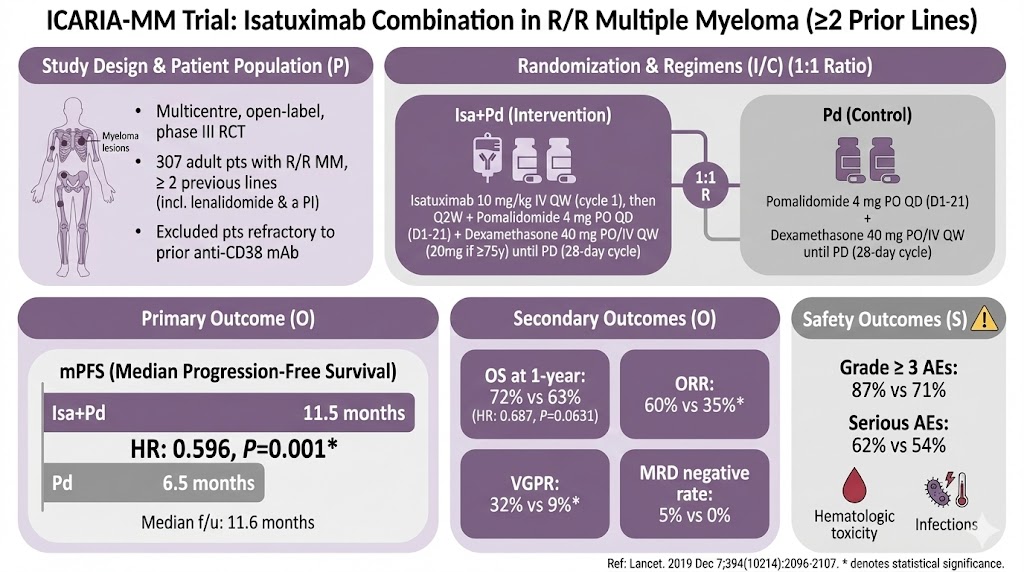
In combination with pomalidomide and dexamethasone, for Tx of adult pts with MM who have received ≥ 2 prior therapies including lenalidomide and a proteasome inhibitor (ICARIA-MM trial, NCT02990338) Ref: Lancet. 2019 Dec 7;394(10214):2096-2107. |
Multicentre, open-label, phase III RCT. 307 adult pts with R/R MM, ≥ 2 previous lines of treatment, including lenalidomide and a PI. Median number of previous lines therapy: 3. Pts refractory to previous anti-CD38 monoclonal antibody were excluded. (1:1 ratio to: Isa + Pd (experimental) vs Pd alone (control)) |
(Median f/u: 11.6 months) mPFS: 11.5 months vs 6.5 months (HR: 0.596, P=0.001)* OS at 1-year: 72% vs 63% (HR: 0.687,P=0·0631) ORR: 60% vs 35%* VGPR: 32% vs 9%* MRD negative rate: 5% vs 0% [Safety outcomes] Grade ≥3 AEs: 87% vs 71% Serious AEs: 62% vs 54% |
[Isa + Pd] 28-days/cycle [Pd] 28-days/cycle pomalidomide 4 mg PO QD D1~D21+ dexamethasone 40 mg PO/IV QW until PD. |
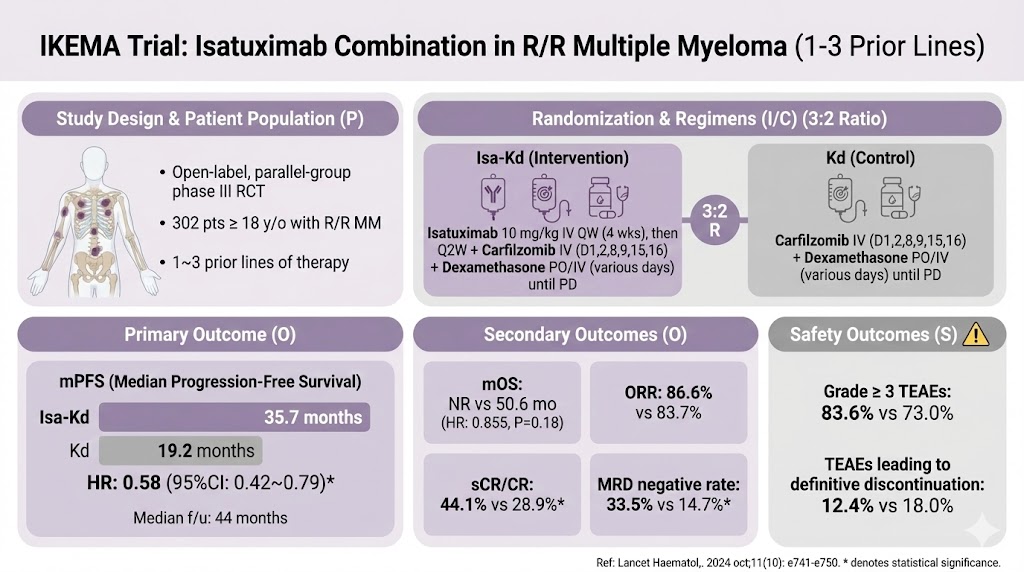
In combination with carfilzomib and dexamethasone, for Tx of adult pts with R/R MM, 1~3 prior lines of therapy. (IKEMA trial, NCT03275285) Ref: Lancet Haematol . 2024 oct;11(10): e741-e750. |
Open-label, parallel-group phase III RCT. 302 pts with R/R MM aged ≥18 years with previous 1~3 lines of therapy. (3:2 ratio to: Isa + Kd (experimental) vs Kd alone (control)) |
(Median f/u: 44 months) mPFS: 35.7 months vs 19.2 months (HR: 0.58, 95%CI: 0.42~0.79)* mOS: NR vs 50.6 month (HR: 0.855, P=0.18) ORR: 86.6% vs 83.7% sCR/CR: 44.1% vs 28.9% (OR: 2.09; 95%CI: 1.26~3.48)* MRD negative rate: 33.5% vs 14.7% (OR: 2.57; 95%CI: 1.35-4.88)* [Safety outcomes] Grade ≥3 TEAEs: 83.6% vs 73.0% TEAEs leading to definitive discontinuation: 12.4% vs 18.0%. |
[Isa + Kd] Isatuximab 10 mg/kg IV QW for the first 4 weeks, then Q2W. Carfilzomib 20 mg/m2 IV D1&2; 56 mg/m2 on D8, 9, 15,16 of cycle 1, then 56 mg/m2 on days 1, 2, 8, 9, 15, and 16 of subsequent cycles. Dexamethasone 20 mg PO/IV on D1, 2, 8, 9, 15, 16, 22, 23 until PD. [Kd] K&d: dose is same as above, until PD. |
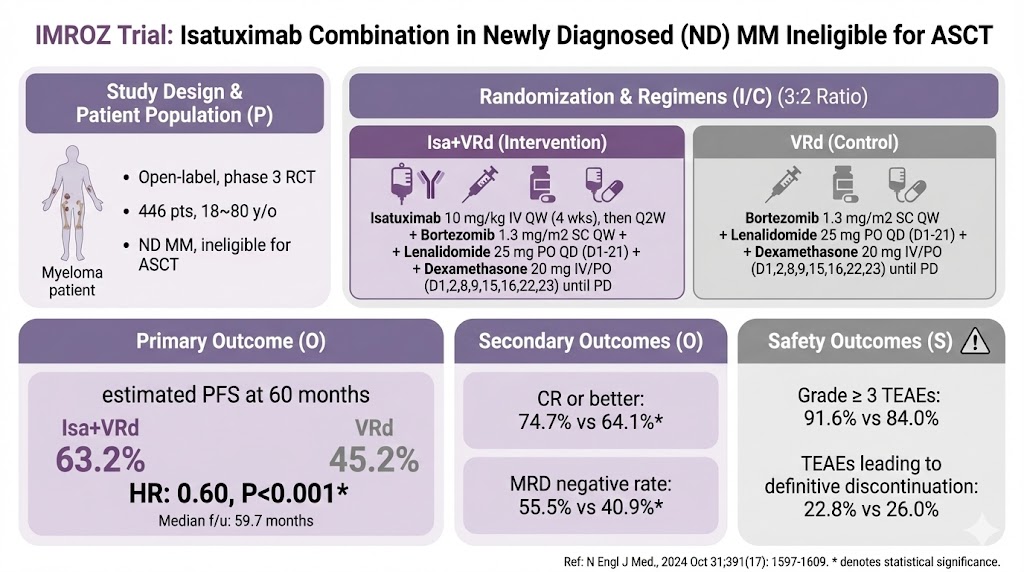
In combination with bortezomib, lenalidomide and dexamethasone, for Tx of adult pts with ND MM who are not eligible for ASCT. (IMROZ trial, NCT03319667) Ref: N Engl J Med . 2024 Oct 31;391(17): 1597-1609. |
Open-label, phase 3 RCT. 446 pts with 18~80 y/o with ND MM who were ineligible for ASCT. (3:2 ratio to isatuximab + VRd or VRd alone) |
(Median f/u: 59.7 months) estimated PFS at 60 months: 63.2% vs 45.2% (HR: 0.60, P<0.001)* CR or better: 74.7% vs 64.1%* MRD-negative status: 55.5% vs 40.9%* [Safety outcomes] Grade ≥3 TEAEs: 91.6% vs 84.0% TEAEs leading to definitive discontinuation: 22.8% vs 26.0%. |
[Isa+VRd] Isatuximab 10 mg/kg IV QW for the first 4 weeks, then Q2W; bortezomib (V) 1.3 mg/m2 SC QW, lenalidomide (R) 25 mg PO QD D1~D21 and d Dexamethaosone (d) 2 0 mg IV/PO on D1, 2, 8, 9, 15, 16, 22, 23 until PD. [VRd] V&R&d: dose is same as above, until PD. |
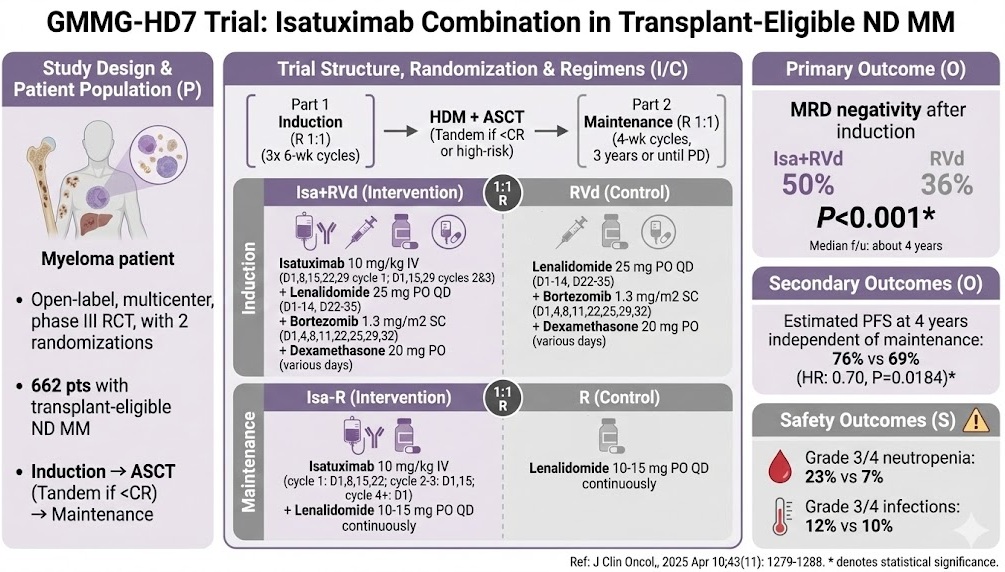
(Not yet approved by US FDA, but listed as category 1 recommendation in NCCN guideline) (GMMG-HD7 trial, NCT03617731) Ref: J Clin Oncol . 2025 Apr 10;43(11): 1279-1288. |
Open-label, multicenter, phase III RCT, with 2 randomization. 662 pts with transplant-eligible patients with ND MM. (Part 1 induction: 1:1 to Isa + RVda (experimental) vs RVda alone (control). Between part 1&2: high-dose melphalan & ASCT. A tandem ASCT was recommended if patients achieved < CR or had high-risk disease. Part 2 maintenance: Isa + R vs R) |
(Median f/u: about 4 years, underwent at least 1 ASCT during trial: 92% vs 84%) MRD negativity after induction: 50% vs 36%* Estimated PFS at 4 years independent of maintenance: 76% vs 69% (HR: 0.70, P=0.0184)* [MRD analysis] Estimated 3-years PFS from end of induction: 88% (all MRD-) vs 71% (all MRD+)* Estimated 3-years PFS from start of maintenance: 87% (all MRD-) vs 73% (all MRD+)* [Safety analysis] Grade 3/4 neutropenia: 23% vs. 7%; Grade 3/4 infections:12% vs. 10%. |
(6 week/cycle * 3 cycles) In part 1, isatuximab 10 mg/kg IV on D1, 8, 15, 22, 29 in cycle 1 and on D1, 15, 29 in cycles 2&3. RVda: lenalidomide 25 mg PO QD D1~14 & D22~35; bortezomib 1.3 mg/m2 SC D1, 4, 8, 11, 22, 25, 29, 32; dexamethasone PO 20 mg/day on D1, 2, 4, 5, 8, 9, 11, 12, 15, 22, 23, 25, 26, 29, 30, 32, 33. Between part 1&2: high-dose melphalan 200 mg/m2 IV once & ASCT. In part 2, maintenance (28-day cycles for up to 3 years) with Isa-R vs R alone (lenalidomide 10 mg PO QD, up to 15 mg PO QD; isatuximab 10 mg/kg IV on D1, 8, 15, 22 of cycle 1, on D1,15 of cycles 2&3, on d1 from cycle 4 onward, up to 39 cycles). |
試驗評論:
|
|||
ASCT: autologous stem cell transplant; Kd: carfilzomib & dexamethasone; MM: multiple myeloma; mPFS: median progression-free survival; MRD: Minimal residual disease; ND: newly diagnosed; OR: odds ratio; ORR: objective response rate; PI: proteasome inhibitor; Pd: pomalidomide & dexamethasone; PD: disease progression; Pt: patients; RCT: randomized controlled trial; R/R: relapsed or refractory; RVd/VRd: lenalidomide & bortezomib & dexamethasone; TEAEs: treatment emergent adverse events.
*denotes statistical significance. a. The dosing schedule of RVd regimen is different from the VRd regimen.
致吐性及骨髓方面副作用9 (以下副作用為其他藥品並用下之發生率)
致吐性:低度致吐性 (10~30%的病人會有嘔吐副作用)
血液學方面副作用:血紅素減少 (99%;3/4 級:17~32%)、嗜中性球減少 (55~96%;3/4 級:20~85%);淋巴球下降 (92~95%;3/4 級:52~60%)、血小板減少 (84~95%;3/4 級:19~30%)。
注意事項及常見副作用 9 (以下副作用為其他藥品並用下之發生率)
常見副作用 (≥20%) 包括:上呼吸道感染、輸注反應、肺炎、腹瀉、疲累。
其他各系統副作用如下:
全身性副作用:疲累 (42~55%;3/4 級:5~11%)、輸注反應 (24~46%;3/4 級:0.4~2.6%)、周邊水腫 (33%)
感染方面副作用:上呼吸道感染 (57~67%;3/4 級:4.6~9%)、肺炎 (31~45%;3/4 級:19~26%)、支氣管炎 (24%;3/4 級:2.3%)、新冠病毒感染 (22%;3/4 級:0.8%)、嗜中性白血球發燒 (12%;3/4 級:11%)
腸胃道方面副作用:腹瀉 (26~55%;3/4 級:2~8%)、噁心 (15%)、嘔吐 (12~15%;3/4 級:1.1~1.3%)、便祕 (36%;3/4 級:2.3%)
心血管方面副作用:高血壓 (37%;3/4 級:20%)
呼吸系統與胸腔方面副作用:呼吸困難 (17~29%;3/4 級:5%)、咳嗽 (23%)
神經系統副作用:周邊感覺神經病變 (54%;3/4 級:7%)
眼睛方面副作用:白內障 (38%;3/4 級:16%)
骨骼肌肉相關副作用:肌肉骨骼疼痛 (38%;3/4 級:4.2%)
皮膚方面副作用:皮疹 (32%;3/4 級:5%)
精神方面副作用:失眠 (22%;3/4 級:3.8%)
註釋:當癌症藥物進行臨床試驗時,所收載的副作用,包括:藥物本身的副作用、原本疾病表現的症狀,或是當下併用的其他藥物的可能副作用。
藥物副作用的定義是由美國癌症研究院制訂的常見毒性標準 (Common Terminology Criteria for Adverse Events, CTCAE),常使用來描述病人接受化學治療後,所發生器官毒性的嚴重度分級。毒性分級由器官系統的特別分類,分為輕微 (1級)、中級 (2級)、嚴重 (3級)、危及生命 (4級)或死亡 (5級)。當發生3級以上的副作用時,需醫療介入處理且進行劑量調整或停藥;若發生4級情形,大多需要住院介入醫療處理。
給藥方式9
給藥時程:
給藥順序:若carfilzomib和dexamethasone並用時,順序為dexamethasone -> isatuximab -> carfilzomib。
| 組合療法 | Isatuximab劑量與給法 |
|---|---|
| 與pomalidomide或carfilzomib、dexamethasone並用時 | 第一週期 (每28天一周期):IV QW 第二週期(含)以後(每28天一周期):IV Q2W |
| 與bortezomib、lenalidomide與 dexamethasone並用時 | 第一週期 (每42天一週期):IV D1, 8, 15, 22, 29 第二至四週期 (每42天一週期): IV D1, 15, 29 第五至十七週期 (每28天一週期): IV Q2W 第十八週期(含)以後(每28天一週期): IV Q4W |
輸注速率之調整:只有當輸注反應在指定時間內皆未發生時,才能加速輸注速率。
安定性:輸注液在常溫下稀釋完後,僅能保存8小時 (包含輸注時間)。
| 稀釋體積 | 輸注速率 | 輸注反應觀察時間 | 加速輸注速率方式 | 最高速率 | |
|---|---|---|---|---|---|
| 首次輸注 | 250 mL | 25 mL/hr | 60分鐘 | 每30分鐘增加速25 mL/hr | 150 mL/hr |
| 第二次輸注 | 250 mL | 50 mL/hr | 30分鐘 | 30分鐘後增加50 mL/hr 之後每30分鐘加速100 mL/hr | 200 mL/hr |
| 後續輸注 | 250 mL | 200 mL/hr | 200 mL/hr | ||
Premedication。建議在isatuximab給藥前15~60分鐘給予Premedication,以降低輸注相關反應。
Acetaminophen 650~1,000 mg PO
H2 antagonist: famotidine 20 mg PO/IV
Diphenhydramine 25 mg~50 mg PO or IV (preferred) for at least the first 4 infusions.
Dexamethasone: 劑量與給藥天數按照組合療法決定。
| 組合療法 | Dexamethasone劑量與給法 |
|---|---|
| Isatuximab與pomolidomide並用時 | 40 mg PO/IV (20 mg PO/IV for 75歲以上 (含) 病人 |
| Isatuximab與carfilzomib並用時 | 20 mg IV於另外兩藥輸注日時,PO 於第22天自從第二週期與以後, 以及PO於每周期的第23天。 |
| Isatuximab與bortezomib與lenalidomide並用時 | 20 mg IV 於isatuximab輸注日時;於其他天擇採用口服 |
劑量調整9
腎功能不全調整:無須調整劑量。
肝功能不全調整:無須調整劑量。
對不良反應的調整與處理:不建議以降低劑量的方式進行調整,當副作用發生時,須按照嚴重程度延後給藥時間或停藥。
此藥有可能會對抗體相關的特定檢驗結果造成干擾。
Indirect antiglobulin試驗:本藥可能造成偽陽性之結果,且停藥後6個月內均可能持續存在此影響。
血清中蛋白質電泳試驗以及血清免疫電泳分析:本藥為IgG kappa抗體,在電泳分析中可能造成干擾。判讀電泳分析時需注意此干擾對於M-protein大小判讀的影響。
對藥物交互作用之劑量調整:本藥無臨床上顯著的藥物交互作用。
警告/注意事項與不良反應9
常見副作用的發生比率與型態:
| 副作用 | 臨床表現/徵象 | 臨床表現發生比率、型態與建議監測 |
| 輸注反應 | 呼吸困難、咳嗽、水腫、血管性水腫、支氣管痙攣、高血壓、心跳驟停 |
|
| 感染 | 發燒、打冷顫、呼吸困難、咳嗽 |
|
| 嗜中性白血球低下 | ANC下降、發燒、感染 |
|
| 次發性癌症 | (按照癌症位置而定) |
|
對胎兒的影響:
基於藥理機轉,本藥可能造成孕期胎兒死亡或導致畸胎。
對於具生育可能之女性患者,服藥期間與停藥後五個月內均需做好避孕措施。對哺乳的影響:
目前尚無本藥乳汁分布之數據,而免疫球蛋白或此類藥物是可能經乳汁分泌。建議患者避免哺乳。對生育能力的影響:
本藥對於男性及女性患者的生育能力影響未知。
藥物交互作用9
本藥主要經網狀內皮系統的細胞 (如肝臟中的Kupffer cells或是脾臟中的巨噬細胞) 以胞飲作用攝入後,被細胞內的蛋白酶逐漸分解為胜肽或胺基酸。
本藥無臨床上顯著的藥物交互作用。
臨床監測項目9
全血球計數:檢查基礎值並常規追蹤。
輸注反應:輸注時持續觀察生命徵象與輸注反應相關症狀。
新癌症跡象:追蹤異常皮膚變化。
治療前評估妊娠狀態 (在具有生殖潛力的女性中)。
機轉10
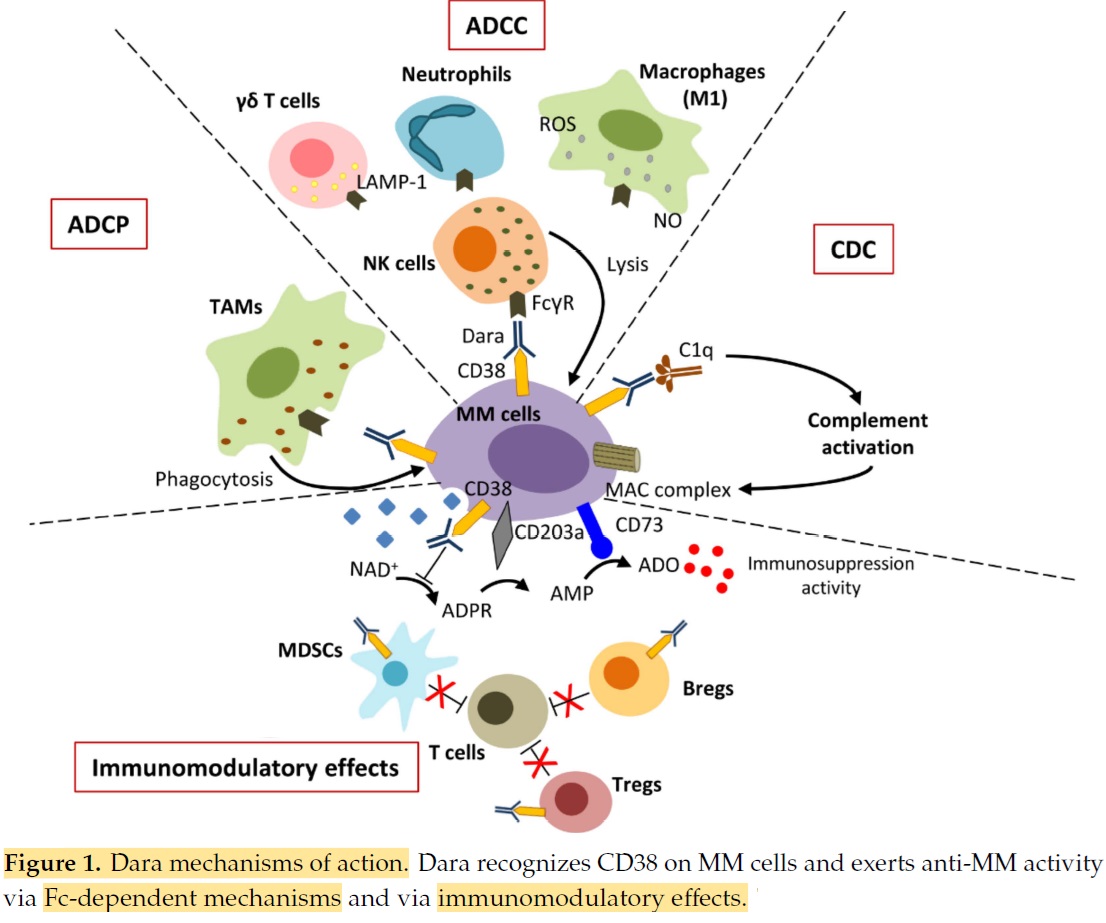
CD38在多發性骨髓瘤的多重功能:
CD38 (cluster of differentiation 38) 為一種跨膜醣蛋白,但不具有訊息傳遞區域。在功能上可作為co-receptor與其他蛋白共同傳遞訊號;也可做為外酶 (ectoenzyme) 來分解NAD⁺和NADP,經過與其他酵素的接續作用來產生adenosine。胞外的adenosine增加,能夠做為paracrine結合到免疫細胞上的purinergic receptors,並造成免疫抑制效果。
CD38在漿細胞中高度表達,而在其他造血細胞和非造血組織中的表達量則較低。
Anti-CD38單株抗體的多重療效:
這類抗體共有兩種抗骨髓瘤機轉。分別是Fc區域依賴性的抗體機制,以及上述提到的免疫調節效果。在Fc區域依賴性的抗體機制是藉由常見的抗體功能,如CDC, ADCC與ADCP來達到抗癌效果。而免疫調節效果,則是透過抑制CD38產生adenosine的功能,來降低其對於微環境中免疫細胞的抑制效果;反之就能增強抗腫瘤效果。
Isatuximab為嵌合的Anti-CD38的單株抗體。與daratumumab同樣具有CDC, ADCC與ADCP及免疫調節之效果。
藥師小叮嚀
本藥經輸注方式給藥,給藥前將給予預防性藥品以降低輸注反應的發生。然而既使有預防仍有可能發生輸注反應,如發燒、打冷顫、呼吸困難、皮疹等症狀。一旦發生懷疑之不良反應症狀,請立刻通知您的護理師。大多數輸注反應於暫停輸注與給予治療藥品後能得到緩解。
本藥以組合療法方式按照時程給藥,請按時服用其他口服藥品如類固醇或免疫調節劑。
如有使用其他藥物,請藥師檢查是否有藥物之間交互作用。
治療期間若有以下症狀,請通知您的醫師與個案管理師:
此藥對於孕婦及胎兒的影響未知。若有計畫生育之考量,請告知您的醫師,女性患者於接受治療期間與停藥後的五個月內都須執行避孕措施。
此藥對於母親乳汁的分布與對嬰兒的影響未知。建議患者禁止哺乳。
副作用等級3或4級即表示該副作用需要回診或入院接受治療。
臨床監測項目:全血球計數、輸注期間不良反應、感染症狀。
References
van de Donk NWCJ, Richardson PG, Malavasi F. CD38 antibodies in multiple myeloma: back to the future. Blood. 2018;131(1):13-29.
De Novellis D, Fontana R, Giudice V, Serio B, Selleri C. Innovative Anti-CD38 and Anti-BCMA Targeted Therapies in Multiple Myeloma: Mechanisms of Action and Resistance. Int J Mol Sci. 2022;24(1):645. Published 2022 Dec 30.
Sonneveld P, Dimopoulos MA, Boccadoro M, et al. Daratumumab, Bortezomib, Lenalidomide, and Dexamethasone for Multiple Myeloma. N Engl J Med. 2024;390(4):301-313.
Dimopoulos MA, Voorhees PM, Schjesvold F, et al. Daratumumab or Active Monitoring for High-Risk Smoldering Multiple Myeloma. N Engl J Med. 2025;392(18):1777-1788.
Attal M, Richardson PG, Rajkumar SV, et al. Isatuximab plus pomalidomide and low-dose dexamethasone versus pomalidomide and low-dose dexamethasone in patients with relapsed and refractory multiple myeloma (ICARIA-MM): a randomised, multicentre, open-label, phase 3 study. Lancet. 2019;394(10214):2096-2107.
Yong K, Martin T, Dimopoulos MA, et al. Isatuximab plus carfilzomib-dexamethasone versus carfilzomib-dexamethasone in patients with relapsed multiple myeloma (IKEMA): overall survival analysis of a phase 3, randomised, controlled trial. Lancet Haematol. 2024;11(10):e741-e750.
Facon T, Dimopoulos MA, Leleu XP, et al. Isatuximab, Bortezomib, Lenalidomide, and Dexamethasone for Multiple Myeloma. N Engl J Med. 2024;391(17):1597-1609.
Mai EK, Bertsch U, Pozek E, et al. Isatuximab, Lenalidomide, Bortezomib, and Dexamethasone Induction Therapy for Transplant-Eligible Newly Diagnosed Multiple Myeloma: Final Part 1 Analysis of the GMMG-HD7 Trial. J Clin Oncol. 2025;43(11):1279-1288.
U.S. Food and Drug Administration. SARCLISA (isatuximab-irfc) Prescribing Information. Sanofi; revised September 2024. Accessed December 4, 2025. https://www.accessdata.fda.gov/drugsatfda_docs/label/2024/761113s012lbl.pdf.
Horenstein AL, Bracci C, Morandi F, Malavasi F. CD38 in Adenosinergic Pathways and Metabolic Re-programming in Human Multiple Myeloma Cells: In-tandem Insights From Basic Science to Therapy. Front Immunol. 2019;10:760. Published 2019 Apr 24.