
第六章、頭頸癌治療後之追蹤與支持性療法
發布日期:2026-06-03
頭頸癌的成功治療不僅依賴精準的打擊腫瘤,更依賴如何讓患者度過治療期間的各種生理危機。這需要營養師、語言治療師及護理團隊的高度介入。
6.1 治療後追蹤 [10]
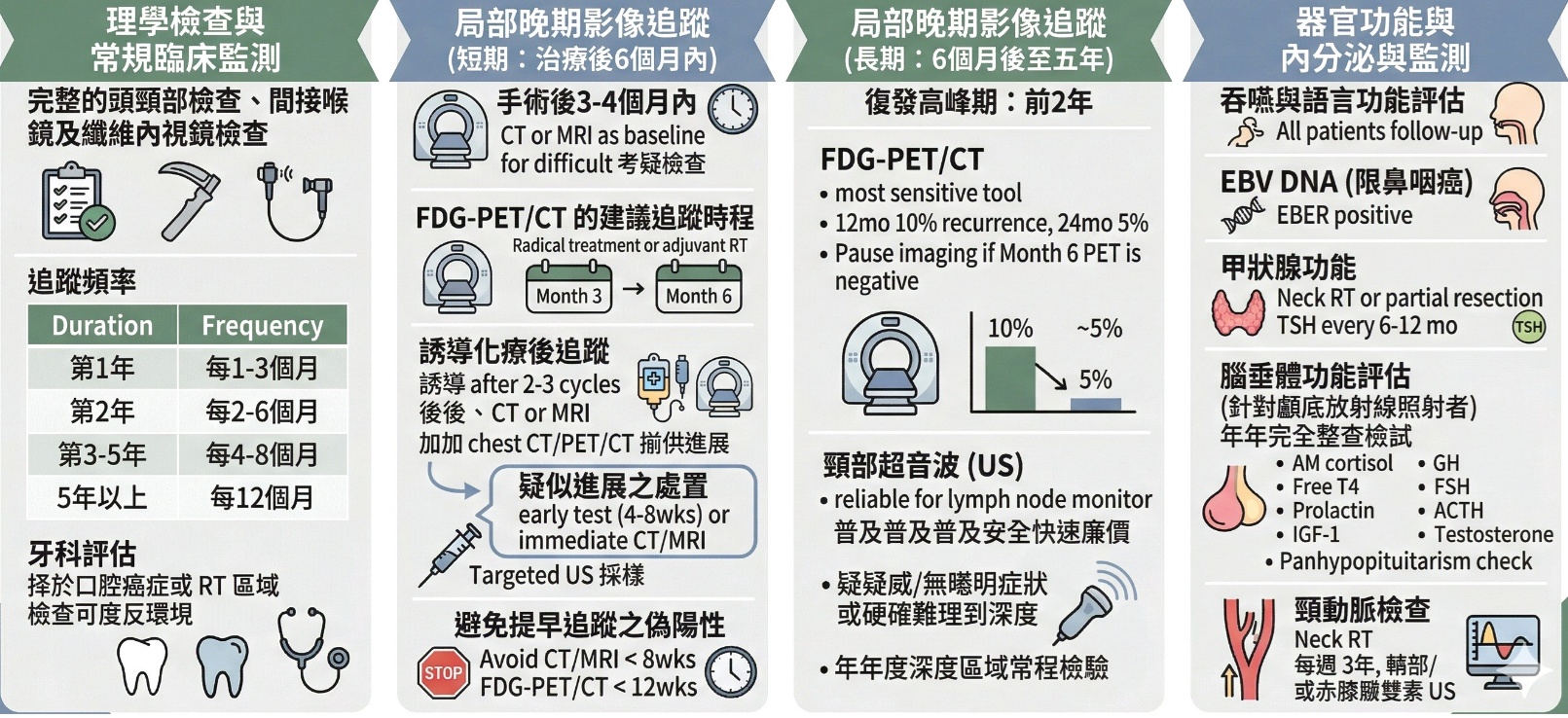
理學檢查與常規臨床監測:
完整的頭頸部檢查、間接喉鏡及纖維內視鏡檢查,建議之追蹤頻率如下:
第1年:每1-3個月一次。
第2年:每2-6個月一次。
第3-5年:每4-8個月一次。
5年以上:每12個月一次。
牙科評估:針對口腔癌或口腔受放射治療顯著照射的部位,評估是否有復發跡象。
局部晚期影像追蹤 (短期:治療後6個月內):
對於解剖結構變動較大、理學檢查困難的患者:應在手術後3-4個月內進行 CT 或 MRI,作為未來對照的新基準。
疑似進展之處置:若懷疑治療無效或疾病進展,可提早於治療後4-8週檢測,甚至根據臨床狀況立即進行CT/MRI。針對可疑組織,可利用頸部超音波進行針對性採樣。
避免提早追蹤之偽陽性:在無明確復發徵兆下,應避免在8週內進行 CT/MRI,或在12週內進行 FDG-PET/CT,因為此時偽陽性率極高。
PET/CT的建議追蹤時程:根治性治療或輔助放療後第3個與第六個月進行FDG-PET/CT。
誘導化療後追蹤:建議在2-3個誘導療程後後進行CT或MRI。若懷疑有局部或遠端轉移進展,可加作胸部CT或PET/CT。
局部晚期影像追蹤 (長期:6個月後至五年):
復發高峰期:前2年為頭頸癌復發之高峰。
FDG-PET/CT:被認為是敏感度最高的工具。研究顯示治療後12個月的PET可在10% 患者中發現復發或第二原發癌;24個月時則約為 5%。 無症狀患者透過PET發現的病灶多位於遠端轉移處。
PET/CT的建議追蹤時程:若第6個月的第二次PET仍為陰性,則可暫緩影像追蹤。
頸部超音波 (US):為監測淋巴結復發的可靠工具,具備普及、安全、快速且廉價的優點。 當出現可疑或模稜兩可的症狀時,建議進行頸部超音波。對於理學檢查無法觸及的深部區域,可考慮每年進行一次常規影像檢查。
EBV DNA (限鼻咽癌):針對EBER陽性者,考慮監測EBV DNA (category 2B) 。
器官功能與內分泌與監測:
吞嚥與語言功能評估:所有患者均須追蹤其吞嚥與發聲功能。
腦垂體功能評估 (針對顱底放射線照射者,category 2B):建議每年檢測,項目包含:
AM cortisol、GH、Free T4、Prolactin、IGF-1、LH、FSH、ACTH及Testosterone。以評估完整的腦垂體功能是否有低下問題 (Panhypopituitarism) 。
甲狀腺功能:若曾接受頸部照射或甲狀腺部分切除,應每6-12個月監測一次TSH。
頸動脈檢查:若頸部曾受照射,考慮每3年進行一次頸部靜脈/動脈雙向超音波檢查。
6.2 營養評估與管理
體重減輕是頭頸癌患者最常見的併發症,這是因為放射治療可能有放射性口腔黏膜炎、唾液腺損傷與口乾症、味覺改變、甚至是長期肌肉纖維化,將大大影響口部喉部咀嚼、吞嚥等連貫性功能。一旦發生營養不足,將增加併發症發生之可能。故治療前與治療期間需持續評估體重與營養。
重點監測對象:
體重顯著減輕者:過去1個月下降5%,或6個月內下降10%。
治療前因疼痛或腫瘤侵犯導致吞嚥困難者。
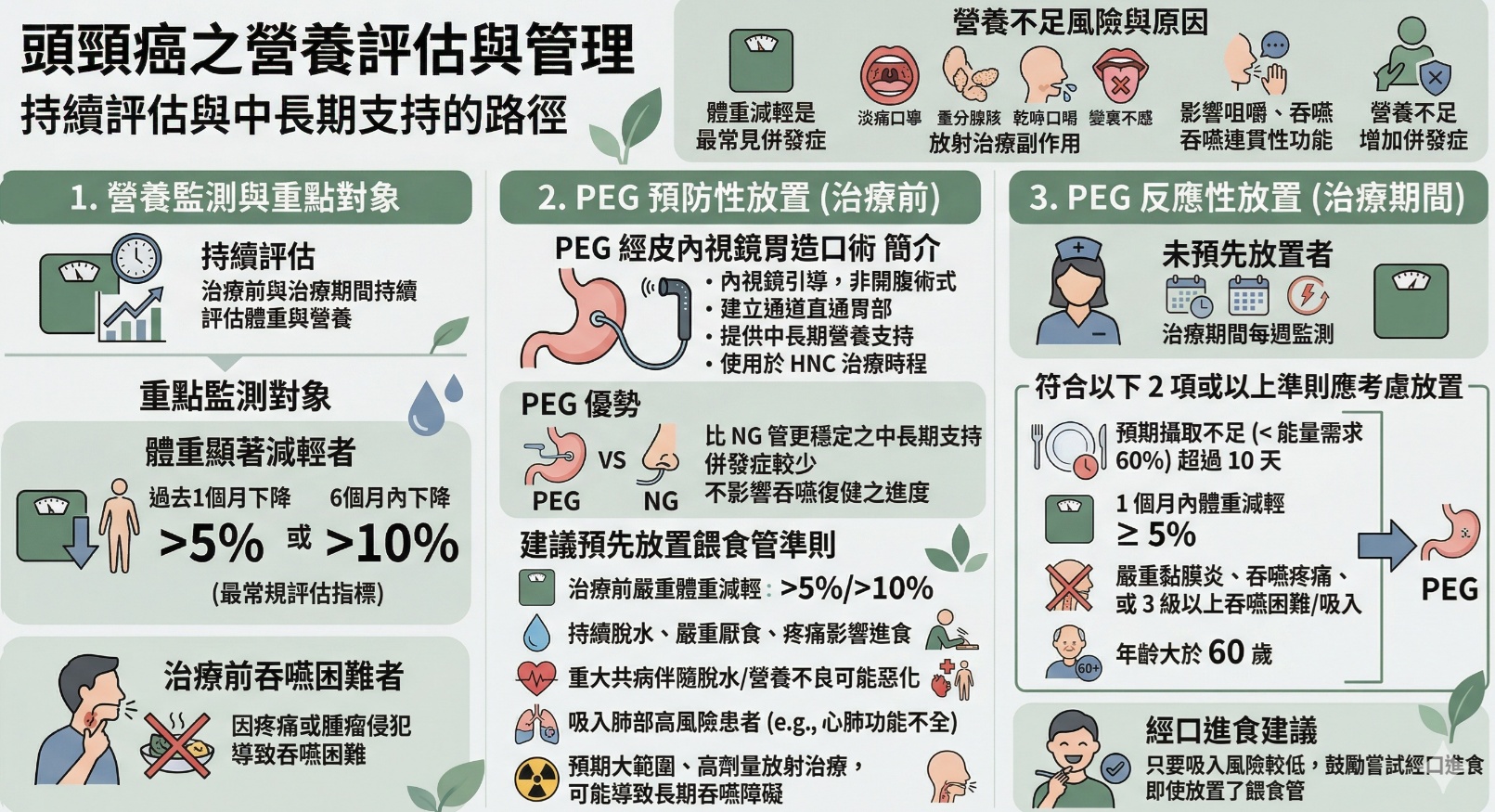
6.2.1 預防性放置經皮胃造口餵食管 (Prophylactic Placement of PEG) [40]
PEG (percutaneous endoscopic gastrostomy) 經皮內視鏡胃造口術:是一種透過內視鏡引導,在腹壁建立通道並直接將餵食管置入胃部的技術。由於使用內視鏡定位,不須開腹之較低侵入性術式。主要用於頭頸癌或食道癌治療期間,提供中長期的營養支持。
PEG優勢:提供了一個比鼻胃管 (NG tube) 更穩定且中長期的營養支持路徑。且併發症較少,也不會影響吞嚥復健之進度。
PEG不建議對象:體能狀態良好且無顯著體重減輕、無呼吸道阻塞或嚴重吞嚥困難者。
建議預先放置餵食管:
治療前嚴重體重減輕 (1 個月內 >5% 或 6 個月內 >10%)
持續脫水、嚴重厭食或疼痛影響進食者
伴隨可能因脫水或營養不良而惡化的重大共病
吸入肺部 (Aspiration) 之高風險患者:如心肺功能不全患者
預期將接受大範圍、高劑量放射治療,可能導致長期吞嚥障礙者
經口進食時機:即使放置了胃造口之餵食管,只要在吸入風險較低情況下,仍應鼓勵患者嘗試經口進食。
6.2.2 反應性放置 (Reactive Placement of PEG)
若治療前未放置,治療期間每週監測。
若符合以下兩項或以上準則應考慮放置:
預期攝取不足 (低於預估能量需求的 60%) 超過 10 天。
1 個月內體重減輕 ≥ 5%。
嚴重黏膜炎、吞嚥疼痛或3級以上的吞嚥困難/吸入 (Aspiration)
年齡大於60歲。
6.3 功能與副作用評估
6.3.1 言語與吞嚥功能
監測工具:臨床吞嚥評估。 纖維內視鏡吞嚥檢查 (FEES)。 螢光顯影吞嚥檢查 (VFSS)。
復健方式:透過範圍運動與強化練習維持口咽活動度。
張口困難 (Trismus) 建議治療:考慮使用Pentoxifylline與維生素 E,或客製化張口器。 針對淋巴水腫與纖維化:進行淋巴減壓治療。 氣切患者:由外科、呼吸治療與語言治療團隊協作,促進溝通、加溫加濕、吞嚥並朝向拔管目標努力。
6.3.2 口腔黏膜炎 (Oral Mucositis) 預防與疼痛控制
放療引起的黏膜損害常導致極度疼痛,甚至造成治療中斷;而接受CCRT之患者得到口腔黏膜炎之風險更高。若有此副作用建議使用止痛藥物或局部漱口水以緩解疼痛。
口腔基礎照護:根據MASCC/ISOO針對放療造成的口腔黏膜炎之指引,建議之口腔照護如下:[41]
常規漱口刷牙:每天進行至少3-4次漱口,且飯後一定要立刻刷牙漱口。
溫和的漱口水:建議使用生理食鹽水或碳酸氫鈉漱口。避免使用抗菌漱口水 (如chlorhexidine),這類漱口水不適合接受放療患者。
物理性清潔-軟毛刷:刷牙時使用軟毛刷,並配合鏡子仔細去除牙齦間的食物殘渣。每日需至少2次,並配合無刺激性的氟化物牙膏進行刷牙。
L-Glutamine (左旋麩醯胺酸)補充:基於統合性分析之16項RCT,結果顯示在治療期間每日服用10-30 mg的L-glutamine可能具預防效果。[42]
統合性分析顯示,預防性使用L-glutamine於放射治療或化學治療前後補充,能顯著降低3級以上口腔黏膜炎 (RR, 0.53; 95% CI, 0.32-0.88)。
口服止痛藥物:高劑量Gabapentin 2700-3600 mg/day (Category 2A) 與Pregabalin (Category 2B) 已被證實能有效減輕黏膜炎疼痛,並顯著降低鴉片類藥物之使用比率。但其使用高劑量下效果較為顯著,需謹慎評估高劑量使用下之副作用,如嗜睡或停藥後癲癇之風險。[43]
漱口液:Doxepin漱口液、含有Lidocaine混合漱口水。另外可考慮使用消炎性的Benzydamine漱口水。
漱口水之實證結果:第三期Alliance A221304試驗證實,使用Doxepin漱口水或Diphenhydramine-lidocaine-antacid三合一漱口水,4小時候之疼痛分數顯著低於安慰劑。[44]
6.3.3 牙科/口腔照護
在放療開始前必須執行的牙科/口腔治療計畫應包括:
消除潛在感染源。
若需拔牙:在放療開始前應留出充足的癒合時間。
治療活動性齲齒與牙周病。 治療口腔念珠菌症。
衛教項目:包括避免使用含糖糖果或口香糖來緩解口乾。
減少併發症之策略:
減輕口乾:使用人工唾液、使用木糖醇 (Xylitol) 錠劑或貼片 (貼附於牙齦、牙齒或假牙上) 、並減少酒精與咖啡因攝取。
降低齲齒風險:使用高濃度局部塗氟。
減少齒槽感染:透過頻繁評估以儘早發現並治療。
預防與處理放射性骨壞死 (Osteoradionecrosis, ORN)。
減輕咀嚼肌張口困難:使用客製化張口器以維持活動範圍。
全程追蹤:在治療期間與之後持續評估以將併發症降至最低。
6.3.4 淋巴水腫與組織纖維化
頸部淋巴結清掃手術或放療者治療後,常出現頸部淋巴水腫與纖維化。護理師應指導患者進行早期的復健運動,並考慮轉介物理治療師進行淋巴減壓按摩。
頭頸癌總結
不同原發位置的頭頸癌在成因 (如HPV關聯性) 與治療選擇上不同。懷疑頭頸癌時,須配合頸部MRI或CT以及組織切片,以確診原發位置與癌別。
早期頭頸癌的局部治療中,口腔癌與鼻竇癌通常優先考慮手術;鼻咽癌則以放射治療為主;下咽癌與喉癌需考量手術對喉部器官功能之影響,來選擇手術或放療。
局部晚期頭頸癌的綜合治療模式,以Cisplatin協同之同步放化療 (CCRT)為核心。而下咽癌與喉癌患者,可考慮於CCRT前進行誘導性化療以能降低額外手術之需要。
高度晚期或轉移性頭頸癌的治療於各癌別差異不大,第一線治療以全身性的免疫療法合併含鉑化療為主;二線療法則依一線用藥決定換用免疫或標靶藥品。
頭頸癌患者之照護需特別注意營養問題,特別是治療期間的體重追蹤。口腔護理對於預防放療造成的口腔黏膜炎極為重要,在衛教此類患者時須特別注意。
References:
Drake RL, Vogl AW, Mitchell AWM. Head and neck. In: Gray's Anatomy for Students. 3rd ed. Philadelphia, PA: Churchill Livingstone/Elsevier; 2014:801-1114.
Sobiesk JL, Munakomi S. Anatomy, Head and Neck, Nasal Cavity. [Updated 2023 Jul 24]. In: StatPearls [Internet]. Treasure Island (FL): StatPearls Publishing; 2026 Jan-. Available from: https://www.ncbi.nlm.nih.gov/books/NBK544232/.
Brizuela M, Winters R. Histology, Oral Mucosa. [Updated 2023 May 8]. In: StatPearls [Internet]. Treasure Island (FL): StatPearls Publishing; 2026 Jan-. Available from: https://www.ncbi.nlm.nih.gov/books/NBK572115/.
Liu Y, Zhang N, Wen Y, Wen J. Head and neck cancer: pathogenesis and targeted therapy. MedComm (2020). 2024;5(9):e702. Published 2024 Aug 21.
Gormley M, Creaney G, Schache A, Ingarfield K, Conway DI. Reviewing the epidemiology of head and neck cancer: definitions, trends and risk factors. Br Dent J. 2022;233(9):780-786.
Su ZY, Siak PY, Leong CO, Cheah SC. The role of Epstein-Barr virus in nasopharyngeal carcinoma. Front Microbiol. 2023;14:1116143. Published 2023 Feb 9.
Bray F, Laversanne M, Weiderpass E, et al. Global cancer statistics 2022: GLOBOCAN estimates of incidence and mortality worldwide for 36 cancers in 185 countries. CA Cancer J Clin. 2024;74(3):229-263.
Health Promotion Administration, Ministry of Health and Welfare (Taiwan). Cancer Registry Annual Report, 2022. Taipei, Taiwan: Health Promotion Administration; 2024. Accessed March 30, 2026.
Bradley PT, Lee YK, Albutt A, et al. Nomenclature of the symptoms of head and neck cancer: a systematic scoping review. Front Oncol. 2024;14:1404860. Published 2024 Jun 17.
National Comprehensive Cancer Network. NCCN Clinical Practice Guidelines in Oncology (NCCN Guidelines®): Head and Neck Cancers. Version 1.2026. Published December 8, 2025. Accessed [April 1, 2026]. https://www.nccn.org/guidelines/category_1.
WHO Classification of Tumours Editorial Board. Head and Neck Tumours [Internet]. 5th ed. Lyon (France): International Agency for Research on Cancer; 2022. (WHO Classification of Tumours Series, vol. 9).
Amin MB, Greene FL, et al. The Eighth Edition AJCC Cancer Staging Manual: Continuing to build a bridge from a population-based to a more "personalized" approach to cancer staging. CA Cancer J Clin. 2017 Mar;67(2):93-99.
Clark CH, Miles EA, Urbano MT, et al. Pre-trial quality assurance processes for an intensity-modulated radiation therapy (IMRT) trial: PARSPORT, a UK multicentre Phase III trial comparing conventional radiotherapy and parotid-sparing IMRT for locally advanced head and neck cancer. Br J Radiol. 2009;82(979):585-594.
Cooper JS, Pajak TF, Forastiere AA, et al. Postoperative concurrent radiotherapy and chemotherapy for high-risk squamous-cell carcinoma of the head and neck. N Engl J Med. 2004;350(19):1937-1944.
Bernier J, Domenge C, Ozsahin M, et al. Postoperative irradiation with or without concomitant chemotherapy for locally advanced head and neck cancer. N Engl J Med. 2004;350(19):1945-1952.
Noronha V, Joshi A, et al. Once-a-Week Versus Once-Every-3-Weeks Cisplatin Chemoradiation for Locally Advanced Head and Neck Cancer: A Phase III Randomized Noninferiority Trial. J Clin Oncol. 2018 Apr 10;36(11):1064-1072.
Patil VM, Noronha V, et al. Results of Phase III Randomized Trial for Use of Docetaxel as a Radiosensitizer in Patients With Head and Neck Cancer, Unsuitable for Cisplatin-Based Chemoradiation. J Clin Oncol. 2023 May 1;41(13):2350-2361.
Bonner JA, Harari PM, Giralt J, et al. Radiotherapy plus cetuximab for squamous-cell carcinoma of the head and neck. N Engl J Med. 2006;354(6):567-578.
Ang KK, Zhang Q, Rosenthal DI, et al. Randomized phase III trial of concurrent accelerated radiation plus cisplatin with or without cetuximab for stage III to IV head and neck carcinoma: RTOG 0522. J Clin Oncol. 2014;32(27):2940-2950.
Gillison ML, Trotti AM, Harris J, et al. Radiotherapy plus cetuximab or cisplatin in human papillomavirus-positive oropharyngeal cancer (NRG Oncology RTOG 1016): a randomised, multicentre, non-inferiority trial. Lancet. 2019;393(10166):40-50.
Mehanna H, Robinson M, Hartley A, et al. Radiotherapy plus cisplatin or cetuximab in low-risk human papillomavirus-positive oropharyngeal cancer (De-ESCALaTE HPV): an open-label randomised controlled phase 3 trial. Lancet. 2019;393(10166):51-60.
Lefebvre JL, Pointreau Y, Rolland F, et al. Induction chemotherapy followed by either chemoradiotherapy or bioradiotherapy for larynx preservation: the TREMPLIN randomized phase II study. J Clin Oncol. 2013;31(7):853-859.
Department of Veterans Affairs Laryngeal Cancer Study Group, Wolf GT, Fisher SG, et al. Induction chemotherapy plus radiation compared with surgery plus radiation in patients with advanced laryngeal cancer. N Engl J Med. 1991;324(24):1685-1690.
Lefebvre JL, Andry G, Chevalier D, et al. Laryngeal preservation with induction chemotherapy for hypopharyngeal squamous cell carcinoma: 10-year results of EORTC trial 24891. Ann Oncol. 2012;23(10):2708-2714.
Forastiere AA, Goepfert H, Maor M, et al. Concurrent chemotherapy and radiotherapy for organ preservation in advanced laryngeal cancer. N Engl J Med. 2003;349(22):2091-2098.
Posner MR, Hershock DM, Blajman CR, et al; TAX 324 Study Group. Cisplatin and fluorouracil alone or with docetaxel in head and neck cancer. N Engl J Med. 2007;357(17):1705-1715.
Haddad R, O'Neill A, Rabinowits G, et al. Induction chemotherapy followed by concurrent chemoradiotherapy (sequential chemoradiotherapy) versus concurrent chemoradiotherapy alone in locally advanced head and neck cancer (PARADIGM): a randomised phase 3 trial. Lancet Oncol. 2013;14(3):257-264.
Cohen EE, Karrison TG, Kocherginsky M, et al. Phase III randomized trial of induction chemotherapy in patients with N2 or N3 locally advanced head and neck cancer. J Clin Oncol. 2014;32(25):2735-2743.
Zhang Y, Chen L, Hu GQ, et al. Gemcitabine and Cisplatin Induction Chemotherapy in Nasopharyngeal Carcinoma. N Engl J Med. 2019;381(12):1124-1135.
Vermorken JB, Mesia R, Rivera F, et al. Platinum-based chemotherapy plus cetuximab in head and neck cancer. N Engl J Med. 2008;359(11):1116-1127.
Guigay J, Aupérin A, Fayette J, et al. Cetuximab, docetaxel, and cisplatin versus platinum, fluorouracil, and cetuximab as first-line treatment in patients with recurrent or metastatic head and neck squamous-cell carcinoma (GORTEC 2014-01 TPExtreme): a multicentre, open-label, randomised, phase 2 trial. Lancet Oncol. 2021;22(4):463-475.
Ferris RL, Blumenschein G Jr, Fayette J, et al. Nivolumab for Recurrent Squamous-Cell Carcinoma of the Head and Neck. N Engl J Med. 2016;375(19):1856-1867.
Cohen EEW, Soulières D, Le Tourneau C, et al. Pembrolizumab versus methotrexate, docetaxel, or cetuximab for recurrent or metastatic head-and-neck squamous cell carcinoma (KEYNOTE-040): a randomised, open-label, phase 3 study. Lancet. 2019;393(10167):156-167.
Burtness B, Harrington KJ, Greil R, et al. Pembrolizumab alone or with chemotherapy versus cetuximab with chemotherapy for recurrent or metastatic squamous cell carcinoma of the head and neck (KEYNOTE-048): a randomised, open-label, phase 3 study. Lancet. 2019;394(10212):1915-1928.
Mai HQ, Chen QY, Chen D, et al. Toripalimab Plus Chemotherapy for Recurrent or Metastatic Nasopharyngeal Carcinoma: The JUPITER-02 Randomized Clinical Trial. JAMA. 2023;330(20):1961-1970.
Haddad RI, Harrington K, Tahara M, et al. Nivolumab Plus Ipilimumab Versus EXTREME Regimen as First-Line Treatment for Recurrent/Metastatic Squamous Cell Carcinoma of the Head and Neck: The Final Results of CheckMate 651. J Clin Oncol. 2023;41(12):2166-2180.
Yang Y, Pan J, Wang H, et al. Tislelizumab plus chemotherapy as first-line treatment for recurrent or metastatic nasopharyngeal cancer: A multicenter phase 3 trial (RATIONALE-309). Cancer Cell. 2023;41(6):1061-1072.e4.
Machiels JP, Haddad RI, Fayette J, et al. Afatinib versus methotrexate as second-line treatment in patients with recurrent or metastatic squamous-cell carcinoma of the head and neck progressing on or after platinum-based therapy (LUX-Head & Neck 1): an open-label, randomised phase 3 trial. Lancet Oncol. 2015;16(5):583-594.
Yang Y, Qu S, Li J, et al. Camrelizumab versus placebo in combination with gemcitabine and cisplatin as first-line treatment for recurrent or metastatic nasopharyngeal carcinoma (CAPTAIN-1st): a multicentre, randomised, double-blind, phase 3 trial. Lancet Oncol. 2021;22(8):1162-1174.
Locher JL, Bonner JA, Carroll WR, et al. Prophylactic percutaneous endoscopic gastrostomy tube placement in treatment of head and neck cancer: a comprehensive review and call for evidence-based medicine. JPEN J Parenter Enteral Nutr. 2011;35(3):365-374.
Elad S, Cheng KKF, Lalla RV, et al. MASCC/ISOO clinical practice guidelines for the management of mucositis secondary to cancer therapy. Cancer. 2020;126(19):4423-4431.
Ariyawardana A, Cheng KKF, Kandwal A, et al. Systematic review of anti-inflammatory agents for the management of oral mucositis in cancer patients and clinical practice guidelines. Support Care Cancer. 2019;27(10):3985-3995.
Hermann GM, Iovoli AJ, Platek AJ, et al. A single-institution, randomized, pilot study evaluating the efficacy of gabapentin and methadone for patients undergoing chemoradiation for head and neck squamous cell cancer. Cancer. 2020;126(7):1480-1491.
Sio TT, Le-Rademacher JG, Leenstra JL, et al. Effect of Doxepin Mouthwash or Diphenhydramine-Lidocaine-Antacid Mouthwash vs Placebo on Radiotherapy-Related Oral Mucositis Pain: The Alliance A221304 Randomized Clinical Trial. JAMA. 2019;321(15):1481-1490.
Yungan Tao et al. Long-term results of the randomized, phase 3 KEYNOTE-412 trial of pembrolizumab (pembro) or placebo (pbo) plus concurrent chemoradiotherapy (CRT) for unresected, locally advanced head and neck squamous cell carcinoma (LA HNSCC).. J Clin Oncol 43, 6013-6013(2025).
整本手冊的 PDF 與重點簡報摘要在手冊首頁。