
第六章、胃癌之追蹤與支持性療法
發布日期:2026-07-13
本章目錄
6.1 胃癌之追蹤
6.1.1 胃癌復發概況
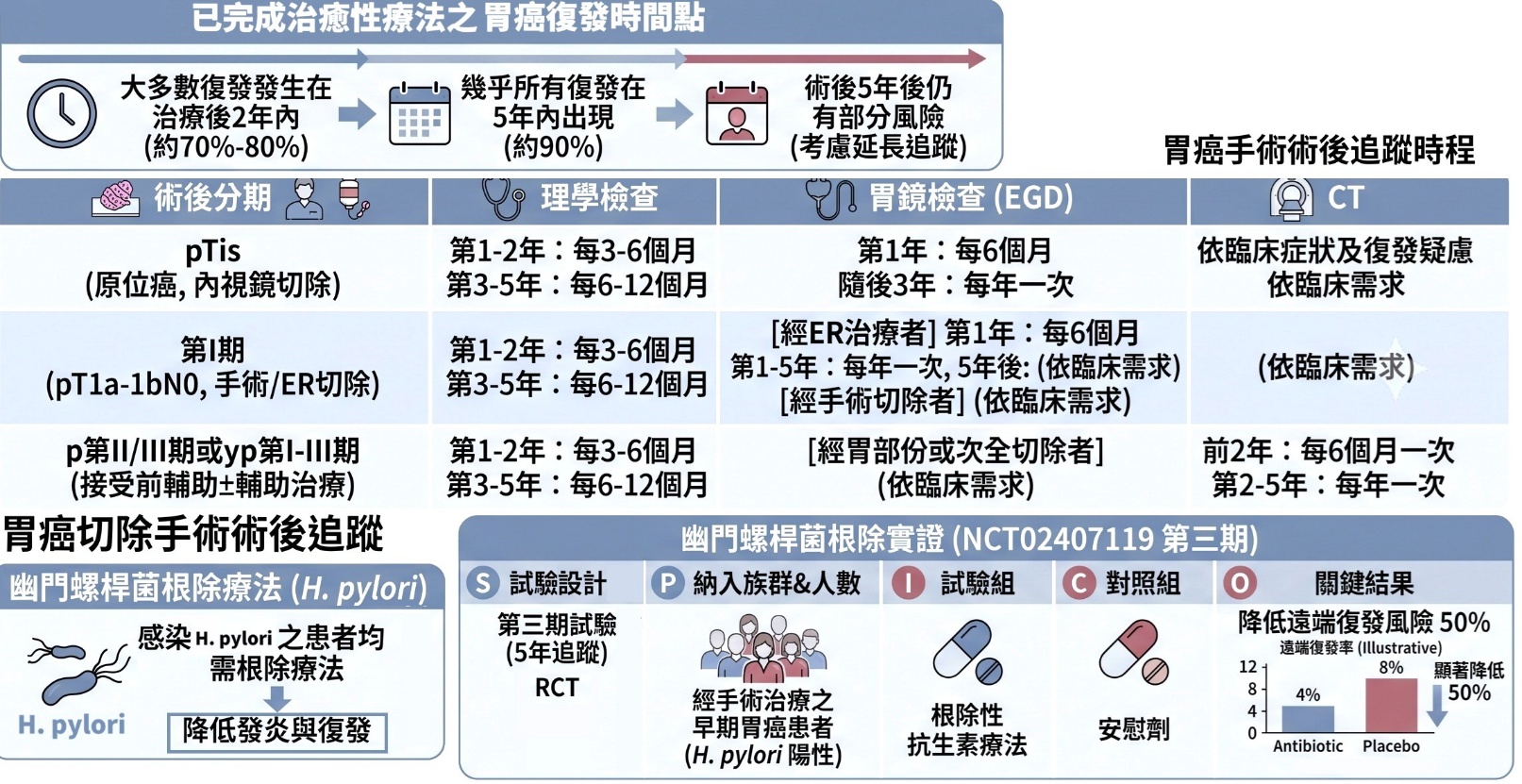
復發時間點:大多數胃癌復發發生在治療完成後的2年內 (約70%-80%) ,且幾乎所有的復發都會在5年內出現 (約90%);但術後5年後仍有部分復發風險。需根據患者的風險因素與共病症,考慮是否延長追蹤期。[6]
早期胃癌預後的異質性:接受R0根治性切除的Tis (原位癌) 患者,其預後已接近非癌症人群,但T1aN0和T1b期的疾病並無如此樂觀的預後。故臨床追蹤建議會根據腫瘤浸潤深度及治療方式的不同而有所調整。
6.1.2 胃癌切除手術術後追蹤
早期胃癌病人按照其接受之手術療法以及病理分期,決定後續追蹤之項目與頻率。[6]
幽門螺旋桿菌 (H. pylori) 感染處置:所有曾證實幽門螺旋桿菌感染之胃癌患者,均需接受幽門螺旋桿菌根除療法,以免因感染造成的慢性發炎與復發。
幽門螺旋桿菌根除療法實證:NCT02407119第三期試驗追蹤5年的結果顯示,在經手術治療之早期胃癌患者投與根除性抗生素療法,相較於安慰劑能顯著降低50%的遠端復發風險。[65]
表6.1.2 胃癌各病理期之手術術後追蹤
| 術後分期 | 理學檢查 | 胃鏡檢查 (EGD) | 電腦斷層 (CT) |
| pTis (原位癌,經內視鏡切除術治療) | 第1-2年:每3-6個月一次 第3-5年:每6-12個月一次 |
第1年:每6個月一次 隨後3年:每年一次 |
依臨床症狀及對復發的疑慮,依臨床需求進行 |
| 第I期 (pT1a-1bN0,經手術切除或 ER治療) | 第1-2年:每3-6個月一次 第3-5年:每6-12個月一次 |
[經ER治療者] 第1年:每6個月一次;第1-5年:每年一次 5年後:(依臨床需求) [經手術切除者] (依臨床需求) |
(依臨床需求) |
| p第II/III期或 yp第I-III期 (接受前輔助 ± 輔助治療) |
第1-2年:每3-6個月一次 第3-5年:每6-12個月一次 |
[經胃部份或次全切除者] (依臨床需求) |
前2年:每6個月一次 第2-5年:每年一次 |
6.2 併發症與副作用之照護
6.2.1 胃切除術後特有後遺症管理
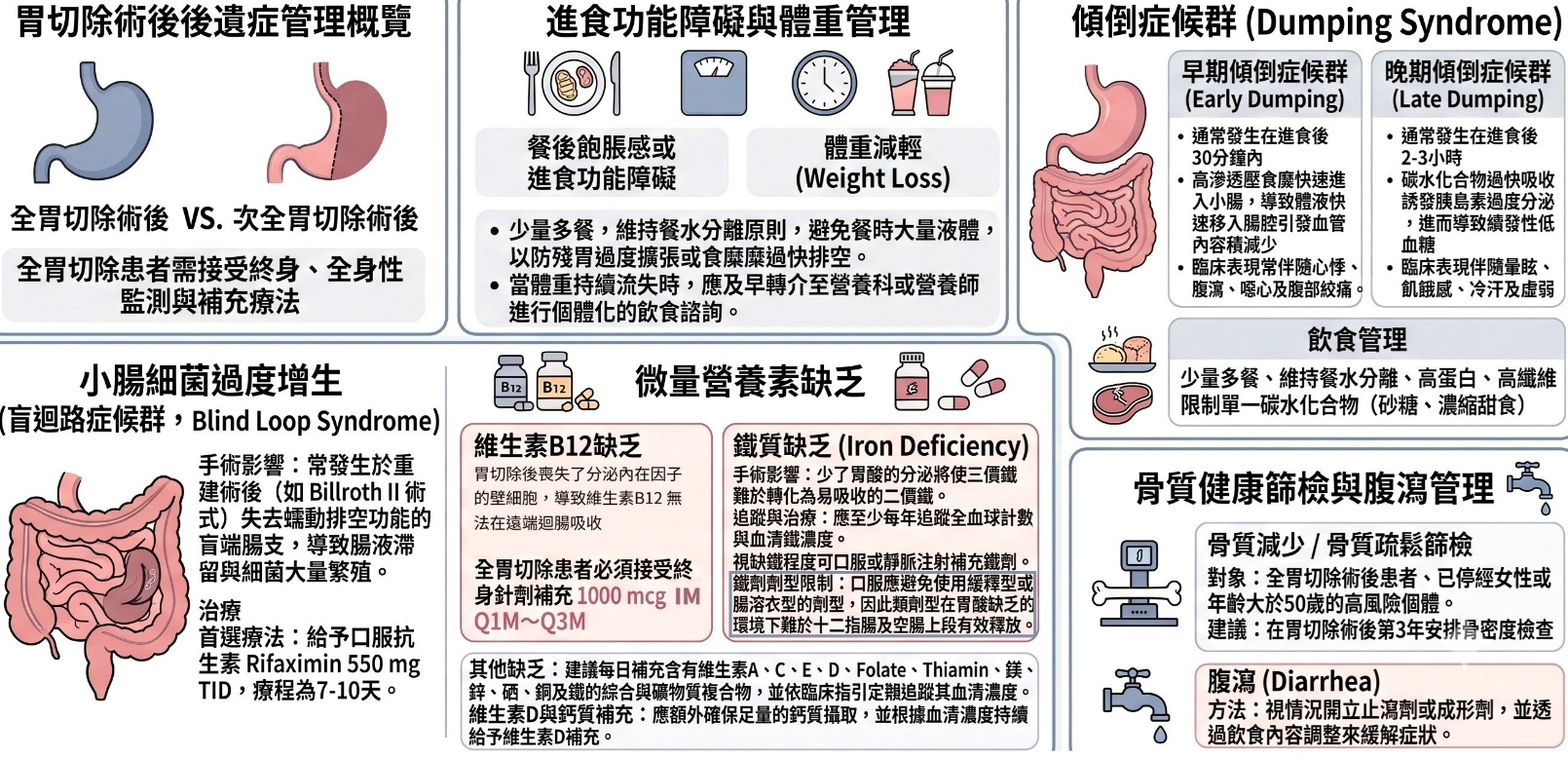
接受胃切除術之患者常面臨的營養與消化功能障礙。相較於次全胃切除患者,全胃切除術後患者需接受終身、全身性的監測與補充療法:
餐後飽脹感或進食功能障礙:鼓勵患者少量多餐,維持餐水分離原則,即避免在用餐時同時攝入大量液體,以防殘胃過度擴張或食糜過快排空。
體重減輕 (Weight Loss):需衛教患者採取少量多餐的進食模式,維持餐水分離原則。當體重持續流失時,應及早轉介至營養科或營養師進行個體化的飲食諮詢。
傾倒症候群 (Dumping Syndrome):胃部切除後失去幽門之控管功能,使得高滲透壓食物迅速進入小腸,所引發之連鎖反應。
早期傾倒症候群 (Early Dumping):通常發生在進食後30分鐘內,生理機制為高滲透壓食糜快速進入小腸,導致體液快速移入腸腔引發血管內容積減少。臨床表現常伴隨心悸、腹瀉、噁心及腹部絞痛。
晚期傾倒症候群 (Late Dumping):通常發生在進食後2-3小時,其生理機制為碳水化合物過快吸收誘發胰島素過度分泌,進而導致續發性低血糖。臨床表現伴隨暈眩、飢餓感、冷汗及虛弱。
飲食管理:少量多餐,維持餐水分離原則。日常飲食組成應以高蛋白、高纖維為主,並限制單一碳水化合物 (如砂糖、濃縮甜食) 的攝取。
維生素B12缺乏:
手術影響:由於胃切除後喪失了分泌內在因子 (Intrinsic Factor) 的壁細胞,導致維生素B12 無法在遠端迴腸吸收。
補充建議:全胃切除患者必須接受終身常規針劑補充 1000 mcg IM Q1M~Q3M。
鐵質缺乏 (Iron Deficiency) :
手術影響:少了胃酸的分泌將使三價鐵難以轉化為易吸收的二價鐵。
追蹤與治療:接受胃部切除術患者,應至少每年追蹤全血球計數與血清鐵濃度。視缺鐵程度可口服或靜脈注射補充鐵劑。
鐵劑劑型限制:口服應避免使用緩釋型或腸溶衣型的劑型,因此類劑型在胃酸缺乏的環境下難於十二指腸及空腸上段有效釋放。
小腸細菌過度增生 (盲迴路症候群, Blind Loop Syndrome) :
手術影響:常發生於重建術後 (如 Billroth II 術式) 失去蠕動排空功能的盲端腸支,導致腸液滯留與細菌大量繁殖。
治療:首選療法為給予口服抗生素Rifaximin 550 mg TID,療程為7-10天。飲食上應配合高蛋白、低碳水化合物飲食以限制細菌的能量來源。
其他微量營養素缺乏:建議每日補充含有維生素A、C、E、D、Folate、Thiamin、鎂、鋅、硒、銅及鐵的綜合維生素與礦物質複合物,並依臨床指引定期追蹤其血清濃度。
維生素D與鈣質補充:除日常綜合維生素外,應額外確保足量的鈣質攝取,並根據血清濃度持續給予維生素D補充。
骨質減少/骨質疏鬆篩檢:對於全胃切除術後患者、已停經女性或年齡大於50歲的高風險個體,推薦在胃切除術後第3年安排骨密度檢查。
腹瀉 (Diarrhea):視情況開立止瀉劑或成形劑,並透過飲食內容調整來緩解症狀。
6.2.2 消化道急性與慢性出血處置
急性消化道出血在晚期胃癌患者中極為常見。原因包括直接源自腫瘤表面的潰瘍與壞死、或全身性治療後的併發症。
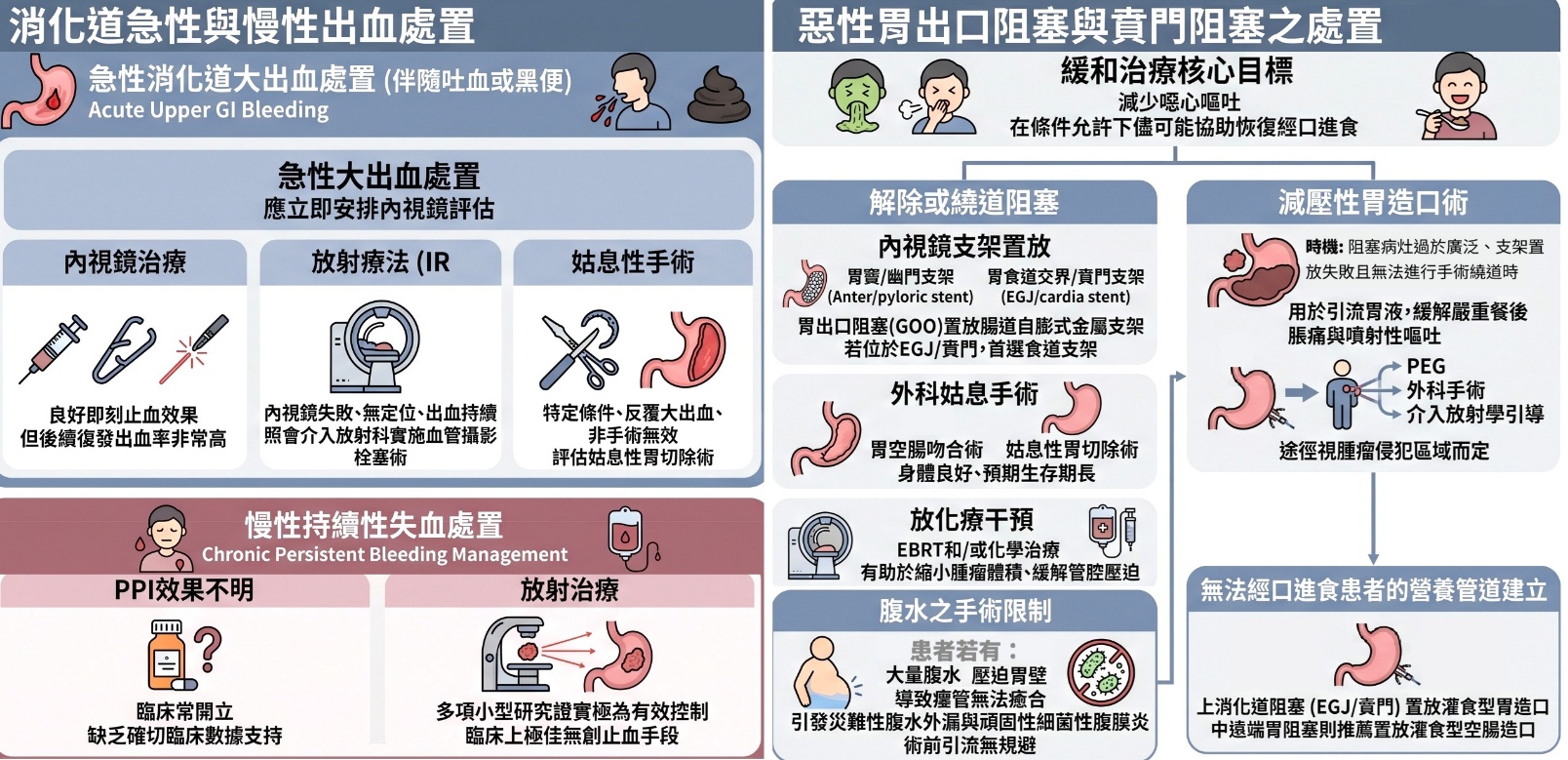
急性大出血處置 (伴隨吐血或黑便):應立即安排內視鏡評估。
內視鏡治療:雖然內視鏡止血在胃癌出血中的長期療效缺乏充分的前瞻性研究,但現有研究顯示,儘管內視鏡治療 (包括局部藥物注射、機械性止血如使用止血夾、或消融療法) 能取得良好的即刻止血效果,但後續的復發出血率非常高。
放射療法 (IR):若內視鏡止血失敗、出血點無法定位或出血持續發生,應迅速照會介入放射科實施血管攝影栓塞術。
姑息性手術:對於特定身體條件允許、反覆大出血且非手術手段無效的患者,可評估實施姑息性胃切除術。
慢性持續性失血處置:
PPI效果不明:雖然臨床上常開立PPI以期減少胃癌病灶的出血風險,但目前尚缺乏確切的臨床數據支持其在此領域的預防療效。
放射治療:多項小型系列研究證實,局部姑息性體外放射治療 (External Beam Radiation Therapy, EBRT) 能極為有效地控制胃癌引起的急性與慢性胃腸道出血,是臨床上極佳的無創止血手段。
6.2.3 惡性胃出口阻塞與賁門阻塞之處置
緩和治療核心目標:減少噁心與嘔吐症狀,並在條件允許下儘可能協助患者恢復經口進食。
阻塞的具體解除與繞道策略如下:
解除或繞道阻塞 (Alleviate or Bypass Obstruction) :
內視鏡支架置放:對於胃竇或幽門引發的胃出口阻塞 (Gastric Outlet Obstruction, GOO),可置放腸道自膨式金屬支架。
若阻塞位於胃食道交界處 (EGJ) 或胃賁門,則首選置放食道支架。外科姑息手術:對於身體狀態良好、預期生存期較長的患者,可實施胃空腸吻合術 (Gastrojejunostomy) 或姑息性胃切除術。
放化療干預:局部姑息性體外放療 (EBRT) 和/或全身性化學治療有助於縮小腫瘤體積,緩解管腔壓迫。
減壓性胃造口術 (Venting Gastrostomy):當阻塞病灶過於廣泛、支架置放失敗且無法進行手術繞道時,建議使用減壓性胃造口術來引流胃液,以緩解嚴重的餐後脹痛與噴射性嘔吐。
造口置放途徑:可經由經皮、內視鏡 (PEG)、外科手術或介入放射學引導下置放胃造口廔管,具體視腫瘤侵犯區域而定。
腹水之手術限制:若患者合併有大量腹水,則可能因腹水的再生並壓迫胃壁,導致廔管無法癒合,引發災難性的腹水外漏與頑固性細菌性腹膜炎。單純的術前腹水引流並無法完全規避此嚴重併發症。
無法經口進食患者的營養管道建立:若腫瘤位置允許,上消化道阻塞 (如EGJ/賁門阻塞) 可置放灌食型胃造口廔管;而中遠端胃阻塞則推薦置放灌食型空腸造口廔管以維持營養供應。
6.2.4 腫瘤相關疼痛與噁心嘔吐
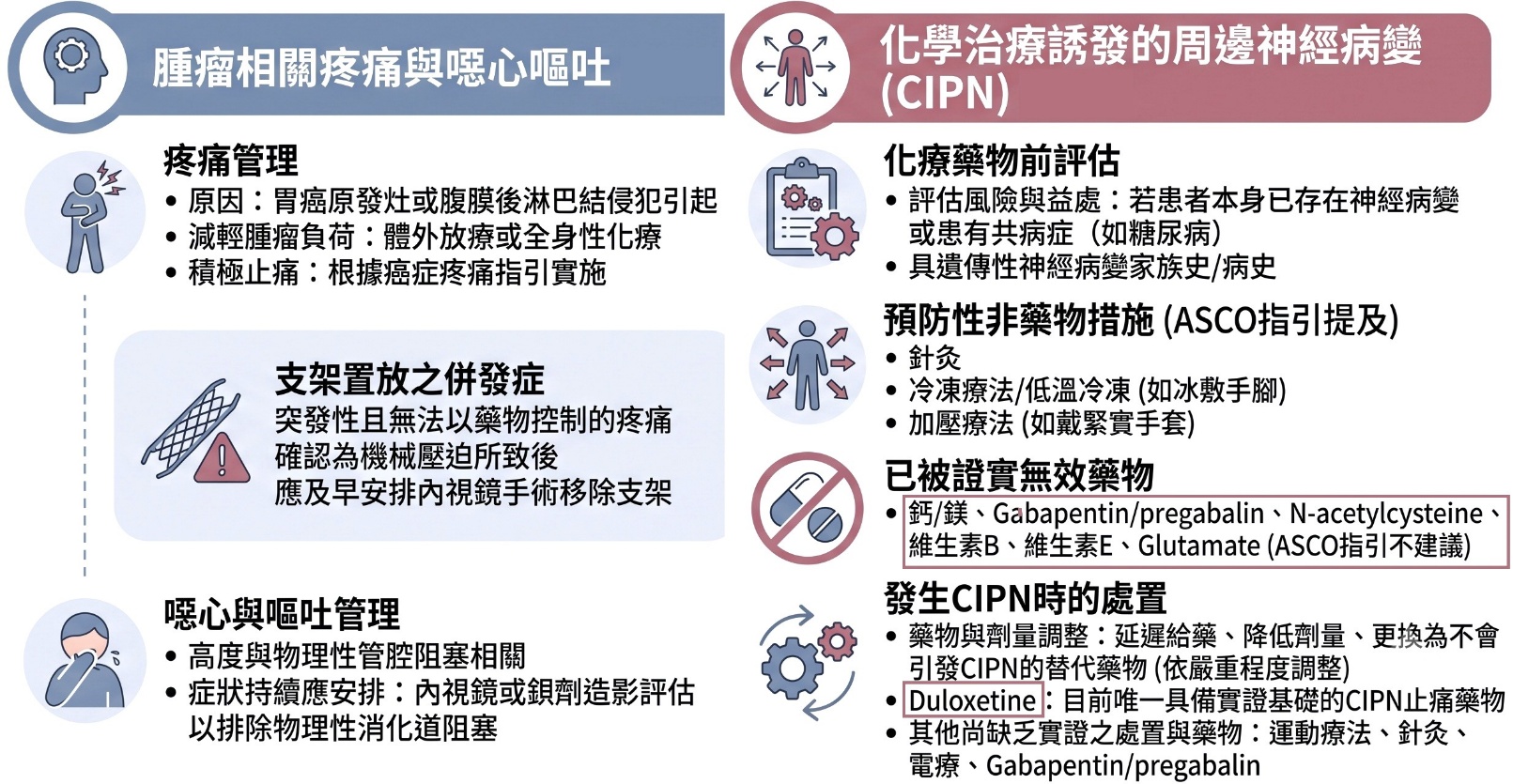
疼痛管理:胃癌原發灶或腹膜後淋巴結侵犯引起的疼痛,可藉由體外放療或全身性化療來減輕腫瘤負荷,並根據癌症疼痛指引實施積極的止痛療法。
支架置放之併發症:若患者在接受胃部支架置放術後出現突發性且無法以藥物控制的疼痛,在確認為支架機械壓迫所致後,應及早安排內視鏡手術將支架移除。
噁心與嘔吐管理:由於胃癌患者的噁心嘔吐與物理性的管腔阻塞高度相關,一旦出現無法緩解的症狀,應立即安排內視鏡或鋇劑造影評估,以排除物理性消化道阻塞。
6.2.5 化學治療誘發的周邊神經病變 (CIPN)
化療藥物前評估:若患者本身已存在神經病變,或患有容易引發神經病變的共病症 (如糖尿病、具備家族或個人遺傳性神經病變病史),在給予可能導致CIPN的化療藥物前,應深切評估其風險與益處。
預防性非藥物措施:ASCO針對化療引起的神經病變之指引提及,雖然以下非藥物預防措施,在部分研究得到正向結果,但仍需更大樣本量的決定性研究來證實療效。[66]
針灸 (Acupuncture)
冷凍療法/低溫冷凍 (Cryotherapy,如冰敷手腳)
加壓療法 (Compression therapy,如戴緊實手套)
已被證實無效藥物:包括如鈣/鎂、Gabapentin/pregabalin、N-acetylcysteine、維生素B、維生素E、Glutamate等,ASCO指引不建議使用。
發生CIPN時的處置:
藥物與劑量調整:按照嚴重程度決定以下的劑量或療程調整。包括延遲給藥、降低劑量 、更換為不會引發CIPN的替代藥物。
Duloxetine:為目前唯一具備實證基礎的CIPN止痛藥物。
其他尚缺乏實證之處置與藥物治療:如運動療法、針灸、電療、Gabapentin/pregabalin等。
結語:
胃分為賁門、胃底、胃體、幽門四區,約85%胃癌發生於胃體或幽門竇。腸型胃癌經Correa cascade逐步進展,主因為幽門螺旋桿菌感染,而瀰漫型胃癌則多與CDH1基因突變相關、與慢性發炎無直接關係。
胃癌早期多無特異症狀,常見以體重減輕、腹痛表現,確診需仰賴內視鏡切片及EUS/CT分期。並按照T (侵犯深度)、N (淋巴結數量)、M (遠端轉移) 判定分期。
早期胃癌(cTis/cT1a或表淺cT1b)優先採內視鏡切除術(ESD優於EMR),局部進展期則以胃切除術+D1或改良型D2淋巴結廓清為主要治癒手段。
可切除的局部進展期胃癌,圍術期化療FLOT為標準治療,而對於PD-L1 TAP≥1% FLOT + 免疫療法Durvalumab可延長存活期;dMMR/MSI-H患者則可用雙免疫療法達到高病理完全緩解率而免除傳統化療。
晚期第一線全身性治療依生物標記決定合併療法:HER2陽性加Trastuzumab (±Pembrolizumab)、PD-L1 CPS≥1加免疫檢查點抑制劑、Claudin 18.2陽性加Zolbetuximab、MSI-H/dMMR則優先免疫療法;二線可用Ramucirumab+化療(或HER2陽性者換用T-DXd),三線後仍有Trifluridine/Tipiracil可延長存活。
Reference:
Drake RL, Vogl AW, Mitchell AWM. Gray's Anatomy for Students. 3rd ed. Churchill Livingstone; Chapter 4: Abdomen. 2014:310-312.
Hsu M, Safadi AO, Lui F. Physiology, stomach. In: StatPearls. StatPearls Publishing; 2023. Updated July 17, 2023. Accessed June 10, 2026. https://www.ncbi.nlm.nih.gov/books/NBK535425/.
Correa P, Piazuelo MB. The gastric precancerous cascade. J Dig Dis. 2012;13(1):2-9.
Patel AK, Sethi NS, Park H. Gastric Cancer: A Review. JAMA. 2026;335(5):439-450.
Health Promotion Administration, Ministry of Health and Welfare, Taiwan. 2023 Taiwan Cancer Registry Report. Taipei, Taiwan: Health Promotion Administration, Ministry of Health and Welfare; December 30, 2025. Available from: https://www.hpa.gov.tw/Pages/TopicList.aspx?nodeid=269. Accessed June 10, 2026.
National Comprehensive Cancer Network. NCCN Clinical Practice Guidelines in Oncology (NCCN Guidelines): Gastric Cancer. Version 2.2026. National Comprehensive Cancer Network; 2026. Updated January 21, 2026. Accessed June 10, 2026. https://www.nccn.org.
Amin MB, Greene FL, Edge SB, et al. The Eighth Edition AJCC Cancer Staging Manual: Continuing to build a bridge from a population-based to a more "personalized" approach to cancer staging. CA Cancer J Clin. 2017;67(2):93-99.
Zhao Y, Wang C. Long-Term Clinical Efficacy and Perioperative Safety of Endoscopic Submucosal Dissection versus Endoscopic Mucosal Resection for Early Gastric Cancer: An Updated Meta-Analysis. Biomed Res Int. 2018;2018:3152346. Published 2018 Jan 11.
Huang C, Liu H, Hu Y, et al. Laparoscopic vs Open Distal Gastrectomy for Locally Advanced Gastric Cancer: Five-Year Outcomes From the CLASS-01 Randomized Clinical Trial. JAMA Surg. 2022;157(1):9-17.
Liu F, Huang C, Xu Z, et al. Morbidity and Mortality of Laparoscopic vs Open Total Gastrectomy for Clinical Stage I Gastric Cancer: The CLASS02 Multicenter Randomized Clinical Trial. JAMA Oncol. 2020;6(10):1590-1597.
Kim HH, Han SU, Kim MC, et al. Effect of Laparoscopic Distal Gastrectomy vs Open Distal Gastrectomy on Long-term Survival Among Patients With Stage I Gastric Cancer: The KLASS-01 Randomized Clinical Trial. JAMA Oncol. 2019;5(4):506-513.
Son SY, Hur H, Hyung WJ, et al. Laparoscopic vs Open Distal Gastrectomy for Locally Advanced Gastric Cancer: 5-Year Outcomes of the KLASS-02 Randomized Clinical Trial. JAMA Surg. 2022;157(10):879-886.
Hartgrink HH, van de Velde CJ, Putter H, et al. Extended lymph node dissection for gastric cancer: who may benefit? Final results of the randomized Dutch gastric cancer group trial. J Clin Oncol. 2004;22(11):2069-2077.
Cuschieri A, Weeden S, Fielding J, et al. Patient survival after D1 and D2 resections for gastric cancer: long-term results of the MRC randomized surgical trial. Surgical Co-operative Group. Br J Cancer. 1999;79(9-10):1522-1530.
Degiuli M, Sasako M, Calgaro M, et al. Morbidity and mortality after D1 and D2 gastrectomy for cancer: interim analysis of the Italian Gastric Cancer Study Group (IGCSG) randomised surgical trial. Eur J Surg Oncol. 2004;30(3):303-308.
Moertel CG, Childs DS Jr, Reitemeier RJ, Colby MY Jr, Holbrook MA. Combined 5-fluorouracil and supervoltage radiation therapy of locally unresectable gastrointestinal cancer. Lancet. 1969;2(7626):865-867.
Hallissey MT, Dunn JA, Ward LC, Allum WH. The second British Stomach Cancer Group trial of adjuvant radiotherapy or chemotherapy in resectable gastric cancer: five-year follow-up. Lancet. 1994;343(8909):1309-1312.
Leong T, Smithers BM, Michael M, et al. Preoperative Chemoradiotherapy for Resectable Gastric Cancer. N Engl J Med. 2024;391(19):1810-1821.
Cunningham D, Allum WH, Stenning SP, et al. Perioperative chemotherapy versus surgery alone for resectable gastroesophageal cancer. N Engl J Med. 2006;355(1):11-20.
Al-Batran SE, Homann N, Pauligk C, et al. Perioperative chemotherapy with fluorouracil plus leucovorin, oxaliplatin, and docetaxel versus fluorouracil or capecitabine plus cisplatin and epirubicin for locally advanced, resectable gastric or gastro-oesophageal junction adenocarcinoma (FLOT4): a randomised, phase 2/3 trial. Lancet. 2019;393(10184):1948-1957.
Ychou M, Boige V, Pignon JP, et al. Perioperative chemotherapy compared with surgery alone for resectable gastroesophageal adenocarcinoma: an FNCLCC and FFCD multicenter phase III trial. J Clin Oncol. 2011;29(13):1715-1721.
Janjigian YY, Al-Batran SE, Wainberg ZA, et al. Perioperative Durvalumab in Gastric and Gastroesophageal Junction Cancer. N Engl J Med. 2025;393(3):217-230.
Kang YK, Terashima M, Kim YW, et al. Adjuvant nivolumab plus chemotherapy versus placebo plus chemotherapy for stage III gastric or gastro-oesophageal junction cancer after gastrectomy with D2 or more extensive lymph-node dissection (ATTRACTION-5): a randomised, multicentre, double-blind, placebo-controlled, phase 3 trial. Lancet Gastroenterol Hepatol. 2024;9(8):705-717.
Shitara K, Rha SY, Wyrwicz LS, et al. Neoadjuvant and adjuvant pembrolizumab plus chemotherapy in locally advanced gastric or gastro-oesophageal cancer (KEYNOTE-585): an interim analysis of the multicentre, double-blind, randomised phase 3 study. Lancet Oncol. 2024;25(2):212-224.
André T, Tougeron D, Piessen G, et al. Neoadjuvant Nivolumab Plus Ipilimumab and Adjuvant Nivolumab in Localized Deficient Mismatch Repair/Microsatellite Instability-High Gastric or Esophagogastric Junction Adenocarcinoma: The GERCOR NEONIPIGA Phase II Study. J Clin Oncol. 2023;41(2):255-265.
Raimondi A, Lonardi S, Murgioni S, et al. Tremelimumab and durvalumab as neoadjuvant or non-operative management strategy of patients with microsatellite instability-high resectable gastric or gastroesophageal junction adenocarcinoma: the INFINITY study by GONO. Ann Oncol. 2025;36(3):285-296.
Bang YJ, Kim YW, Yang HK, Chung HC, Park YK, Lee KH, Lee KW, Kim YH, Noh SI, Cho JY, Mok YJ, Kim YH, Ji J, Yeh TS, Button P, Sirzén F, Noh SH; CLASSIC trial investigators. Adjuvant capecitabine and oxaliplatin for gastric cancer after D2 gastrectomy (CLASSIC): a phase 3 open-label, randomised controlled trial. Lancet. 2012 Jan 28;379(9813):315-21.
Smalley SR, Benedetti JK, Haller DG, et al. Updated analysis of SWOG-directed intergroup study 0116: a phase III trial of adjuvant radiochemotherapy versus observation after curative gastric cancer resection. J Clin Oncol. 2012;30(19):2327-2333.
Lee J, Lim DH, Kim S, et al. Phase III trial comparing capecitabine plus cisplatin versus capecitabine plus cisplatin with concurrent capecitabine radiotherapy in completely resected gastric cancer with D2 lymph node dissection: the ARTIST trial. J Clin Oncol. 2012;30(3):268-273.
Park SH, Lim DH, Sohn TS, et al. A randomized phase III trial comparing adjuvant single-agent S1, S-1 with oxaliplatin, and postoperative chemoradiation with S-1 and oxaliplatin in patients with node-positive gastric cancer after D2 resection: the ARTIST 2 trial☆. Ann Oncol. 2021;32(3):368-374.
Kelly RJ, Ajani JA, Kuzdzal J, et al. Adjuvant Nivolumab in Resected Esophageal or Gastroesophageal Junction Cancer. N Engl J Med. 2021;384(13):1191-1203.
Conroy T, Galais MP, Raoul JL, et al. Definitive chemoradiotherapy with FOLFOX versus fluorouracil and cisplatin in patients with oesophageal cancer (PRODIGE5/ACCORD17): final results of a randomised, phase 2/3 trial. Lancet Oncol. 2014;15(3):305-314.
Chicago Consensus Working Group. The Chicago Consensus on peritoneal surface malignancies: Management of gastric metastases. Cancer. 2020;126(11):2541-2546.
Yang XJ, Huang CQ, Suo T, et al. Cytoreductive surgery and hyperthermic intraperitoneal chemotherapy improves survival of patients with peritoneal carcinomatosis from gastric cancer: final results of a phase III randomized clinical trial. Ann Surg Oncol. 2011;18(6):1575-1581.
Rau B, Lang H, Koenigsrainer A, et al. Effect of Hyperthermic Intraperitoneal Chemotherapy on Cytoreductive Surgery in Gastric Cancer With Synchronous Peritoneal Metastases: The Phase III GASTRIPEC-I Trial. J Clin Oncol. 2024;42(2):146-156.
Koemans WJ, van der Kaaij RT, Boot H, et al. Cytoreductive surgery and hyperthermic intraperitoneal chemotherapy versus palliative systemic chemotherapy in stomach cancer patients with peritoneal dissemination, the study protocol of a multicentre randomised controlled trial (PERISCOPE II). BMC Cancer. 2019;19(1):420. Published 2019 May 6.
Kang YK, Kang WK, Shin DB, et al. Capecitabine/cisplatin versus 5-fluorouracil/cisplatin as first-line therapy in patients with advanced gastric cancer: a randomised phase III noninferiority trial. Ann Oncol. 2009;20(4):666-673.
Al-Batran SE, Hartmann JT, Probst S, Schmalenberg H, Hollerbach S, Hofheinz R, Rethwisch V, Seipelt G, Homann N, Wilhelm G, Schuch G, Stoehlmacher J, Derigs HG, Hegewisch-Becker S, Grossmann J, Pauligk C, Atmaca A, Bokemeyer C, Knuth A, Jäger E; Arbeitsgemeinschaft Internistische Onkologie. Phase III trial in metastatic gastroesophageal adenocarcinoma with fluorouracil, leucovorin plus either oxaliplatin or cisplatin: a study of the Arbeitsgemeinschaft Internistische Onkologie. J Clin Oncol. 2008 Mar 20;26(9):1435-42.
Dank M, Zaluski J, Barone C, et al. Randomized phase III study comparing irinotecan combined with 5-fluorouracil and folinic acid to cisplatin combined with 5-fluorouracil in chemotherapy naive patients with advanced adenocarcinoma of the stomach or esophagogastric junction. Ann Oncol. 2008;19(8):1450-1457.
Van Cutsem E, Moiseyenko VM, Tjulandin S, Majlis A, Constenla M, Boni C, Rodrigues A, Fodor M, Chao Y, Voznyi E, Risse ML, Ajani JA; V325 Study Group. Phase III study of docetaxel and cisplatin plus fluorouracil compared with cisplatin and fluorouracil as first-line therapy for advanced gastric cancer: a report of the V325 Study Group. J Clin Oncol. 2006 Nov 1;24(31):4991-7.
Inal A, Kaplan MA, Kucukoner M, Isikdogan A. Docetaxel and Cisplatin Plus Fluorouracil compared with Modified Docetaxel, Cisplatin, and 5-Fluorouracil as first-line therapy for advanced gastric cancer: a retrospective analysis of single institution. Neoplasma. 2012;59(2):233-236.
Bang YJ, Van Cutsem E, Feyereislova A, et al. Trastuzumab in combination with chemotherapy versus chemotherapy alone for treatment of HER2-positive advanced gastric or gastro-oesophageal junction cancer (ToGA): a phase 3, open-label, randomised controlled trial. Lancet. 2010;376(9742):687-697.
Rivera F, Romero C, Jimenez-Fonseca P, et al. Phase II study to evaluate the efficacy of Trastuzumab in combination with Capecitabine and Oxaliplatin in first-line treatment of HER2-positive advanced gastric cancer: HERXO trial. Cancer Chemother Pharmacol. 2019;83(6):1175-1181.
Janjigian YY, Kawazoe A, Bai Y, et al. Pembrolizumab plus trastuzumab and chemotherapy for HER2-positive gastric or gastrooesophageal junction adenocarcinoma: interim analyses from the phase 3 KEYNOTE-811 randomised placebo-controlled trial. Lancet. 2023;402(10418):2197-2208.
Janjigian YY, Shitara K, Moehler M, et al. First-line nivolumab plus chemotherapy versus chemotherapy alone for advanced gastric, gastro-oesophageal junction, and oesophageal adenocarcinoma (CheckMate 649): a randomised, open-label, phase 3 trial. Lancet. 2021;398(10294):27-40.
Rha SY, Oh DY, Yañez P, et al. Pembrolizumab plus chemotherapy versus placebo plus chemotherapy for HER2-negative advanced gastric cancer (KEYNOTE-859): a multicentre, randomised, double-blind, phase 3 trial. Lancet Oncol. 2023;24(11):1181-1195.
Qiu MZ, Oh DY, Kato K, et al. Tislelizumab plus chemotherapy versus placebo plus chemotherapy as first line treatment for advanced gastric or gastro-oesophageal junction adenocarcinoma: RATIONALE-305 randomised, double blind, phase 3 trial. BMJ. 2024;385:e078876. Published 2024 May 28.
Shitara K, Lordick F, Bang YJ, et al. Zolbetuximab plus mFOLFOX6 in patients with CLDN18.2-positive, HER2-negative, untreated, locally advanced unresectable or metastatic gastric or gastro-esophageal junction adenocarcinoma (SPOTLIGHT): a multi-center, randomized, double-blind, phase 3 trial. Lancet. 2023;401(10389):1655-1668.
Shah MA, Shitara K, Ajani JA, et al. Zolbetuximab plus CAPOX in CLDN18.2-positive gastric or gastroesophageal junction adenocarcinoma: the randomized, phase 3 GLOW trial. Nat Med. 2023;29(8):2133-2141.
Marabelle A, Le DT, Ascierto PA, et al. Efficacy of Pembrolizumab in Patients With Noncolorectal High Microsatellite Instability/Mismatch Repair-Deficient Cancer: Results From the Phase II KEYNOTE-158 Study. J Clin Oncol. 2020;38(1):1-10.
Chao J, Fuchs CS, Shitara K, et al. Assessment of Pembrolizumab Therapy for the Treatment of Microsatellite Instability-High Gastric or Gastroesophageal Junction Cancer Among Patients in the KEYNOTE-059, KEYNOTE-061, and KEYNOTE-062 Clinical Trials. JAMA Oncol. 2021;7(6):895-902.
André T, Berton D, Curigliano G, et al. Antitumor Activity and Safety of Dostarlimab Monotherapy in Patients With Mismatch Repair Deficient Solid Tumors: A Nonrandomized Controlled Trial. JAMA Netw Open. 2023;6(11):e2341165. Published 2023 Nov 1.
Shitara K, Ajani JA, Moehler M, et al. Nivolumab plus chemotherapy or ipilimumab in gastro-oesophageal cancer. Nature. 2022;603(7903):942-948.
Wilke H, Muro K, Van Cutsem E, et al. Ramucirumab plus paclitaxel versus placebo plus paclitaxel in patients with previously treated advanced gastric or gastro-oesophageal junction adenocarcinoma (RAINBOW): a double-blind, randomised phase 3 trial. Lancet Oncol. 2014;15(11):1224-1235.
Klempner SJ, Maron SB, Chase L, Lomnicki S, Wainberg ZA, Catenacci DVT. Initial Report of Second-Line FOLFIRI in Combination with Ramucirumab in Advanced Gastroesophageal Adenocarcinomas: A Multi-Institutional Retrospective Analysis. Oncologist. 2019;24(4):475-482.
Fuchs CS, Shitara K, Di Bartolomeo M, et al. Ramucirumab with cisplatin and fluoropyrimidine as first-line therapy in patients with metastatic gastric or junctional adenocarcinoma (RAINFALL): a double-blind, randomised, placebo-controlled, phase 3 trial. Lancet Oncol. 2019;20(3):420-435.
Ford HE, Marshall A, Bridgewater JA, et al. Docetaxel versus active symptom control for refractory oesophagogastric adenocarcinoma (COUGAR-02): an open-label, phase 3 randomised controlled trial. Lancet Oncol. 2014;15(1):78-86.
Hironaka S, Ueda S, Yasui H, et al. Randomized, open-label, phase III study comparing irinotecan with paclitaxel in patients with advanced gastric cancer without severe peritoneal metastasis after failure of prior combination chemotherapy using fluoropyrimidine plus platinum: WJOG 4007 trial. J Clin Oncol. 2013;31(35):4438-4444.
Sym SJ, Hong J, Park J, et al. A randomized phase II study of biweekly irinotecan monotherapy or a combination of irinotecan plus 5-fluorouracil/leucovorin (mFOLFIRI) in patients with metastatic gastric adenocarcinoma refractory to or progressive after first-line chemotherapy. Cancer Chemother Pharmacol. 2013;71(2):481-488.
Shitara K, Bang YJ, Iwasa S, et al. Trastuzumab Deruxtecan in Previously Treated HER2-Positive Gastric Cancer. N Engl J Med. 2020;382(25):2419-2430.
Drilon A, Laetsch TW, Kummar S, et al. Efficacy of Larotrectinib in TRK Fusion-Positive Cancers in Adults and Children. N Engl J Med. 2018;378(8):731-739.
Subbiah V, Wolf J, Konda B, et al. Tumour-agnostic efficacy and safety of selpercatinib in patients with RET fusion-positive solid tumours other than lung or thyroid tumours (LIBRETTO-001): a phase 1/2, open-label, basket trial. Lancet Oncol. 2022;23(10):1261- 1273.
Salama AKS, Li S, Macrae ER, et al. Dabrafenib and Trametinib in Patients With Tumors With BRAFV600E Mutations: Results of the NCIMATCH Trial Subprotocol H. J Clin Oncol. 2020;38(33):3895-3904.
Shitara K, Doi T, Dvorkin M, et al. Trifluridine/Tipiracil Versus Placebo in Patients With Heavily Pretreated Metastatic Gastric Cancer (TAGS): A Randomised, Double-Blind, Placebo-Controlled, Phase 3 Trial. Lancet Oncol. 2018;19(11):1437-1448.
Choi IJ, Kook MC, Kim YI, et al. Helicobacter pylori Therapy for the Prevention of Metachronous Gastric Cancer. N Engl J Med. 2018;378(12):1085-1095.
Loprinzi CL, Lacchetti C, Bleeker J, et al. Prevention and Management of Chemotherapy-Induced Peripheral Neuropathy in Survivors of Adult Cancers: ASCO Guideline Update. J Clin Oncol. 2020;38(28):3325-3348.
整本手冊的 PDF 與重點簡報摘要在手冊首頁。