
第六章、食道癌患者之追蹤監測與副作用照護
發布日期:2026-07-26
6.1 階段性追蹤建議
復發時間特徵:九成以上的復發發生在局部治療完成後的最初2年內。但在局部治療結束5年以後,臨床上仍會偵測到需治療的延遲性復發。
異時性惡性腫瘤 (Metachronous malignancy):對於長期存活者,必須考慮到發生異時性二重癌的風險 (例如殘留食道中長出新癌症,或在鱗狀細胞癌患者的其他器官中長出第二種癌症)。
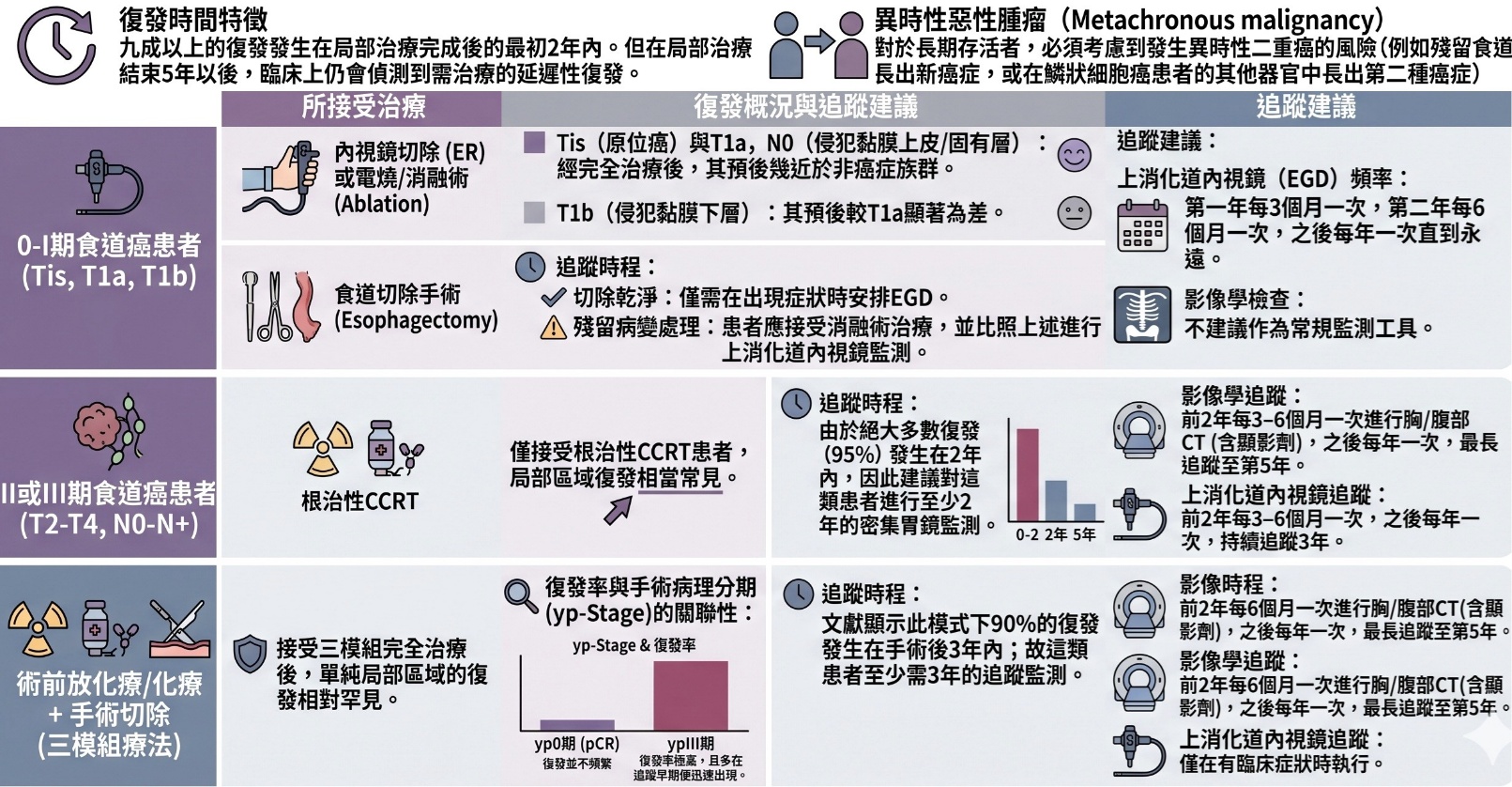
6.1.1 分期與治療模式導向的追蹤建議[13]
| 食道癌期別 | 所接受治療 |
|
| 0-I期食道癌患者 (Tis, T1a, T1b) | 內視鏡切除 (ER) 或電燒/消融術 (Ablation) |
追蹤建議:
|
| 食道切除手術 (Esophagectomy) |
|
|
| II或III期食道癌患者 (T2-T4,N0-N+) | 根治性CCRT | 僅接受根治性CCRT患者,局部區域復發相當常見。
|
| 術前放化療/化療 + 手術切除 (三模組療法) | 接受三模組完全治療後,單純局部區域的復發相對罕見。
|
6.2 食道癌患者之初期症狀治療
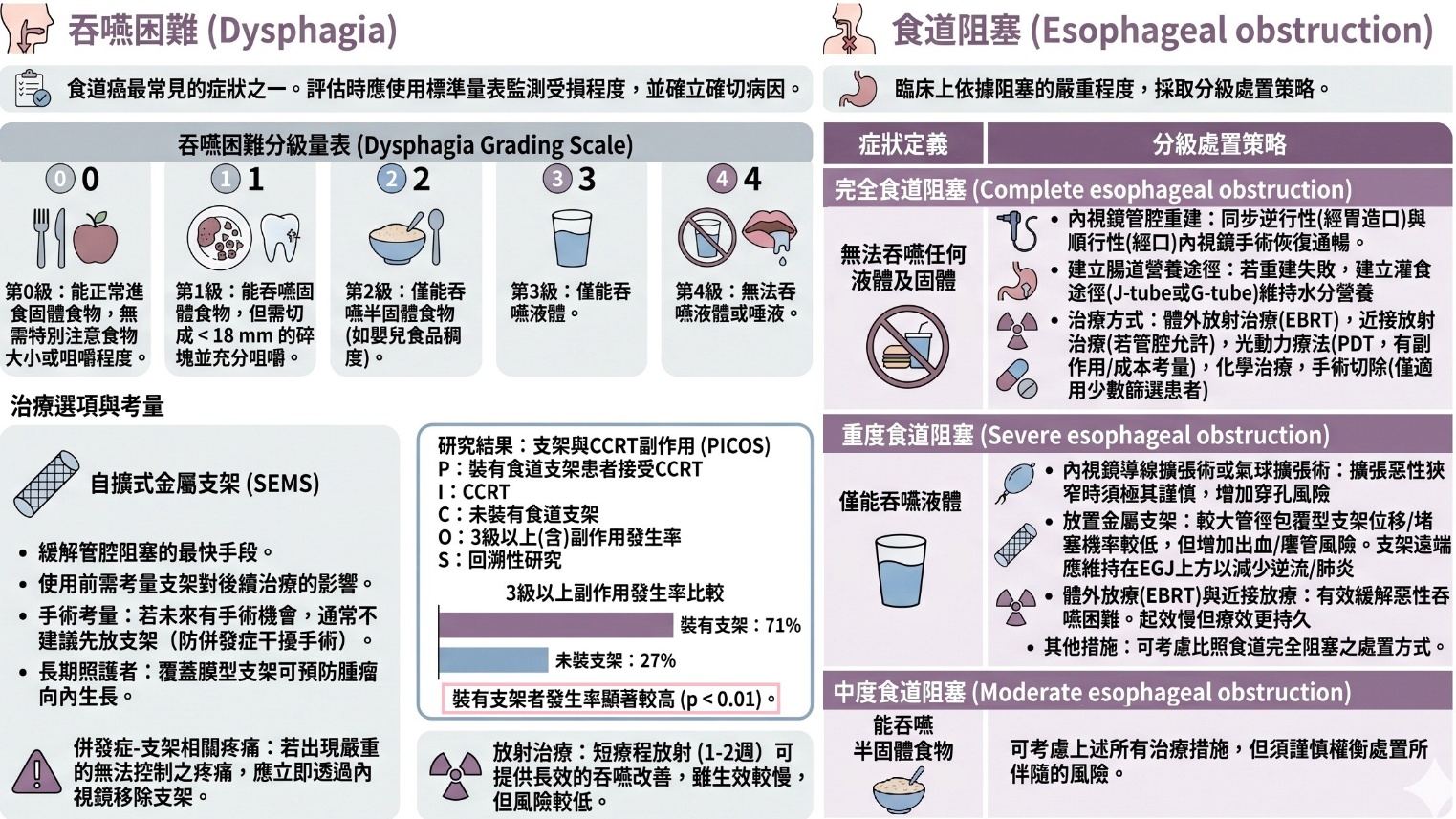
6.2.1 吞嚥困難 (Dysphagia)
吞嚥困難 (Dysphagia) 是食道癌最常見的症狀之一。評估時應使用標準量表監測吞嚥功能的受損程度,並確立引發吞嚥困難的確切病因。
吞嚥困難分級量表 (Dysphagia Grading Scale):[13]
第0級:能正常進食固體食物,無需特別注意食物大小或咀嚼程度。
第1級:能吞嚥固體食物,但需切成直徑 < 18 mm 的碎塊並經過充分咀嚼。
第2級:僅能吞嚥半固體食物 (如嬰兒食品稠度)。
第3級:僅能吞嚥液體。
第4級:無法吞嚥液體或唾液。
自擴式金屬支架 (Self expandable metallic stent, SEMS):是緩解管腔阻塞的最快手段,但使用前需考量支架對後續治療的影響。
手術考量:若未來有手術機會,通常不建議先放支架,以防併發症干擾手術。對於長期照護者,覆蓋膜型支架可預防腫瘤向內生長。
副作用考量:若病人在CCRT期間裝有食道支架,可能會增加副作用發生比率。在一篇回溯性研究顯示,裝有食道支架患者接受CCRT,其3級以上 (含) 副作用發生率為71%,顯著高於未裝有食道支架的27% (p < 0.01)。[64]
併發症-支架相關疼痛:患者在放置食道支架後,若出現嚴重的無法控制之疼痛,應立即透過內視鏡將支架移除。
放射治療:短療程放射 (1-2週) 可提供長效的吞嚥改善,雖生效較慢,但風險較低。
6.2.2 食道阻塞 (Esophageal obstruction)
臨床上依據阻塞的嚴重程度,採取分級處置策略:
表6.2.2 食道阻塞之分級處置策略
| 嚴重程度 | 症狀定義 |
|
| 完全食道阻塞 (Complete esophageal obstruction) | 無法吞嚥任何液體及固體 |
治療方式:
|
| 重度食道阻塞 (Severe esophageal obstruction) | 僅能吞嚥液體 |
|
| 中度食道阻塞 (Moderate esophageal obstruction) | 能吞嚥半固體食物 |
|
6.3 食道癌患者治療相關併發症之處理
6.3.1 術後胃腸道功能障礙與營養[65]
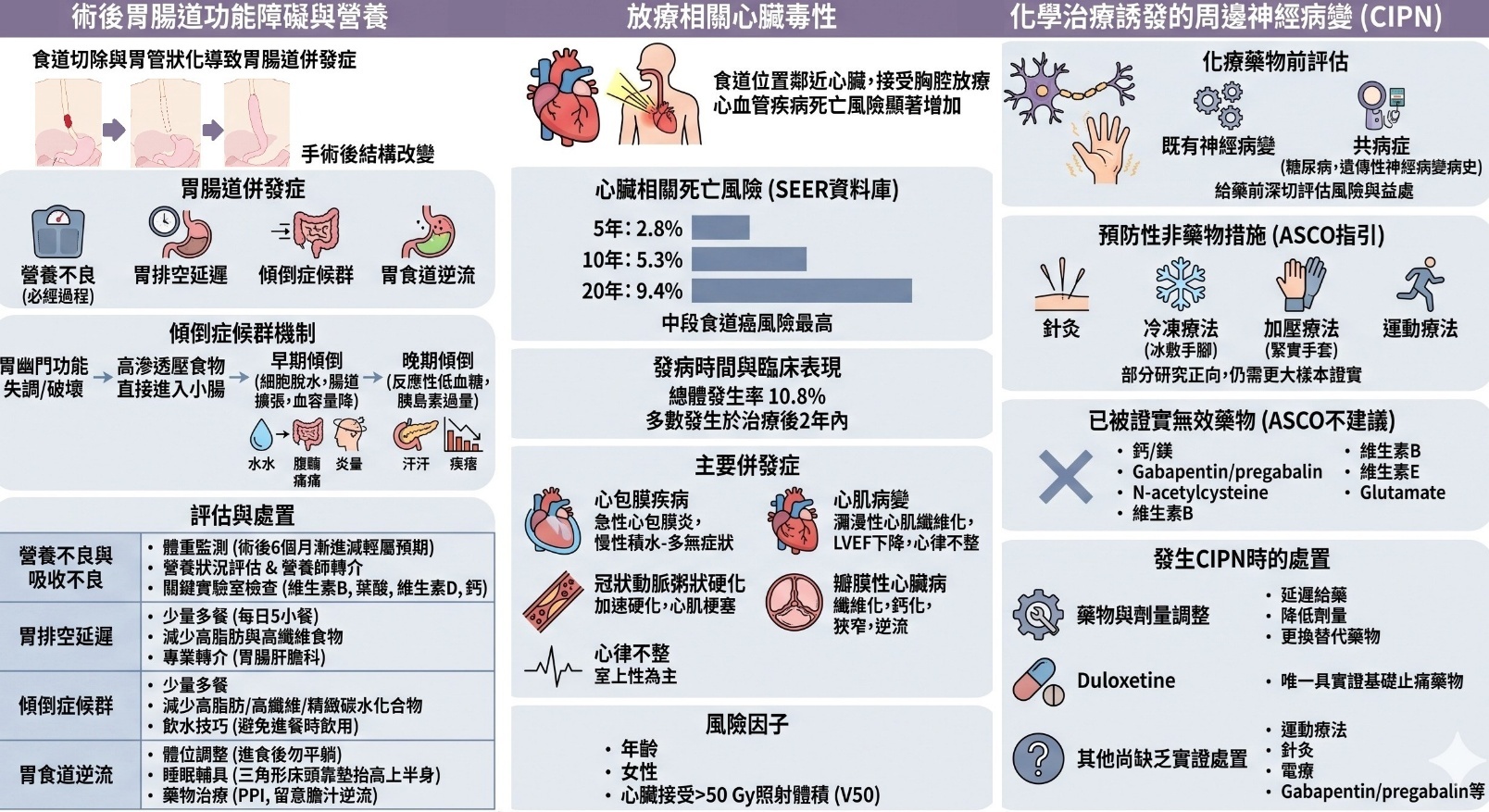
胃腸道併發症:食道癌與胃食道交界處 (EGJ) 癌患者在經歷根治性手術後,因上消化道結構與長度改變,導致的長期胃腸道併發症。其中包括術後6個月內必經之營養不良,以及胃排空延遲、傾倒症候群、或是胃食道逆流。
傾倒症候群 (Dumping syndrome):為食道癌、胃癌或胃縮短手術後常見的併發症。
幽門生理功能:調控胃部消化完的糜狀食物進入腸道的速度,同時嚴密防止鹼性的十二指腸液反流回胃部。
傾倒症候群機制:胃幽門功能失調或被手術破壞,使得高滲透壓食物 (特別是高糖、精緻碳水化合物) 未經充分消化,便直接傾倒進幽門後方的十二指腸/空腸中。
早期傾倒 (細胞脫水):高滲透壓的食物殘渣進入小腸後,周邊血管的大量水分會因滲透壓而被迅速抽吸進入腸腔。這將導致腸道急速擴張、組織液暴增 (引發腹痛、腹瀉),同時伴隨全身血容量驟降 (引發頭暈、心悸、臉色蒼白、甚至休克)。
晚期傾倒 (反應性低血糖):高濃度的糖分瞬間被小腸吸收進入血液,會刺激胰臟報復性分泌過量的胰島素,導致血糖在餐後1–3小時內雪崩式暴跌,引發嚴重的低血糖症狀 (冒冷汗、手抖、昏厥)。
| 術後併發症 | 病因 | 評估與處置 |
| 營養不良與吸收不良 | 食道切除後胃部管狀化並拉入胸腔。容積大幅縮小導致稍微進食就有飽脹感 |
|
| 胃排空延遲 (Delayed Gastric Emptying) | 胃幽門失去神經支配 導致胃壁肌肉無法協調收縮以達胃排空 |
|
| 傾倒症候群 (Dumping Syndrome) | 賁門控制喪失與高滲透壓食物瞬間湧入小腸以致腹瀉或腹痛 |
|
| 胃食道逆流 (Gastroesophageal reflux) | 下食道括約肌 (LES) 功能喪失、胸腔負壓加重逆流產生 |
|
6.3.2 放療相關心臟毒性[66]
心臟毒性原因:由於食道位置與心臟極近,接受胸腔放療的食道癌患者發生心血管疾病導致死亡的風險顯著增加。
心臟相關死亡風險:SEER資料庫分析經放射治療的食道癌患者,其心臟疾病相關的絕對死亡風險隨時間上升,於5年、10年、20年分別高達2.8%、5.3%和9.4%。依據原發部位劃分,中段食道癌的心臟相關死亡風險最高。
發病時間與臨床表現:文獻回顧分析顯示,具臨床意義放療相關心臟毒性總體發生率為10.8%,且多數事件發生在治療後2年內。其中以心包膜積水 (Pericardial effusion)最常見,發生率高但多數無症狀,僅在影像學追蹤中被發現。
風險因子:年齡、女性、心臟接受超過 50 Gy 照射的絕對體積 (V50)。
放射線誘發的心臟併發症主要包括:
心包膜疾病:可表現為急性心包膜炎或慢性心包膜積水 (後者多數無症狀)。
心肌病變 :病理學特徵通常為瀰漫性心肌纖維化,可導致LVEF下降,有時會引發心律不整。
冠狀動脈粥狀硬化:放療會加速冠狀動脈的硬化進程,可能導致心肌梗塞。
瓣膜性心臟病:表現為瓣膜纖維化、瓣膜鈣化與狹窄,這些改變會導致射血分數降低與瓣膜逆流。
心律不整:通常以室上性 (Supraventricular) 心律不整為主。
6.3.3 化學治療誘發的周邊神經病變 (CIPN)[67]
化療藥物前評估:若患者本身已存在神經病變,或患有容易引發神經病變的共病症 (如糖尿病、具備家族或個人遺傳性神經病變病史),在給予已知會導致 CIPN 的化療藥物前,應深切評估其風險與益處。
預防性非藥物措施:ASCO針對化療引起的神經病變之指引提及,雖然以下非藥物預防措施,在部分研究得到正向結果,但仍需更大樣本量的決定性研究來證實療效。
針灸 (Acupuncture)
冷凍療法/低溫冷凍 (Cryotherapy,如冰敷手腳)
加壓療法 (Compression therapy,如戴緊實手套)
運動療法 (Exercise therapy)
已被證實無效藥物:包括如鈣/鎂、Gabapentin/pregabalin、N-acetylcysteine、維生素B、維生素E、Glutamate等,ASCO指引不建議使用。
發生CIPN時的處置:
藥物與劑量調整:按照嚴重程度決定以下的劑量或療程調整。包括延遲給藥、降低劑量 、更換為不會引發CIPN的替代藥物。
Duloxetine:為目前唯一具備實證基礎的CIPN止痛藥物
其他尚缺乏實證之處置與藥物治療:如運動療法、針灸、電療、Gabapentin/pregabalin等。
結語
食道癌依照病理型態分為鱗狀細胞癌與腺癌兩大類,其發病與菸酒、肥胖或胃食道逆流密切相關,且初期缺乏典型症狀導致多數患者確診時已屬晚期。
精確的疾病診斷高度仰賴內視鏡切片,內視鏡超音波、電腦斷層與正子攝影等影像學評估。
局限性食道癌的治癒手段以微創切除手術或精準放射線治療為主,且患者在治療後必須落實階段性追蹤,並妥善防範吞嚥困難、傾倒症候群或心臟毒性等長期併發症。
針對局部區域性腫瘤,透過術前化放療、圍手術期化療或術後免疫輔助等全身性綜合治療介入,能有效縮小腫瘤分期並顯著提升患者的長期存活率。
晚期與轉移性食道癌的治療已走向個人化精準醫療,強烈建議應先確認HER2、PD-L1(CPS評分)與CLDN18.2等生物標記狀態,以量身打造最適切的標靶或免疫合併化療方案。
Reference:
Omole AE, Bordoni B. Anatomy, Thorax, Esophagus. [Updated 2026 Jan 31]. In: StatPearls [Internet]. Treasure Island (FL): StatPearls Publishing; 2026 Jan-. Available from: https://www.ncbi.nlm.nih.gov/books/NBK482513/.
Drake RL, Vogl AW, Mitchell AWM. Gray's Anatomy for Students. 3rd ed. Philadelphia, PA: Churchill Livingstone/Elsevier; 2014:222.
Stringham N. Anatomy, embryology & histology. PathologyOutlines.com website. https://www.pathologyoutlines.com/topic/esophagusnormalhistology.html. Accessed April 17th, 2026.
Zhang, S., Shen, Y., Zhu, L. et al. Esophageal cancer: from pathogenesis to precision therapies. Sig Transduct Target Ther 11, 134 (2026). https://doi.org/10.1038/s41392-026-02614-7.
Bray, F. et al. Global cancer statistics 2022: GLOBOCAN estimates of incidence and mortality worldwide for 36 cancers in 185 countries. CA Cancer J. Clin. 74, 229–263 (2024).
Health Promotion Administration, Ministry of Health and Welfare (Taiwan). 2021 Cancer Registry Report. Ministry of Health and Welfare; 2024.
Wang QL, Xie SH, Li WT, Lagergren J. Smoking Cessation and Risk of Esophageal Cancer by Histological Type: Systematic Review and Meta-analysis. J Natl Cancer Inst. 2017;109(12):10.1093/jnci/djx115.
Jin ZY, Liu K, Wallar G, et al. Environmental tobacco smoking (ETS) and esophageal cancer: A population-based case-control study in Jiangsu Province, China. Int J Cancer. 2025;156(8):1552-1562.
Szymańska K, Hung RJ, Wünsch-Filho V, et al. Alcohol and tobacco, and the risk of cancers of the upper aerodigestive tract in Latin America: a case-control study. Cancer Causes Control. 2011;22(7):1037-1046.
Kastelein F, Spaander MC, Steyerberg EW, et al. Proton pump inhibitors reduce the risk of neoplastic progression in patients with Barrett's esophagus. Clin Gastroenterol Hepatol. 2013;11(4):382-388.
Liu M, Yang W, Guo C, et al. Effectiveness of Endoscopic Screening on Esophageal Cancer Incidence and Mortality: A 9-Year Report of the Endoscopic Screening for Esophageal Cancer in China (ESECC) Randomized Trial. J Clin Oncol. 2024;42(14):1655-1664.
Shaheen NJ, Falk GW, Iyer PG, et al. Diagnosis and Management of Barrett's Esophagus: An Updated ACG Guideline. Am J Gastroenterol. 2022;117(4):559-587.
National Comprehensive Cancer Network. Esophageal and Esophagogastric Junction Cancers. Version 2.2026. NCCN Clinical Practice Guidelines in Oncology (NCCN Guidelines®). Published January 21, 2026.
Siewert JR, Stein HJ. Classification of adenocarcinoma of the oesophagogastric junction. Br J Surg. 1998;85(11):1457-1459.
Lam AK. Updates on World Health Organization classification and staging of esophageal tumors: implications for future clinical practice. Hum Pathol. 2021;108:100-112.
Phoa KN, van Vilsteren FGI, Weusten BLAM, et al. Radiofrequency ablation vs endoscopic surveillance for patients with Barrett esophagus and low-grade dysplasia: a randomized clinical trial. JAMA. 2014;311(12):1209-1217.
Shaheen NJ, Sharma P, Overholt BF, et al. Radiofrequency ablation in Barrett's esophagus with dysplasia. N Engl J Med. 2009;360(22):2277-2288.
Rice TW, Patil DT, Blackstone EH. 8th edition AJCC/UICC staging of cancers of the esophagus and esophagogastric junction: application to clinical practice. Ann Cardiothorac Surg. 2017;6(2):119-130.
National Cancer Institute. SEER cancer stat facts: esophageal cancer. National Cancer Institute. Updated 2026. Accessed April 22, 2026. https://seer.cancer.gov/statfacts/html/esoph.html.
Ning B, Abdelfatah MM, Othman MO. Endoscopic submucosal dissection and endoscopic mucosal resection for early stage esophageal cancer. Ann Cardiothorac Surg. 2017;6(2):88-98.
Jung MK, Schmidt T, Chon SH, et al. Current surgical treatment standards for esophageal and esophagogastric junction cancer. Ann N Y Acad Sci. 2020;1482(1):77-84.
Straatman J, van der Wielen N, Cuesta MA, et al. Minimally Invasive Versus Open Esophageal Resection: Three-year Follow-up of the Previously Reported Randomized Controlled Trial: the TIME Trial. Ann Surg. 2017;266(2):232-236.
Mariette C, Markar SR, Dabakuyo-Yonli TS, et al. Hybrid Minimally Invasive Esophagectomy for Esophageal Cancer. N Engl J Med. 2019;380(2):152-162.
van der Sluis PC, van der Horst S, May AM, et al. Robot-assisted Minimally Invasive Thoracolaparoscopic Esophagectomy Versus Open Transthoracic Esophagectomy for Resectable Esophageal Cancer: A Randomized Controlled Trial. Ann Surg. 2019;269(4):621-630.
Tao H, Zhou Y, Yao C, Gu D, Chen W, Lu J. Phase II Trial of Intensity-Modulated Radiotherapy Concurrent With Chemotherapy for Postoperative Node-Positive Esophageal Squamous Cell Carcinoma. Oncol Res. 2017;25(8):1357-1362.
Lin SH, Hobbs BP, Verma V, et al. Randomized Phase IIB Trial of Proton Beam Therapy Versus Intensity-Modulated Radiation Therapy for Locally Advanced Esophageal Cancer. J Clin Oncol. 2020;38(14):1569-1579.
van Hagen P, Hulshof MC, van Lanschot JJ, et al. Preoperative chemoradiotherapy for esophageal or junctional cancer. N Engl J Med. 2012;366(22):2074-2084.
Leichman LP, Goldman BH, Bohanes PO, et al. S0356: a phase II clinical and prospective molecular trial with oxaliplatin, fluorouracil, and external-beam radiation therapy before surgery for patients with esophageal adenocarcinoma. J Clin Oncol. 2011;29(34):4555-4560.
Tepper J, Krasna MJ, Niedzwiecki D, et al. Phase III trial of trimodality therapy with cisplatin, fluorouracil, radiotherapy, and surgery compared with surgery alone for esophageal cancer: CALGB 9781. J Clin Oncol. 2008;26(7):1086-1092.
Yang H, Liu H, Chen Y, et al. Neoadjuvant Chemoradiotherapy Followed by Surgery Versus Surgery Alone for Locally Advanced Squamous Cell Carcinoma of the Esophagus (NEOCRTEC5010): A Phase III Multicenter, Randomized, Open-Label Clinical Trial. J Clin Oncol. 2018;36(27):2796-2803.
Lordick F, Ott K, Krause BJ, et al. PET to assess early metabolic response and to guide treatment of adenocarcinoma of the oesophagogastric junction: the MUNICON phase II trial. Lancet Oncol. 2007;8(9):797-805.
Goodman KA, Ou FS, Hall NC, et al. Randomized Phase II Study of PET Response-Adapted Combined Modality Therapy for Esophageal Cancer: Mature Results of the CALGB 80803 (Alliance) Trial. J Clin Oncol. 2021;39(25):2803-2815.
Cunningham D, Allum WH, Stenning SP, et al. Perioperative chemotherapy versus surgery alone for resectable gastroesophageal cancer. N Engl J Med. 2006;355(1):11-20.
Al-Batran SE, Homann N, Pauligk C, et al. Perioperative chemotherapy with fluorouracil plus leucovorin, oxaliplatin, and docetaxel versus fluorouracil or capecitabine plus cisplatin and epirubicin for locally advanced, resectable gastric or gastro-oesophageal junction adenocarcinoma (FLOT4): a randomised, phase 2/3 trial. Lancet. 2019;393(10184):1948-1957.
Ychou M, Boige V, Pignon JP, et al. Perioperative chemotherapy compared with surgery alone for resectable gastroesophageal adenocarcinoma: an FNCLCC and FFCD multicenter phase III trial. J Clin Oncol. 2011;29(13):1715-1721.
Reynolds JV, Preston SR, O'Neill B, et al. Trimodality therapy versus perioperative chemotherapy in the management of locally advanced adenocarcinoma of the oesophagus and oesophagogastric junction (Neo-AEGIS): an open-label, randomised, phase 3 trial. Lancet Gastroenterol Hepatol. 2023;8(11):1015-1027.
Ryan R, Gibbons D, Hyland JM, et al. Pathological response following long-course neoadjuvant chemoradiotherapy for locally advanced rectal cancer. Histopathology. 2005;47(2):141-146.
Kelly RJ, Ajani JA, Kuzdzal J, et al. Adjuvant Nivolumab in Resected Esophageal or Gastroesophageal Junction Cancer. N Engl J Med. 2021;384(13):1191-1203.
Bang YJ, Kim YW, Yang HK, et al. Adjuvant capecitabine and oxaliplatin for gastric cancer after D2 gastrectomy (CLASSIC): a phase 3 open-label, randomised controlled trial. Lancet. 2012;379(9813):315-321.
Conroy T, Galais MP, Raoul JL, et al. Definitive chemoradiotherapy with FOLFOX versus fluorouracil and cisplatin in patients with oesophageal cancer (PRODIGE5/ACCORD17): final results of a randomised, phase 2/3 trial. Lancet Oncol. 2014;15(3):305-314.
Minsky BD, Pajak TF, Ginsberg RJ, et al. INT 0123 (Radiation Therapy Oncology Group 94-05) phase III trial of combined-modality therapy for esophageal cancer: high-dose versus standard-dose radiation therapy. J Clin Oncol. 2002;20(5):1167-1174.
Bang YJ, Van Cutsem E, Feyereislova A, et al. Trastuzumab in combination with chemotherapy versus chemotherapy alone for treatment of HER2-positive advanced gastric or gastro-oesophageal junction cancer (ToGA): a phase 3, open-label, randomised controlled trial. Lancet. 2010;376(9742):687-697.
Rivera F, Romero C, Jimenez-Fonseca P, et al. Phase II study to evaluate the efficacy of Trastuzumab in combination with Capecitabine and Oxaliplatin in first-line treatment of HER2-positive advanced gastric cancer: HERXO trial. Cancer Chemother Pharmacol. 2019;83(6):1175-1181.
Janjigian YY, Kawazoe A, Bai Y, et al. Pembrolizumab plus trastuzumab and chemotherapy for HER2-positive gastric or gastro-oesophageal junction adenocarcinoma: interim analyses from the phase 3 KEYNOTE-811 randomised placebo-controlled trial. Lancet. 2023;402(10418):2197-2208.
Sun JM, Shen L, Shah MA, et al. Pembrolizumab plus chemotherapy versus chemotherapy alone for first-line treatment of advanced oesophageal cancer (KEYNOTE-590): a randomised, placebo-controlled, phase 3 study. Lancet. 2021;398(10302):759-771.
Doki Y, Ajani JA, Kato K, et al. Nivolumab Combination Therapy in Advanced Esophageal Squamous-Cell Carcinoma. N Engl J Med. 2022;386(5):449-462.
Xu J, Kato K, Raymond E, et al. Tislelizumab plus chemotherapy versus placebo plus chemotherapy as first-line treatment for advanced or metastatic oesophageal squamous cell carcinoma (RATIONALE-306): a global, randomised, placebo-controlled, phase 3 study. Lancet Oncol. 2023;24(5):483-495.
Janjigian YY, Shitara K, Moehler M, et al. First-line nivolumab plus chemotherapy versus chemotherapy alone for advanced gastric, gastro-oesophageal junction, and oesophageal adenocarcinoma (CheckMate 649): a randomised, open-label, phase 3 trial. Lancet. 2021;398(10294):27-40.
Qiu MZ, Oh DY, Kato K, et al. Tislelizumab plus chemotherapy versus placebo plus chemotherapy as first line treatment for advanced gastric or gastro-oesophageal junction adenocarcinoma: RATIONALE-305 randomised, double blind, phase 3 trial. BMJ. 2024;385:e078876. Published 2024 May 28.
André T, Berton D, Curigliano G, et al. Antitumor Activity and Safety of Dostarlimab Monotherapy in Patients With Mismatch Repair Deficient Solid Tumors: A Nonrandomized Controlled Trial. JAMA Netw Open. 2023;6(11):e2341165. Published 2023 Nov 1.
Marabelle A, Le DT, Ascierto PA, et al. Efficacy of Pembrolizumab in Patients With Noncolorectal High Microsatellite Instability/Mismatch Repair-Deficient Cancer: Results From the Phase II KEYNOTE-158 Study. J Clin Oncol. 2020;38(1):1-10.
Shitara K, Lordick F, Bang YJ, et al. Zolbetuximab plus mFOLFOX6 in patients with CLDN18.2-positive, HER2-negative, untreated, locally advanced unresectable or metastatic gastric or gastro-esophageal junction adenocarcinoma (SPOTLIGHT): a multi-center, randomized, double-blind, phase 3 trial. Lancet. 2023;401(10389):1655-1668.
Shah MA, Shitara K, Ajani JA, et al. Zolbetuximab plus CAPOX in CLDN18.2-positive gastric or gastroesophageal junction adenocarcinoma: the randomized, phase 3 GLOW trial. Nat Med. 2023;29(8):2133-2141.
Wilke H, Muro K, Van Cutsem E, et al. Ramucirumab plus paclitaxel versus placebo plus paclitaxel in patients with previously treated advanced gastric or gastro-oesophageal junction adenocarcinoma (RAINBOW): a double-blind, randomised phase 3 trial. Lancet Oncol. 2014;15(11):1224-1235.
Klempner SJ, Maron SB, Chase L, Lomnicki S, Wainberg ZA, Catenacci DVT. Initial Report of Second-Line FOLFIRI in Combination with Ramucirumab in Advanced Gastroesophageal Adenocarcinomas: A Multi-Institutional Retrospective Analysis. Oncologist. 2019;24(4):475-482.
Shitara K, Bang YJ, Iwasa S, et al. Trastuzumab Deruxtecan in Previously Treated HER2-Positive Gastric Cancer. N Engl J Med. 2020;382(25):2419-2430.
Kato K, Cho BC, Takahashi M, et al. Nivolumab versus chemotherapy in patients with advanced oesophageal squamous cell carcinoma refractory or intolerant to previous chemotherapy (ATTRACTION-3): a multicentre, randomised, open-label, phase 3 trial. Lancet Oncol. 2019;20(11):1506-1517.
Kojima T, Shah MA, Muro K, et al. Randomized Phase III KEYNOTE-181 Study of Pembrolizumab Versus Chemotherapy in Advanced Esophageal Cancer. J Clin Oncol. 2020;38(35):4138-4148.
Shen L, Kato K, Kim SB, et al. Tislelizumab Versus Chemotherapy as Second-Line Treatment for Advanced or Metastatic Esophageal Squamous Cell Carcinoma (RATIONALE-302): A Randomized Phase III Study. J Clin Oncol. 2022;40(26):3065-3076.
Drilon A, Laetsch TW, Kummar S, et al. Efficacy of Larotrectinib in TRK Fusion-Positive Cancers in Adults and Children. N Engl J Med. 2018;378(8):731-739.
Salama AKS, Li S, Macrae ER, et al. Dabrafenib and Trametinib in Patients With Tumors With BRAFV600E Mutations: Results of the NCI-MATCH Trial Subprotocol H. J Clin Oncol. 2020;38(33):3895-3904.
Subbiah V, Wolf J, Konda B, et al. Tumour-agnostic efficacy and safety of selpercatinib in patients with RET fusion-positive solid tumours other than lung or thyroid tumours (LIBRETTO-001): a phase 1/2, open-label, basket trial. Lancet Oncol. 2022;23(10):1261-1273.
Shitara K, Doi T, Dvorkin M, et al. Trifluridine/Tipiracil Versus Placebo in Patients With Heavily Pretreated Metastatic Gastric Cancer (TAGS): A Randomised, Double-Blind, Placebo-Controlled, Phase 3 Trial. Lancet Oncol. 2018;19(11):1437-1448.
Francis SR, Orton A, Thorpe C, Stoddard G, Lloyd S, Anker CJ. Toxicity and Outcomes in Patients With and Without Esophageal Stents in Locally Advanced Esophageal Cancer. Int J Radiat Oncol Biol Phys. 2017;99(4):884-894.
Poghosyan T, Gaujoux S, Chirica M, Munoz-Bongrand N, Sarfati E, Cattan P. Functional disorders and quality of life after esophagectomy and gastric tube reconstruction for cancer. J Visc Surg. 2011;148(5):e327-e335.
Vošmik M, Hodek M, Buka D, et al. Cardiotoxicity of radiation therapy in esophageal cancer. Rep Pract Oncol Radiother. 2020;25(3):318-322.
Loprinzi CL, Lacchetti C, Bleeker J, et al. Prevention and Management of Chemotherapy-Induced Peripheral Neuropathy in Survivors of Adult Cancers: ASCO Guideline Update. J Clin Oncol. 2020;38(28):3325-3348.
整本手冊的 PDF 與重點簡報摘要在手冊首頁。