
第六章、膽道癌之追蹤與支持性療法
發布日期:2026-08-30
6.1 膽道癌之追蹤
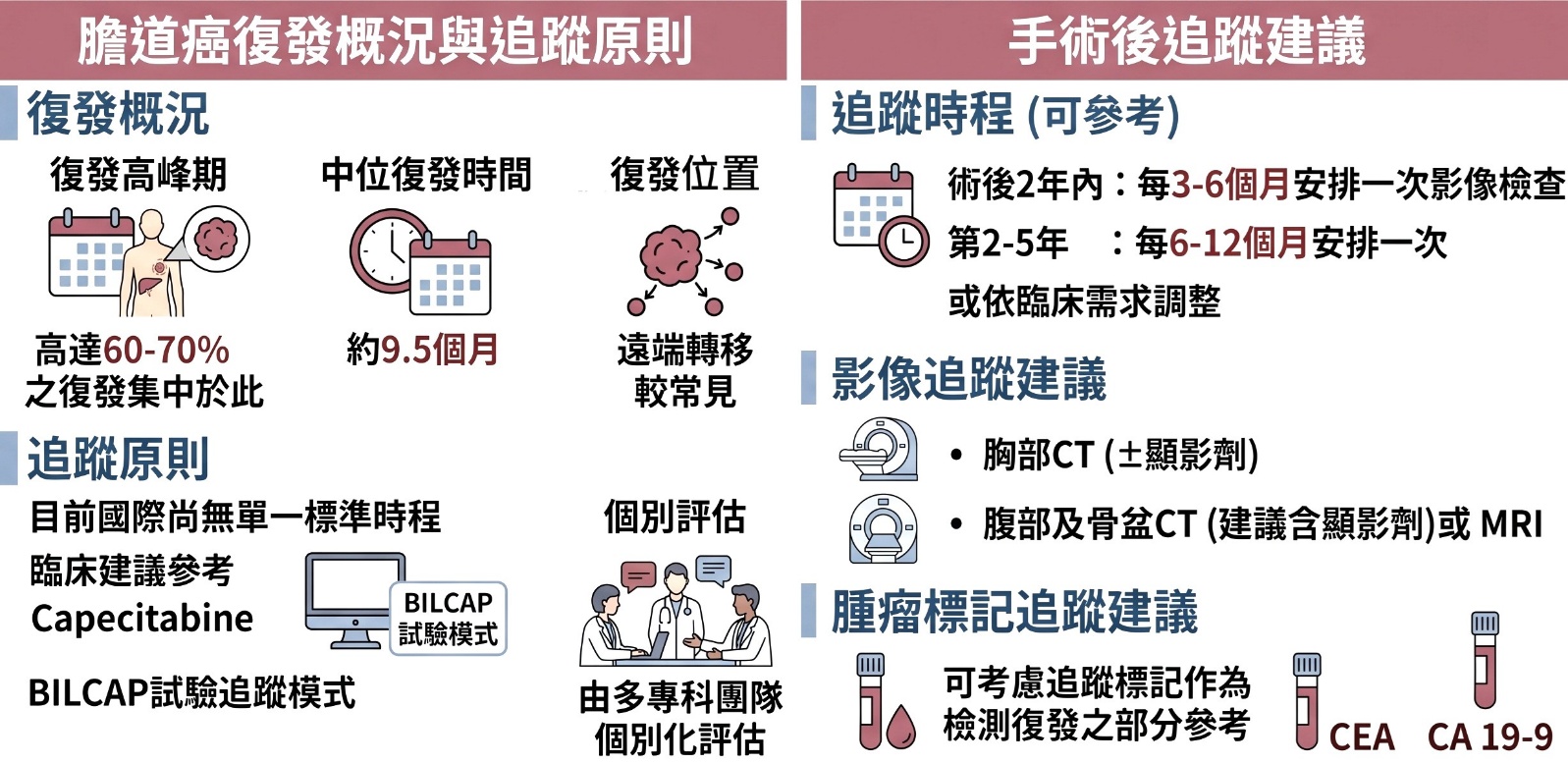
6.1.1 膽道癌復發概況與追蹤要點[8]
復發高峰期:高達60-70%之復發集中於術後2年內 (中位復發時間約9.5個月),且以遠端轉移較常見。[61]
追蹤原則:目前國際尚無單一標準時程,臨床建議參考Capecitabine的BILCAP試驗追蹤模式,並由多專科團隊個別化評估。
6.1.2 手術後追蹤建議[8]
可參考之追蹤時程:建議患者於術後2年內需每3-6個月安排一次影像檢查,第2-5年每6-12個月安排一次,或依臨床需求調整。
影像追蹤建議:胸部CT (±顯影劑) + 腹部及骨盆CT (建議含顯影劑)或MRI。
腫瘤標記追蹤建議:可考慮追蹤CEA與CA 19-9兩種標記作為檢測復發之部分參考。
6.2 膽道與壺腹癌併發症之照護
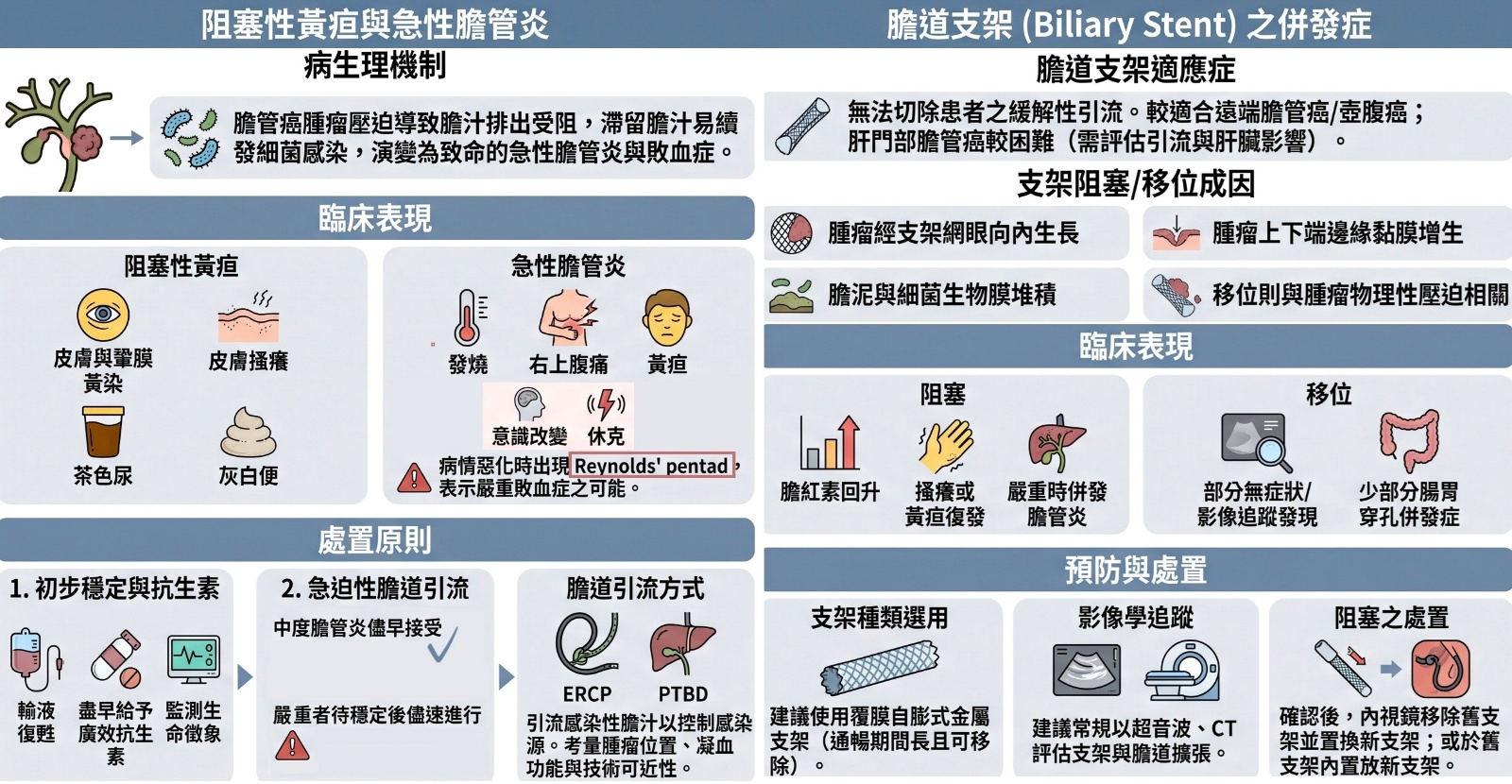
6.2.1 阻塞性黃疸與急性膽管炎[62]
病生理機制:膽管癌腫瘤直接壓迫管腔導致膽汁排出受阻,滯留之膽汁極易續發腸道細菌逆行性感染,演變為致命的急性膽管炎與敗血症。
臨床表現:
阻塞性黃疸:皮膚與鞏膜黃染、皮膚搔癢、茶色尿、灰白便 (陶土便)
急性膽管炎:典型表現為Charcot's triad (發燒、右上腹痛、黃疸)。病情惡化時可出現Reynolds' pentad (再加上意識改變與休克),表示嚴重敗血症之可能。
處置原則:
初步穩定與抗生素:輸液復甦、盡早給予廣效抗生素、監測生命徵象
急迫性膽道引流:中度膽管炎建議儘早接受內視鏡或經皮穿肝膽道引流。較嚴重之患者則待生命徵象與血液動力學穩定後,儘速進行膽道引流。
膽道引流方式:可選擇內視鏡ERCP或經皮PTBD,將滯留之感染性膽汁引流以達到感染源控制。需綜合考量腫瘤位置 (腫瘤擴散風險)、病人凝血功能與技術可近性。
6.2.2 膽道支架 (Biliary Stent) 之併發症:支架阻塞/移位[63]
膽道支架適應症:對於無法切除患者之緩解性引流方式。較適合使用於遠端膽管癌或是壺腹癌;對於肝門部膽管癌則較困難 (需評估單側或雙側引流與對肝臟影響)。
支架阻塞/移位成因:腫瘤經支架網眼向內生長、腫瘤上下端邊緣的黏膜增生反應、膽泥 (sludge) 與細菌生物膜堆積於支架管腔。移位則與腫瘤物理性壓迫較相關。
臨床表現:
支架阻塞:膽紅素回升、搔癢或黃疸復發,嚴重時會併發膽管炎。
支架移位:部分患者無症狀,並由影像追蹤時意外發現。少部分患者可能有腸胃穿孔併發症。
預防與處置:
支架種類選用:建議使用具有覆膜的自膨式金屬支架 (Covered self-expandable metal stent),因其通暢期間長,且具有可移除性。
影像學追蹤:建議常規以超音波、CT評估支架位置與膽道擴張程度。
阻塞之處置:經超音波或CT確認後,以內視鏡療法進行舊支架移除與置換新支架。部分情況下無法移除舊支架,則可能於支架內置放新支架。
6.3 膽道癌用藥副作用之管理
6.3.1 膽道癌化療藥物相關副作用
膽道癌症最常使用的化療藥物包括晚期與轉移性全身性療法首選的Gemcitabine與白金類藥物;其次為輔助療法使用的Capecitabine。其餘為二線療法可能用的5-FU、Oxaliplatin與Irinotecan。詳細之注意事項與預防照護如下表:
表6.3.1 膽道癌化療藥物常見副作用之預防與處置
| 膽道癌化療藥物 | 常見副作用 | 預防與照護 |
| Gemcitabine | 皮疹、肝功能上升、骨髓抑制 |
|
| Cisplatin | 噁心嘔吐、腎毒性、離子異常、周邊神經毒性、耳毒性 (耳鳴、高音頻聽力喪失) |
|
| Carboplatin | 血小板低下、嗜中性白血球低下、蓄積性過敏反應 |
|
Capecitabine, 5-FU |
手足症候群 (紅斑/脫屑/起水泡)、口腔黏膜炎 |
|
| Oxaliplatin | 骨髓抑制、周邊神經病變 |
|
Irinotecan, Liposomal irinotecan |
早發性/晚發性腹瀉、嗜中性球低下 |
|
6.3.2 免疫相關副作用 (Immune-Related Adverse Events, irAEs)[64]
免疫檢查點抑制劑 (ICIs) 為目前轉移性膽道癌首選療法組成之一,免疫相關副作用(irAEs) 之預防與照護相當重要。
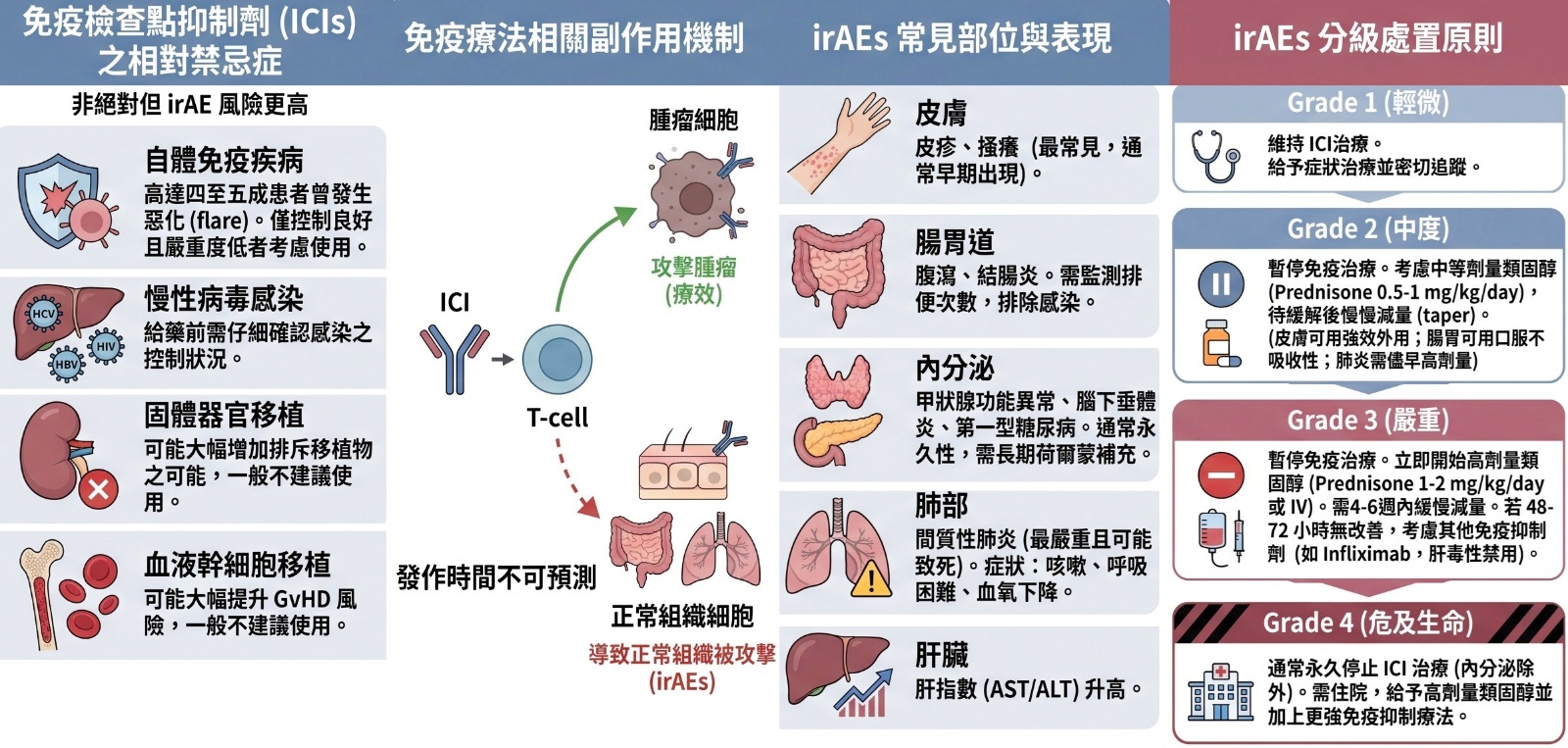
免疫檢查點抑制劑之相對禁忌症 (非絕對但irAE風險更高):
自體免疫疾病:高達四至五成具有自體免疫疾病背景的患者,在免疫檢查點抑制劑治療期間曾發生自體免疫疾病惡化 (flare) 之情形。僅控制良好且自體免疫疾病嚴重度低之患者可能考慮使用ICI。
慢性病毒感染:如曾感染HCV、HBV、HIV。給藥前需仔細確認感染之控制狀況。
固體器官移植:使用ICI可能大幅增加排斥移植物之可能,一般來說不建議使用ICI。
血液幹細胞移植:曾移植過患者,使用免疫檢查點抑制劑可能會大幅提升GvHD風險,一般來說不建議使用ICI。
免疫療法相關副作用機制:免疫檢查點抑制劑透過活化T細胞攻擊腫瘤,同時也可能導致正常組織被攻擊。irAEs可發生在任何器官,發作時間不可預測。
irAEs常見部位:
皮膚:皮疹、搔癢(最常見,通常早期出現)。
腸胃道:腹瀉、結腸炎 (Colitis) 。需監測排便次數,排除感染。
內分泌:甲狀腺功能低下/亢進 (需定期監測TSH, fT4)、腦下垂體炎、第一型糖尿病。內分泌副作用通常是永久性的,需長期荷爾蒙補充。
肺部:間質性肺炎 (Pneumonitis)。這是最嚴重且可能致死的副作用。症狀包括咳嗽、呼吸困難、血氧下降。
肝臟:肝指數 (AST/ALT) 升高。
irAEs分級處置原則:
Grade 1 (輕微):維持ICI治療,給予症狀治療並密切追蹤。
Grade 2 (中度):暫停免疫治療,直到副作用緩解至Grade 1或消失。若持續不退,考慮開始使用中等劑量全身性類固醇 (Prednisone或Methylprednisolone IV 0.5-1 mg/kg/day),待緩解後慢慢減量 (taper)。
若為皮膚毒性則可使用強效外用類固醇。
腸胃毒性則可考慮使用口服不吸收性類固醇。
若為二級之間質性肺炎,經排除其他原因應儘早給予高劑量全身性類固醇 (Prednisone或Methylprednisolone IV 1-2 mg/kg/day)。
Grade 3 (嚴重):暫停免疫治療。立即開始高劑量全身性皮質性類固醇 (Prednisone 1-2 mg/kg/day 或IV methylprednisolone)。類固醇需在4-6週內緩慢減量。若48-72小時內嚴重程度未能有效降低,需考慮其他免疫抑制劑 (如Infliximab,但肝毒性病患禁用)。
Grade 4 (危及生命):通常永久停止ICI治療 (內分泌副作用除外)。需住院並給予高劑量類固醇並加上更強的免疫抑制療法。
6.3.3 標靶藥物相關副作用
膽道癌症使用標靶之患者佔少數,須按照特定標靶藥物之副作用進行預防與處置。
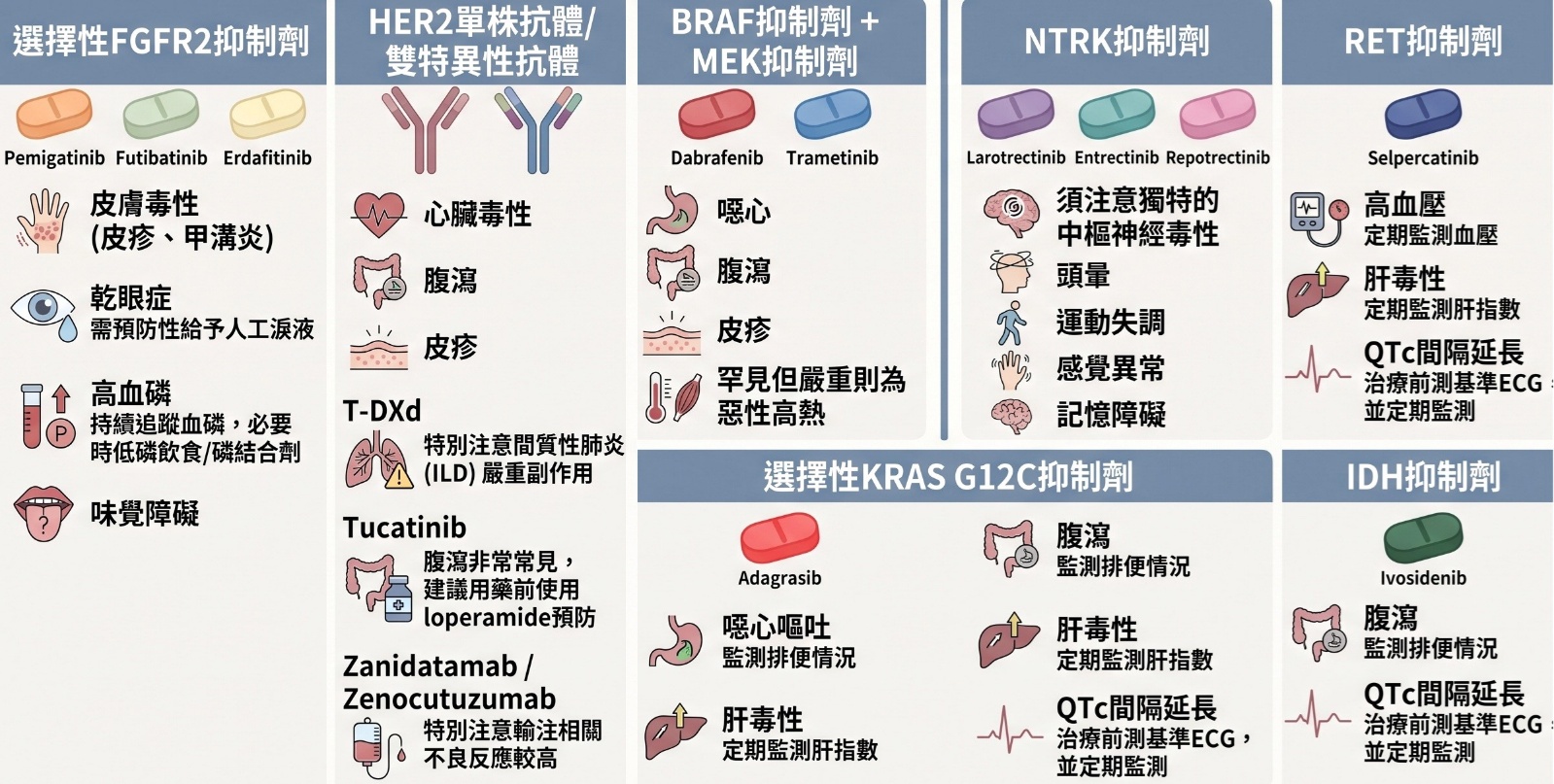
選擇性FGFR2抑制劑 (如Pemigatinib、Futibatinib、Erdafitinib):常見副作用為皮膚毒性 (皮疹、甲溝炎)、乾眼症、高血磷與味覺障礙。需預防性給予人工淚液,並持續追蹤血磷數值,必要時行低磷飲食甚至服用磷結合劑。
HER2單株抗體/雙特異性抗體:共通之副作用為心臟毒性、腹瀉與皮疹。T-DXd則需特別注意間質性肺炎 (ILD) 之嚴重副作用;Tucatinib造成之腹瀉非常常見,仿單建議開始用藥前必須使用loperamide預防;而Zanidatamab與Zenocutuzumab等BsAb則需特別注意輸注相關不良反應較高。
IDH抑制劑 (如:Ivosidenib):常見副作用為腹瀉與QTc間隔延長。治療前需測基準ECG,並定期監測ECG與排便情況。
BRAF抑制劑 + MEK抑制劑:副作用包括噁心、腹瀉與皮疹,罕見但嚴重則為惡性高熱。
NTRK抑制劑:須注意其獨特的中樞神經毒性,包括頭暈、運動失調、感覺異常與記憶障礙。
RET抑制劑:常見副作用為高血壓、肝毒性與QTc間隔延長。治療前需測基準ECG,並定期監測血壓、ECG、腸胃毒性與肝指數
選擇性KRAS G12C抑制劑 (如:Adagrasib):常見副作用為腹瀉、噁心嘔吐、肝毒性與QTc間隔延長。治療前需測基準ECG,並定期監測ECG、腸胃毒性與肝指數。
表6.3.3 膽道與壺腹癌相關標靶藥物副作用之預防處置
| 膽道癌標靶藥物 | 常見副作用 | 預防與照護 |
| Trastuzumab; Pertuzumab |
皮疹、腹瀉、心毒性 (可逆性) |
|
| T-DXd | 骨髓毒性、間質性肺炎 (ILD) |
|
| Tucatinib | 嚴重腹瀉、肝指數異常 |
|
Zanidatamab Zenocutuzumab |
輸注相關不良反應 |
|
Pemigatinib Futibatinib Erdafitinib |
皮膚乾燥、甲溝炎、乾眼症、味覺障礙、掉髮、高血磷症 |
|
Larotrectinib Entrectinib Repotrectinib |
頭暈、運動失調、感覺異常與記憶障礙、便祕 |
|
| Selpercatinib | 高血壓、肝毒性、QTc 間隔延長、出血、傷口癒合不良 |
|
Dabrafenib + Trametinib |
噁心、腹瀉、皮疹、惡性高熱 |
|
| Adagrasib | 噁心嘔吐、腹瀉、QTc 間隔延長、肝毒性 |
|
| Ivosidenib | 疲倦、關節痛、皮疹、QTc 間隔延長 |
|
ECG: electrocardiography; LVEF: left ventricular ejection fraction; ILD: interstitial lung disease. *本表格資訊整理自各藥物美國FDA仿單,詳細劑量調整與完整警語請參閱各藥物最新版仿單。
結語
膽道癌依解剖位置分為肝內、肝門、遠端膽道癌與膽囊癌四大類,慢性膽道發炎為推動膽道上皮癌化之危險因子。而壺腹癌則為另一種癌症。
初期影像評估依賴多相位CT搭配MRCP進行分期,診斷則以以ERCP直視膽道鏡切片為主要方式。
進行根治性手術以達成R0切緣為唯一治癒方式,遠端膽管/壺腹癌採Whipple術式、膽囊癌採擴大膽囊切除、肝門膽管癌則採取半肝併尾狀葉切除。
由於膽道癌術後復發率仍高,且以遠端復發為主,術後患者建議進行6個月的口服 Capecitabine輔助療法。
轉移性/不可切除之膽道癌,第一線標準療法為Durvalumab/Pembrolizumab加上雙藥化療GEMCIS,二線療法首選FOLFOX。
References:
Drake RL, Vogl AW, Mitchell AWM. Abdomen. In: Gray's Anatomy for Students. 3rd ed. Churchill Livingstone; 2015:251-418. Accessed August 5, 2026. https://www.clinicalkey.com/.
Definition of liver and bile duct cancer. NCI Dictionary of Cancer Terms. National Cancer Institute. Accessed August 5, 2026. https://www.cancer.gov/publications/dictionaries/cancer-terms/def/liver-and-bile-duct-cancer.
Valle JW, Kelley RK, Nervi B, Oh DY, Zhu AX. Biliary tract cancer. Lancet. 2021;397(10272):428-444.
Ahn DH, Bekaii-Saab T. Ampullary cancer: an overview. Am Soc Clin Oncol Educ Book. 2014;34:112-115.
Nakanuma Y, Kakuda Y, Sugino T, et al. Pathologies of Precursor Lesions of Biliary Tract Carcinoma. Cancers (Basel). 2022;14(22):5669.
Bray F, Laversanne M, Sung H, et al. Global cancer statistics 2022: GLOBOCAN estimates of incidence and mortality worldwide for 36 cancers in 185 countries. CA Cancer J Clin. 2024;74(3):229-263.
Health Promotion Administration, Ministry of Health and Welfare, Taiwan. Taiwan Cancer Registry Annual Report 2022. Ministry of Health and Welfare; 2024.
National Comprehensive Cancer Network. NCCN Clinical Practice Guidelines in Oncology (NCCN Guidelines): Biliary Tract Cancers. Version 1.2026. Published March 10, 2026. Accessed August 6, 2026. https://www.nccn.org/.
National Comprehensive Cancer Network. NCCN Guidelines for Patients: Gallbladder and Bile Duct Cancers. Published 2025. Accessed August 6, 2026. https://www.nccn.org/patients/
National Comprehensive Cancer Network. NCCN Clinical Practice Guidelines in Oncology (NCCN Guidelines): Ampullary Adenocarcinoma. Version 2.2026. Published February 10, 2026. Accessed August 6, 2026. https://www.nccn.org/
Amin MB, Edge SB, Greene FL, et al., eds. AJCC Cancer Staging Manual. 8th ed. New York: Springer; 2017.
Felder SI, Menon VG, Nissen NN, Margulies DR, Lo S, Colquhoun SD. Hepaticojejunostomy using short-limb Roux-en-Y reconstruction. JAMA Surg. 2013;148(3):253-258.
Tao R, Krishnan S, Bhosale PR, et al. Ablative Radiotherapy Doses Lead to a Substantial Prolongation of Survival in Patients With Inoperable Intrahepatic Cholangiocarcinoma: A Retrospective Dose Response Analysis. J Clin Oncol. 2016;34(3):219-226.
Primrose JN, Fox RP, Palmer DH, et al. Capecitabine compared with observation in resected biliary tract cancer (BILCAP): a randomised, controlled, multicentre, phase 3 study. Lancet Oncol. 2019;20(5):663-673.
Nakachi K, Ikeda M, Konishi M, et al. Adjuvant S-1 compared with observation in resected biliary tract cancer (JCOG1202, ASCOT): a multicentre, open-label, randomised, controlled, phase 3 trial. Lancet. 2023;401(10372):195-203.
Takada T, Amano H, Yasuda H, et al. Is postoperative adjuvant chemotherapy useful for gallbladder carcinoma? A phase III multicenter prospective randomized controlled trial in patients with resected pancreaticobiliary carcinoma. Cancer. 2002;95(8):1685-1695.
Edeline J, Benabdelghani M, Bertaut A, et al. Gemcitabine and Oxaliplatin Chemotherapy or Surveillance in Resected Biliary Tract Cancer (PRODIGE 12-ACCORD 18-UNICANCER GI): A Randomized Phase III Study. J Clin Oncol. 2019;37(8):658-667.
Jeong H, Kim KP, Jeong JH, et al. Adjuvant gemcitabine plus cisplatin versus capecitabine in node-positive extrahepatic cholangiocarcinoma: the STAMP randomized trial. Hepatology. 2023;77(5):1540-1549.
Ebata T, Hirano S, Konishi M, et al. Randomized clinical trial of adjuvant gemcitabine chemotherapy versus observation in resected bile duct cancer. Br J Surg. 2018;105(3):192-202.
Ben-Josef E, Guthrie KA, El-Khoueiry AB, et al. SWOG S0809: A Phase II Intergroup Trial of Adjuvant Capecitabine and Gemcitabine Followed by Radiotherapy and Concurrent Capecitabine in Extrahepatic Cholangiocarcinoma and Gallbladder Carcinoma. J Clin Oncol. 2015;33(24):2617-2622.
Dominguez DA, Wong P, Chen YJ, et al. Adjuvant Chemoradiation in Resected Biliary Adenocarcinoma: Evaluation of SWOG S0809 with a Large National Database. Ann Surg Oncol. 2024;31(8):4896-4904.
Tsilimigras DI, Kurzrock R, Pawlik TM. Molecular Testing and Targeted Therapies in Hepatobiliary Cancers: A Review. JAMA Surg. 2025 May 1;160(5):576-585.
Hakeem AR, Papoulas M, Menon KV. The role of neoadjuvant chemotherapy or chemoradiotherapy for advanced gallbladder cancer - A systematic review. Eur J Surg Oncol. 2019;45(2):83-91.
Chaudhari VA, Ostwal V, Patkar S, et al. Outcome of neoadjuvant chemotherapy in "locally advanced/borderline resectable" gallbladder cancer: the need to define indications. HPB (Oxford). 2018;20(9):841-847.
Thorsten Oliver Goetze et al. Neoadjuvant chemotherapy with gemcitabine plus cisplatin followed by radical liver resection versus immediate radical liver resection alone followed adjuvant therapy in biliary tract cancer: Final results from the phase III AIO/CALGP/ACO-GAIN-Trial.. J Clin Oncol 43, 4008-4008(2025).
Engineer R, Patkar S, Lewis SC, et al. A phase III randomised clinical trial of perioperative therapy (neoadjuvant chemotherapy versus chemoradiotherapy) in locally advanced gallbladder cancers (POLCAGB): study protocol. BMJ Open. 2019;9(6):e028147. Published 2019 Jun 27.
Park SY, Kim JH, Yoon HJ, Lee IS, Yoon HK, Kim KP. Transarterial chemoembolization versus supportive therapy in the palliative treatment of unresectable intrahepatic cholangiocarcinoma. Clin Radiol. 2011;66(4):322-328.
Edeline J, Touchefeu Y, Guiu B, et al. Radioembolization Plus Chemotherapy for First-line Treatment of Locally Advanced Intrahepatic Cholangiocarcinoma: A Phase 2 Clinical Trial. JAMA Oncol. 2020;6(1):51-59.
Schartz DA, Porter M, Schartz E, et al. Transarterial Yttrium-90 Radioembolization for Unresectable Intrahepatic Cholangiocarcinoma: A Systematic Review and Meta-Analysis. J Vasc Interv Radiol. 2022;33(6):679-686.
Cercek A, Boerner T, Tan BR, et al. Assessment of Hepatic Arterial Infusion of Floxuridine in Combination With Systemic Gemcitabine and Oxaliplatin in Patients With Unresectable Intrahepatic Cholangiocarcinoma: A Phase 2 Clinical Trial. JAMA Oncol. 2020;6(1):60-67.
Franssen S, Rousian M, Filipe WF, et al. Hepatic Arterial Infusion Pump Chemotherapy in Patients With Unresectable Intrahepatic Cholangiocarcinoma-PUMP-2 Trial. J Clin Oncol. 2026;44(6):455-465.
Boehm LM, Jayakrishnan TT, Miura JT, et al. Comparative effectiveness of hepatic artery based therapies for unresectable intrahepatic cholangiocarcinoma. J Surg Oncol. 2015;111(2):213-220.
Valle J, Wasan H, Palmer DH, et al. Cisplatin plus gemcitabine versus gemcitabine for biliary tract cancer. N Engl J Med. 2010;362(14):1273-1281.
Ioka T, Kanai M, Kobayashi S, et al. Randomized phase III study of gemcitabine, cisplatin plus S-1 versus gemcitabine, cisplatin for advanced biliary tract cancer (KHBO1401- MITSUBA). J Hepatobiliary Pancreat Sci. 2023;30(1):102-110.
Lamarca A, Palmer DH, Wasan HS, et al. Second-line FOLFOX chemotherapy versus active symptom control for advanced biliary tract cancer (ABC-06): a phase 3, open-label, randomised, controlled trial. Lancet Oncol. 2021;22(5):690-701.
Oh DY, Ruth He A, Qin S, et al. Durvalumab plus Gemcitabine and Cisplatin in Advanced Biliary Tract Cancer. NEJM Evid. 2022;1(8):EVIDoa2200015.
Kelley RK, Ueno M, Yoo C, et al. Pembrolizumab in combination with gemcitabine and cisplatin compared with gemcitabine and cisplatin alone for patients with advanced biliary tract cancer (KEYNOTE-966): a randomised, double-blind, placebo-controlled, phase 3 trial. Lancet. 2023;401(10391):1853-1865.
Williams KJ, Picus J, Trinkhaus K, et al. Gemcitabine with carboplatin for advanced biliary tract cancers: a phase II single institution study. HPB (Oxford). 2010;12(6):418-426.
Sharma A, Dwary AD, Mohanti BK, et al. Best supportive care compared with chemotherapy for unresectable gall bladder cancer: a randomized controlled study. J Clin Oncol. 2010;28(30):4581-4586.
Kim ST, Kang JH, Lee J, et al. Capecitabine plus oxaliplatin versus gemcitabine plus oxaliplatin as first-line therapy for advanced biliary tract cancers: a multicenter, open-label, randomized, phase III, noninferiority trial. Ann Oncol. 2019;30(5):788-795.
Sahai V, Catalano PJ, Zalupski MM, et al. Nab-Paclitaxel and Gemcitabine as First-line Treatment of Advanced or Metastatic Cholangiocarcinoma: A Phase 2 Clinical Trial. JAMA Oncol. 2018;4(12):1707-1712.
Borbath I, Bridgewater J, Morizane C, et al. Efficacy and tolerability of zenocutuzumab in advanced NRG1 fusion-positive cholangiocarcinoma: results from the eNRGy phase II trial. J Clin Oncol. 2024;42(24):2876-2884
Choi IS, Kim KH, Lee JH, et al. A randomised phase II study of oxaliplatin/5-FU (mFOLFOX) versus irinotecan/5-FU (mFOLFIRI) chemotherapy in locally advanced or metastatic biliary tract cancer refractory to first-line gemcitabine/cisplatin chemotherapy. Eur J Cancer. 2021;154:288-295.
Yoo C, Saborowski A, Hyung J, et al. Liposomal irinotecan for previously treated patients with biliary tract cancer: A pooled analysis of NIFTY and NALIRICC trials. J Hepatol. 2025;83(4):909-916.
Chen L. Next-generation isoform-selective fibroblast growth factor receptor inhibitors. Trends Pharmacol Sci. 2025;46(11):1091-1104.
Pant S, Schuler M, Iyer G, et al. Erdafitinib in patients with advanced solid tumours with FGFR alterations (RAGNAR): an international, single-arm, phase 2 study. Lancet Oncol. 2023;24(8):925-935.
Abou-Alfa GK, Sahai V, Hollebecque A, et al. Pemigatinib for previously treated, locally advanced or metastatic cholangiocarcinoma: a multicentre, open-label, phase 2 study. Lancet Oncol. 2020;21(5):671-684.
Goyal L, Meric-Bernstam F, Hollebecque A, et al. Futibatinib for FGFR2-Rearranged Intrahepatic Cholangiocarcinoma. N Engl J Med. 2023;388(3):228-239.
Meric-Bernstam F, Makker V, Oaknin A, et al. Efficacy and Safety of Trastuzumab Deruxtecan in Patients With HER2-Expressing Solid Tumors: Primary Results From the DESTINY-PanTumor02 Phase II Trial. J Clin Oncol. 2024;42(1):47-58.
Cannon TL, Rothe M, Mangat PK, et al. Pertuzumab Plus Trastuzumab in Patients With Biliary Tract Cancer With ERBB2/3 Alterations: Results From the Targeted Agent and Profiling Utilization Registry Study. J Clin Oncol. 2024;42(27):3228-3237.
Nakamura Y, Mizuno N, Sunakawa Y, et al. Tucatinib and Trastuzumab for Previously Treated Human Epidermal Growth Factor Receptor 2-Positive Metastatic Biliary Tract Cancer (SGNTUC-019): A Phase II Basket Study. J Clin Oncol. 2023;41(36):5569-5578.
Harding JJ, Fan J, Oh DY, et al. Zanidatamab for HER2-amplified, unresectable, locally advanced or metastatic biliary tract cancer (HERIZON-BTC-01): a multicentre, single-arm, phase 2b study. Lancet Oncol. 2023;24(7):772-782.
Abou-Alfa GK, Macarulla T, Javle MM, et al. Ivosidenib in IDH1-mutant, chemotherapy-refractory cholangiocarcinoma (ClarIDHy): a multicentre, randomised, double-blind, placebo-controlled, phase 3 study. Lancet Oncol. 2020;21(6):796-807.
Marabelle A, Le DT, Ascierto PA, et al. Efficacy of Pembrolizumab in Patients With Noncolorectal High Microsatellite Instability/Mismatch Repair-Deficient Cancer: Results From the Phase II KEYNOTE-158 Study. J Clin Oncol. 2020;38(1):1-10.
André T, Berton D, Curigliano G, et al. Antitumor Activity and Safety of Dostarlimab Monotherapy in Patients With Mismatch Repair Deficient Solid Tumors: A Nonrandomized Controlled Trial. JAMA Netw Open. 2023;6(11):e2341165. Published 2023 Nov 1.
Schenker M, Burotto M, Richardet M, et al. Randomized, open-label, phase 2 study of nivolumab plus ipilimumab or nivolumab monotherapy in patients with advanced or metastatic solid tumors of high tumor mutational burden. J Immunother Cancer. 2024;12(8):e008872. Published 2024 Aug 6.
Drilon A, Laetsch TW, Kummar S, et al. Efficacy of Larotrectinib in TRK Fusion-Positive Cancers in Adults and Children. N Engl J Med. 2018;378(8):731-739.
Subbiah V, Wolf J, Konda B, et al. Tumour-agnostic efficacy and safety of selpercatinib in patients with RET fusion-positive solid tumours other than lung or thyroid tumours (LIBRETTO-001): a phase 1/2, open-label, basket trial. Lancet Oncol. 2022;23(10):1261- 1273.
Salama AKS, Li S, Macrae ER, et al. Dabrafenib and Trametinib in Patients With Tumors With BRAFV600E Mutations: Results of the NCIMATCH Trial Subprotocol H. J Clin Oncol. 2020;38(33):3895-3904.
Bekaii-Saab TS, Yaeger R, Spira AI, et al. Adagrasib in Advanced Solid Tumors Harboring a KRASG12C Mutation. J Clin Oncol. 2023;41(25):4097-4106.
Margonis GA, Gani F, Buettner S, et al. Rates and patterns of recurrence after curative intent resection for gallbladder cancer: a multi-institution analysis from the US Extra-hepatic Biliary Malignancy Consortium. HPB (Oxford). 2016;18(11):872-878.
Rerknimitr R, Angsuwatcharakon P, Ratanachu-ek T, et al. Asia-Pacific consensus recommendations for endoscopic and interventional management of hilar cholangiocarcinoma. J Gastroenterol Hepatol. 2013;28(4):593-607.
Moy BT, Birk JW. An Update to Hepatobiliary Stents. J Clin Transl Hepatol. 2015;3(1):67-77.
Schneider BJ, Naidoo J, Santomasso BD, et al. Management of Immune-Related Adverse Events in Patients Treated With Immune Checkpoint Inhibitor Therapy: ASCO Guideline Update. J Clin Oncol. 2021;39(36):4073-4126.
Nassour I, Hynan LS, Christie A, et al. Association of Adjuvant Therapy with Improved Survival in Ampullary Cancer: A National Cohort Study. J Gastrointest Surg. 2018;22(4):695-702.
Narang AK, Miller RC, Hsu CC, et al. Evaluation of adjuvant chemoradiation therapy for ampullary adenocarcinoma: the Johns Hopkins Hospital-Mayo Clinic collaborative study. Radiat Oncol. 2011;6:126. Published 2011 Sep 28.
Neoptolemos JP, Moore MJ, Cox TF, et al. Effect of adjuvant chemotherapy with fluorouracil plus folinic acid or gemcitabine vs observation on survival in patients with resected periampullary adenocarcinoma: the ESPAC-3 periampullary cancer randomized trial. JAMA. 2012;308(2):147-156.
Conroy T, Hammel P, Hebbar M, et al. FOLFIRINOX or Gemcitabine as Adjuvant Therapy for Pancreatic Cancer. N Engl J Med. 2018;379(25):2395-2406.
Neoptolemos JP, Palmer DH, Ghaneh P, et al. Comparison of adjuvant gemcitabine and capecitabine with gemcitabine monotherapy in patients with resected pancreatic cancer (ESPAC-4): a multicentre, open-label, randomised, phase 3 trial. Lancet. 2017;389(10073):1011-1024.
整本手冊的 PDF 與重點簡報摘要在手冊首頁。