
第七章、子宮肉瘤之特性與治療
發布日期:2026-05-04
本章目錄
7.1 子宮肉瘤之特性與流行病學
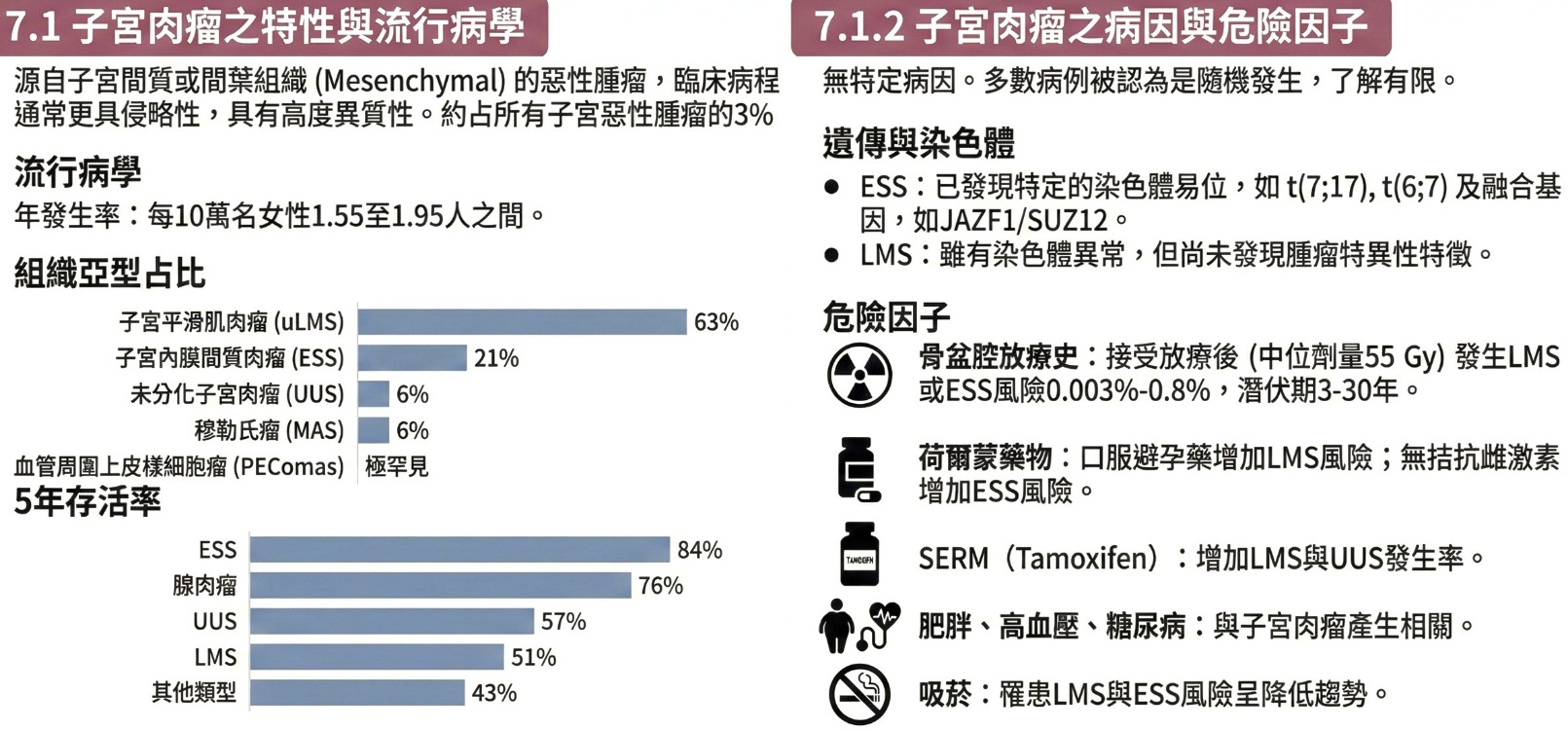
子宮肉瘤 (Uterine Sarcomas) 是一類源自子宮間質或間葉組織 (Mesenchymal) 的惡性腫瘤,雖然其發生率僅佔所有子宮惡性腫瘤的約3%,但其臨床病程通常更具侵略性。這類腫瘤具有高度的異質性,每種亞型都有其特定的生物學行為與治療反應。[9]
7.1.1 子宮肉瘤之流行病學與分類
子宮肉瘤占比:約占所有子宮體惡性腫瘤的3%至5%。[46]
組織亞型:一篇系統性回顧數據顯示子宮肉瘤之子型態占比如下:
子宮平滑肌肉瘤 (Uterine Leiomyosarcoma, uLMS) 最常見,佔子宮肉瘤63%。
其次是子宮內膜間質肉瘤 (Endometrial Stromal Sarcoma, ESS),約佔21%。
未分化子宮肉瘤 (Undifferentiated Uterine Sarcoma, UUS),約6%。
穆勒氏瘤 (Müllerian Adenosarcoma, MAS),約6%。
血管周圍上皮樣細胞瘤 (PEComas) ,極罕見。
年發生率:每10萬名女性1.55至1.95人之間。
5年存活率:ESS的預後相對較好,而其他類型則較差。ESS:84%;腺肉瘤:76%;UUS:57%;LMS:51%;其他類型:43%。
7.1.2 子宮肉瘤之病因與危險因子
病因:無特定病因。目前對其病因了解有限,多數病例被認為是隨機發生。[46]
遺傳與染色體:
ESS:已發現特定的染色體易位,如 t(7;17), t(6;7) 及融合基因,如JAZF1/SUZ12。
LMS:雖有染色體異常,但尚未發現腫瘤特異性特徵。
風險因子:
骨盆腔放療史:接受放療後 (中位劑量55 Gy) 發生LMS或ESS的風險估計為0.003%至0.8%,潛伏期為3至30年。
荷爾蒙藥物影響:口服避孕藥會增加LMS風險;無拮抗雌激素則會增加ESS風險。
SERM:使用Tamoxifen的患者中觀察到LMS與UUS的發生率增加。
肥胖、高血壓、糖尿病亦與子宮肉瘤產生相關。
吸菸:罹患LMS與ESS的風險則呈現降低趨勢。
7.2 子宮肉瘤病理評估與分類
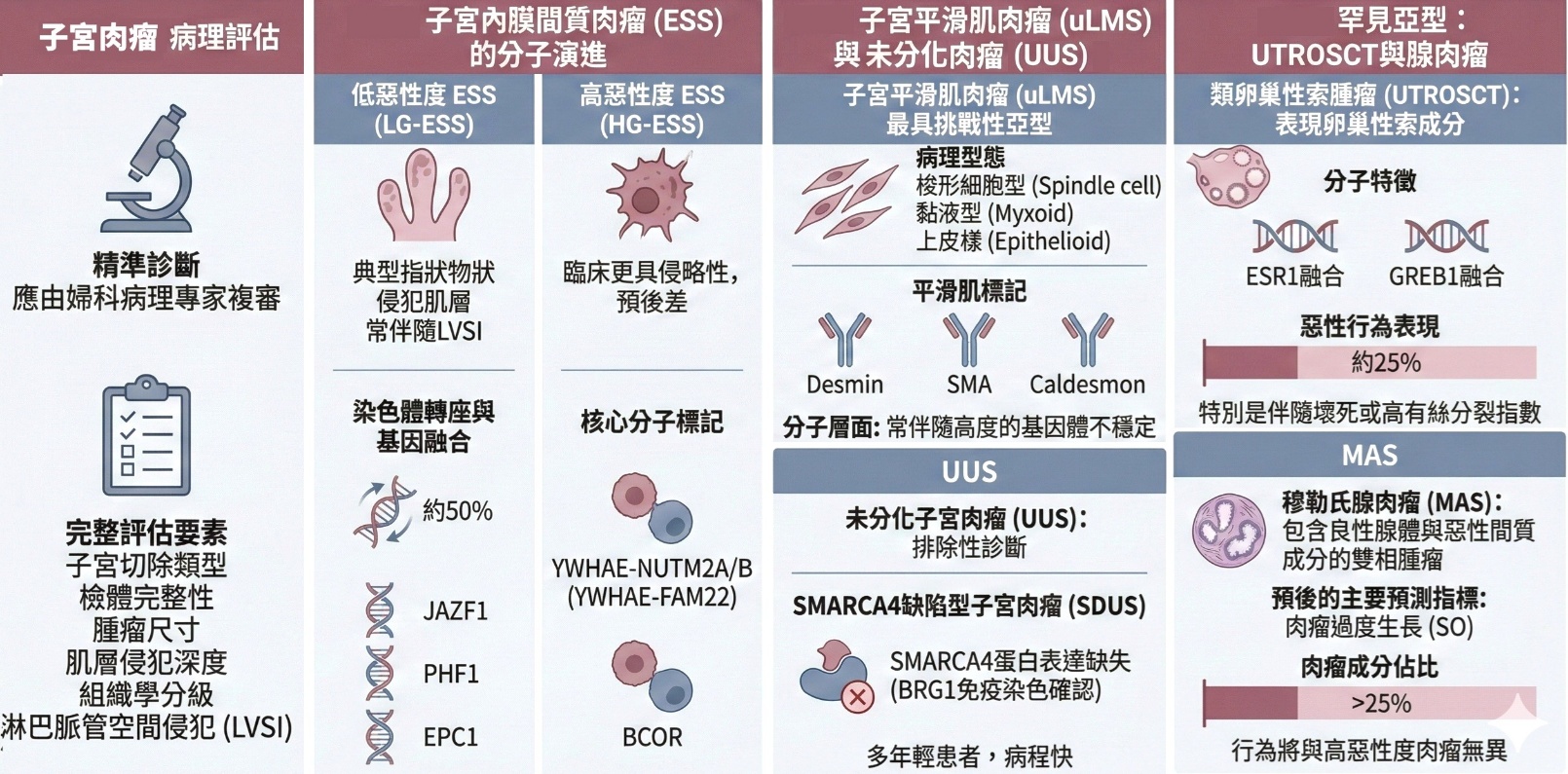
精準的病理診斷是決定子宮肉瘤治療成敗的首要環節。所有疑似子宮肉瘤的病例都應由具備豐富經驗的婦科病理專家進行複審。
完整的病理評估:包含子宮切除的類型、檢體完整性 (是否曾受碎瘤術影響)、腫瘤尺寸、肌層侵犯深度、組織學分級以及淋巴脈管空間侵犯 (LVSI) 的情況。
7.2.1 子宮內膜間質肉瘤 (ESS) 的分子演進
子宮內膜間質肉瘤由類似於增生期子宮內膜間質的細胞構成。根據其臨床行為與基因特徵,可分為低惡性度與高惡性度兩大類。
低惡性度 ESS (LG-ESS):其有典型的指狀物狀肌層侵入,且經常伴隨LVSI。這類腫瘤約有一半帶有特徵性的染色體轉座與基因融合,最常見的是JAZF1、PHF1或EPC1。
高惡性度 ESS (HG-ESS):其臨床表現更具侵略性,且預後顯著較差。其核心分子標記為YWHAE-NUTM2A/B (以前稱為YWHAE-FAM22) 基因融合。近期發現的一類帶有 BCOR基因改變的腫瘤也被歸類為HG-ESS。
7.2.2 子宮平滑肌肉瘤 (uLMS) 的免疫與基因譜系
uLMS 是最具挑戰性的亞型之一。
病理型態:典型的uLMS為梭形細胞型,但也有黏液型 (Myxoid) 或上皮樣 (Epithelioid) 變體。病理診斷主要依賴平滑肌標記,包括Desmin、SMA以及Caldesmon。
分子層面:常伴隨高度的基因體不穩定。
7.2.3 未分化子宮肉瘤 (UUS) 與SMARCA4缺陷
未分化子宮肉瘤為一種排除性診斷,即病理特徵不符合任何已知的特定間質腫瘤,且缺乏特定分化方向時所下的診斷。
SMARCA4缺陷型子宮肉瘤 (SDUS):其特徵是SMARCA4蛋白表達缺失 (透過BRG1免疫染色確認)。這類腫瘤多發生於年輕患者,且病程進展極快。
7.2.4 罕見亞型:UTROSCT與腺肉瘤
類卵巢性索腫瘤 (UTROSCT):非常罕見,特徵是表現出卵巢性索成分的細胞分化
分子特徵:常帶有ESR1或GREB1融合,約25%的病例會表現出惡性行為,特別是當伴隨壞死或高有絲分裂指數時。
穆勒氏腺肉瘤 (MAS):這是一種包含良性腺體與惡性間質成分的雙相腫瘤。
預後指標:是否存在肉瘤過度生長 (Sarcomatous Overgrowth, SO),定義為肉瘤成分佔據整個腫瘤體積的25%以上。若出現SO,其行為將與高惡性度肉瘤無異。
7.3 子宮肉瘤手術治療策略
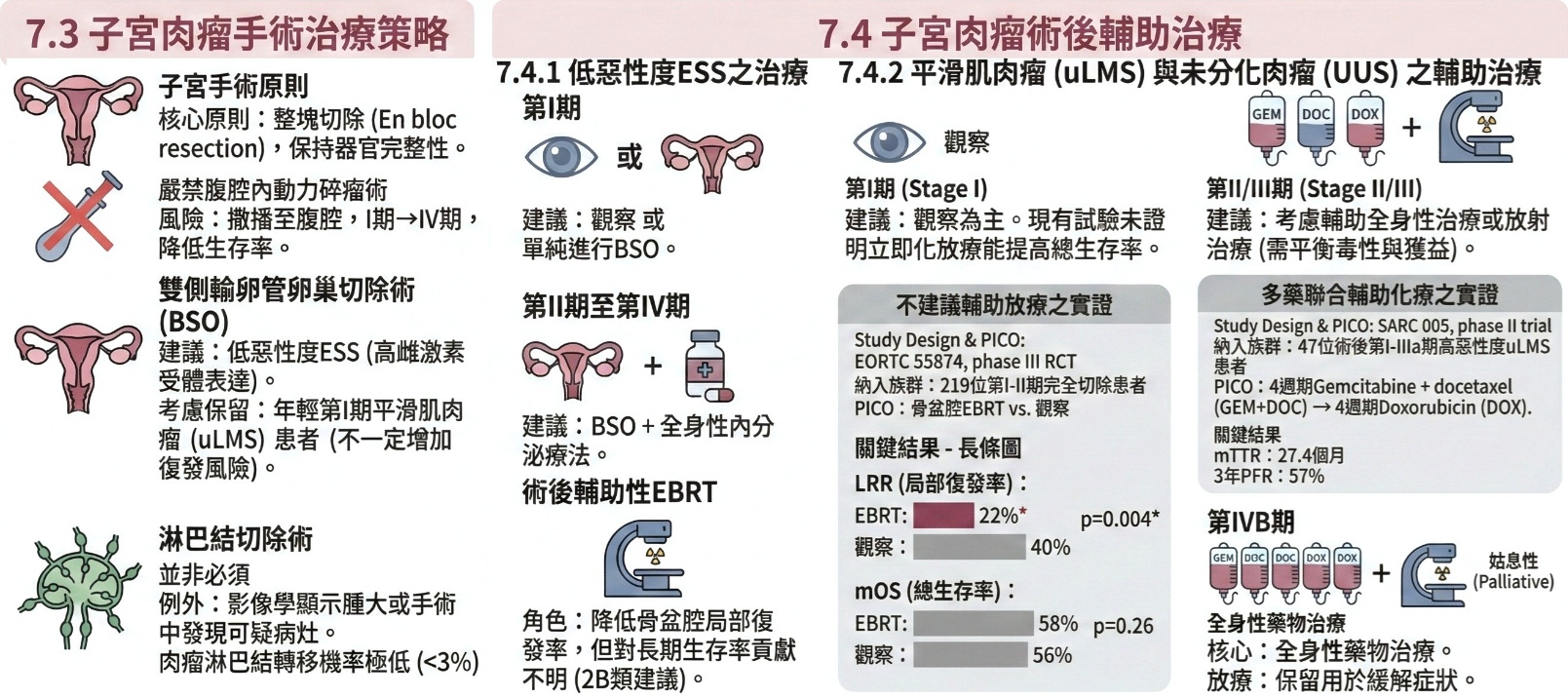
子宮手術原則:手術是子宮肉瘤唯一的根治性手段,核心原則是整塊切除,這要求醫師在切除子宮時應保持器官完整性,嚴禁在腹腔內進行動力碎瘤術。大量證據顯示,碎瘤術會導致原本局限於子宮的肉瘤碎片撒播至腹腔各處,將患者從第I期推向第IV期,顯著降低總生存率。
雙側輸卵管卵巢切除術 (BSO):低惡性度ESS具有高度的雌激素受體表達,因此建議進行BSO以減少刺激。然而對於希望保留內分泌功能的年輕第I期平滑肌肉瘤患者,保留卵巢可能是一個可考慮的選項,因為這不一定會增加復發風險。
淋巴結切除術並非必須,除非影像學顯示有明顯腫大的淋巴結或手術中發現可疑病灶,因為肉瘤發生淋巴結轉移的機率極低 (通常小於3%)。
7.4 子宮肉瘤術後輔助治療 (Adjuvant therapy)
術後輔助治療的選擇取決於肉瘤的組織學亞型與分期。
7.4.1 低惡性度ESS之治療
第I期低惡性度ESS:術後建議觀察或單純進行BSO。
第II期至第IV期:BSO外,建議加入全身性內分泌療法。
術後輔助性EBRT的角色:可以降低骨盆腔局部復發率,但由於其對長期生存率的貢獻尚不透明,因此在指引中被歸類為2B類建議。
7.4.2 平滑肌肉瘤 (uLMS) 與未分化肉瘤 (UUS) 之輔助治療
這是目前臨床上最具爭議的部分。
第I期:即使是高惡性度的uLMS,若已完全切除,建議仍以觀察為主。現有的大型臨床試驗未能證明術後立即給予化療或放療能提高總生存率。
不建議輔助放療之實證:第三期EORTC 55874試驗顯示,第I-II期完全切除後的子宮肉瘤患者,接受輔助性EBRT顯著降低局部復發率 (22% vs 40%, p=0.004),但對mOS無顯著改善。放射線主要用於優化區域控制,對於高復發風險患者仍有其輔助價值,但不應被視為增加存活率的手段。[47]
第II/III期:對於這類具有高度遠端轉移風險的患者,專家組建議考慮進行輔助全身性治療或放射治療。然而須在平衡藥物毒性與預期獲益後決定。
多藥聯合輔助化療:第二期SARC 005試驗證實,輔助性4週期的Gemcitabine + docetaxel隨後再4週期Doxorubicin (GT→A)於早期高危患者中的潛力。[48]
第IVB期:對於已有遠端轉移的患者,治療的核心是全身性藥物治療,放射治療則保留用於緩解疼痛或壓迫症狀 (姑息性用途)。
表7.4 子宮肉瘤之術後輔助治療關鍵試驗結果
| 試驗/對照組 | 試驗名稱 | 納入族群 | 關鍵結果 |
| 骨盆腔EBRT vs. 觀察 | EORTC 55874, phase III RCT [47] | 219位第I-II期完全切除後的子宮肉瘤患者 | LRR: 22% vs. 40% (p=0.004)* DFS: 50% vs. 45% (p=0.35) OS: 58.% vs. 56% (p=0.26) |
| Gemcitabine + docetaxel隨後Doxorubicin | SARC 005, phase II trial [48] | 47位術後局限於子宮第I-IIIa期的高惡性度uLMS患者 | mTTR: 27.4個月 3年PFR: 57% |
DFS: disease-free survival; mTTR: median time to recurrence; LRR: local recurrence rate; OS: overall survival. PFR: progression-free rate.
7.5 復發性與轉移性子宮肉瘤的全身性治療
子宮平滑肌肉瘤的復發率極高,約50%至70%的患者最終會面臨復發。治療計畫應根據復發位置與前線使用之療法進行個體化調整。
7.5.1 局部復發
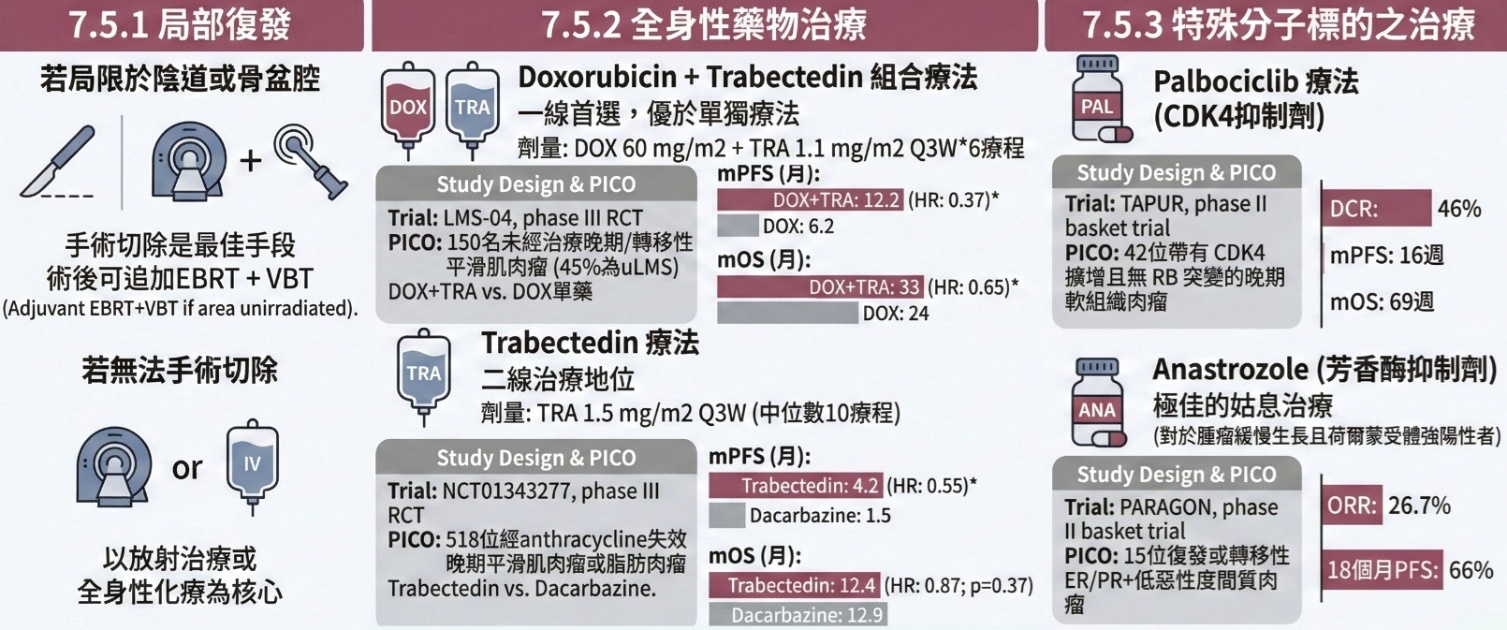
若復發局限於陰道或骨盆腔,且影像學排除遠端轉移,手術切除是最佳手段。對於未曾接受過放射治療的區域,術後可追加EBRT + VBT。
對於無法手術切除的病灶,則以放射治療或全身性化療為核心。
7.5.2 全身性藥物治療
對於子宮肉瘤而言,最有效的藥物包含Anthracycline以及Trabectedin。一線療法即為兩者的組合,其效果顯著優於單獨療法。
Doxorubicin + Trabectedin組合療法:第三期LMS-04試驗證實,D+T於晚期/轉移性平滑肌肉瘤之效果,顯著優於小紅莓單獨療法;雖然骨髓抑制等毒性較高。此試驗在平滑肌肉瘤的一線治療上取得了里程碑式的進步。[49]
療程:Doxorubicin 60 mg/m2 IV + Trabectedin 1.1 mg/m2 IV Q3W*6療程。
Trabectedin療法:第二期NCT01343277試驗證實,晚期患者於一線anthracycline療法失效後,二線使用Trabectedin效果顯著優於dacarbazine。故奠定其於二線治療之地位。[50]
療程:Trabectedin 1.5 mg/m2 IV Q3W (中位數10療程)
7.5.3 特殊分子標的之治療
Palbociclib療法:第二期TAPUR籃子試驗納入CDK4過度表現的軟組織癌患者。結果顯示使用palbociclib能達到46%疾病控制率。顯示CDK4抑制劑在特定基因特徵的肉瘤中具有二線治療潛力。[51]
Anastrozole:對於腫瘤緩慢生長且荷爾蒙受體強陽性的患者,芳香酶抑制劑雖然緩解率不高,但為極佳的姑息治療。[52]
表7.5 晚期子宮肉瘤之治療關鍵試驗結果
| 試驗/對照組 | 試驗名稱 | 納入族群 | 關鍵結果 |
| Doxorubicin + Trabectedin vs. Doxorubicin單藥 | LMS-04, phase III RCT [49] | 150名未經治療的晚期/轉移性平滑肌肉瘤 (45%為子宮平滑肌肉瘤) | mPFS: 12.2 vs. 6.2個月 (HR: 0.37)* mOS: 33 vs. 24個月 (HR: 0.65)* |
| Trabectedin / Dacarbazine | NCT01343277, phase III RCT [50] | 518位經anthracycline失效的晚期平滑肌肉瘤或脂肪肉瘤 | mPFS: 4.2 vs. 1.5個月 (HR: 0.55, p<0.001) mOS: 12.4 vs. 12.9個月 (HR: 0.87; p=0.37) |
| Palbociclib | TAPUR, phase II basket trial [51] | 42位帶有 CDK4 擴增且無 RB 突變的晚期軟組織肉瘤 | DCR: 46% mPFS:16週; mOS: 69週 |
| Anastrozole | PARAGON, phase II basket trial [52] | 15位復發或轉移性ER/PR+低惡性度間質肉瘤 | ORR: 26.7% 18個月PFS: 66% |
DCR: disease-control rate; HR: hazard ratio; mDOR: median duration of response; mOS: median overall survival; mTTR: median time to recurrence; ORR: objective response rate; PFS: progression-free survival. RCT: randomized controlled trial.
7.6 子宮肉瘤治療後監測
子宮肉瘤患者在術後2至3年內復發風險最高,因此必須執行嚴密的監測計畫。[9]
7.6.1 臨床追蹤計畫
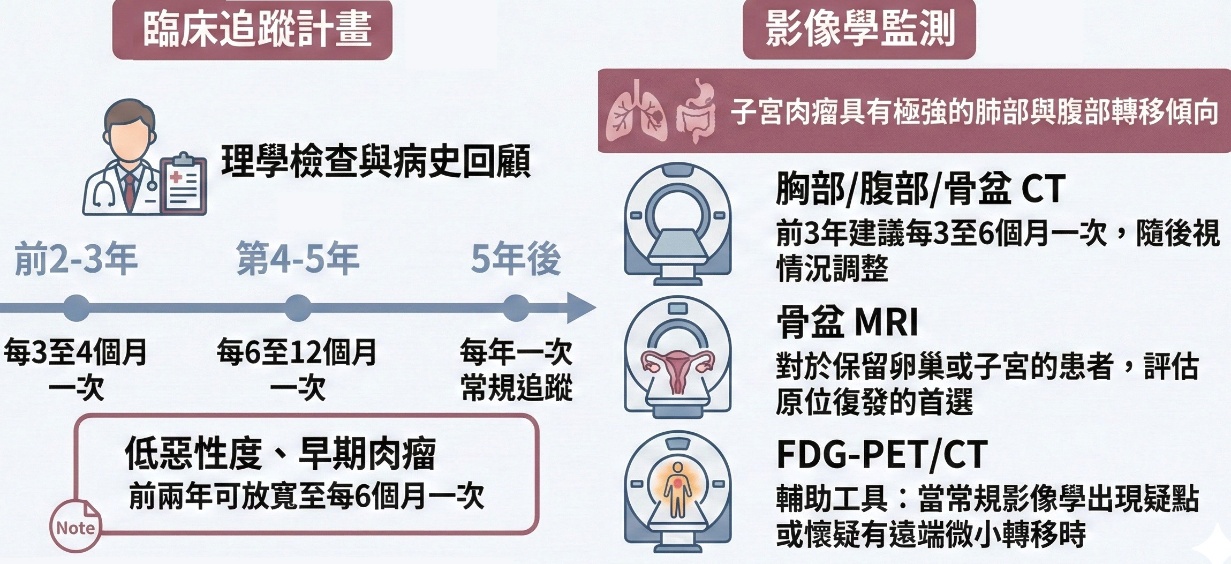
前2-3年:每3至4個月進行一次理學檢查與病史回顧。
第4-5年:每6至12個月一次。
5年後:每年一次常規追蹤。
對於低惡性度、早期肉瘤,前兩年的追蹤可放寬至每6個月一次。
7.6.2 影像學監測
與上皮性癌症不同,子宮肉瘤具有極強的肺部與腹部轉移傾向。
胸部/腹部/骨盆 CT:前3年建議每3至6個月進行一次,隨後視情況調整頻率。
MRI:對於保留卵巢或子宮的患者,骨盆MRI是評估原位復發的首選。
FDG-PET/CT:當常規影像學出現疑點,或懷疑有遠端微小轉移時,可作為輔助工具。
總結
這份手冊系統性地整合了子宮內膜癌的診療全景。首章釐清子宮解剖構造與子宮癌症流行病學,強調其與子宮頸癌在病因學上的本質差異,並指引臨床症狀的初步辨識。
第二章至第四章聚焦於早期治療的革命。核心在於 FIGO 2023 最新分期標準,正式將 POLE、MSI、p53 等分子分型納入決策指標。手冊詳述了微創手術與保留生育功能的評估門檻,並依據風險分層(如LVSI侵犯程度)精準規劃術後放射與化療的必要性。
第五章針對晚期與復發性疾病,詳列了免疫檢查點抑制劑結合標靶藥物的一線與後線路徑,為過往預後不佳的患者提供實證支持。
最後兩章則鎖定癌肉瘤與子宮肉瘤等高風險亞型,區分其與上皮癌的不同生物特性,並整理最新的臨床藥物數據(如 T-DXd、Trabectedin),確保罕見且侵襲性強的案例能獲得最適化的治療方案。
References:
Ameer MA, Peterson DC. Anatomy, Abdomen and Pelvis: Uterus. [Updated 2025 Jun 3]. In: StatPearls [Internet]. Treasure Island (FL): StatPearls Publishing; 2025 Jan-. Available from: https://www.ncbi.nlm.nih.gov/books/NBK470297/
National Comprehensive Cancer Network. NCCN Guidelines for Patients: Uterine Cancer. National Comprehensive Cancer Network; 2025. Accessed February 6, 2026. https://www.nccn.org/patients/guidelines/content/PDF/uterine-patient-guideline.pdf
Mahdy H, Vadakekut ES, Crotzer D. Endometrial Cancer. [Updated 2024 Apr 20]. In: StatPearls [Internet]. Treasure Island (FL): StatPearls Publishing; 2025 Jan-. Available from: https://www.ncbi.nlm.nih.gov/books/NBK525981/
Yamanaka T, Nishikawa T, Yoshida H. Development of Antibody-Drug Conjugates for Malignancies of the Uterine Corpus: A Review. Cells. 2025;14(5):333. Published 2025 Feb 24.
Makker V, MacKay H, Ray-Coquard I, et al. Endometrial cancer. Nat Rev Dis Primers. 2021;7(1):88. Published 2021 Dec 9.
International Agency for Research on Cancer. Global Cancer Observatory: Cancer Today. World Health Organization; 2024. Accessed February 6, 2026. https://gco.iarc.who.int/today.
Health Promotion Administration, Ministry of Health and Welfare. 2021 Cancer Registry Report. Ministry of Health and Welfare; 2024. Accessed February 6, 2026. https://www.hpa.gov.tw/Pages/List.aspx?nodeid=119.
Smith RA, Brooks D, Cokkinides V, Saslow D, Brawley OW. Cancer screening in the United States, 2013: a review of current American Cancer Society guidelines, current issues in cancer screening, and new guidance on cervical cancer screening and lung cancer screening. CA Cancer J Clin. 2013;63(2):88-105.
National Comprehensive Cancer Network. NCCN Clinical Practice Guidelines in Oncology (NCCN Guidelines): Uterine Neoplasms. Version 2.2026. National Comprehensive Cancer Network; 2026. Accessed February 6, 2026. https://www.nccn.org/professionals/physician_gls/pdf/uterine.pdf.
McAlpine J, Leon-Castillo A, Bosse T. The rise of a novel classification system for endometrial carcinoma; integration of molecular subclasses. J Pathol. 2018;244(5):538-549.
Berek JS, Matias-Guiu X, Creutzberg C, et al. FIGO staging of endometrial cancer: 2023. Int J Gynaecol Obstet. 2023;162(2):383-394. doi:10.1002/ijgo.14923.
Kim JJ, Kurita T, Bulun SE. Progesterone action in endometrial cancer, endometriosis, uterine fibroids, and breast cancer. Endocr Rev. 2013;34(1):130-162.
Gunderson CC, Fader AN, Carson KA, Bristow RE. Oncologic and reproductive outcomes with progestin therapy in women with endometrial hyperplasia and grade 1 adenocarcinoma: a systematic review. Gynecol Oncol. 2012;125(2):477-482.
Walker JL, Piedmonte MR, Spirtos NM, et al. Recurrence and survival after random assignment to laparoscopy versus laparotomy for comprehensive surgical staging of uterine cancer: Gynecologic Oncology Group LAP2 Study. J Clin Oncol. 2012;30(7):695-700.
Janda M, Gebski V, Davies LC, et al. Effect of Total Laparoscopic Hysterectomy vs Total Abdominal Hysterectomy on Disease-Free Survival Among Women With Stage I Endometrial Cancer: A Randomized Clinical Trial. JAMA. 2017;317(12):1224-1233.
ASTEC study group, Kitchener H, Swart AM, Qian Q, Amos C, Parmar MK. Efficacy of systematic pelvic lymphadenectomy in endometrial cancer (MRC ASTEC trial): a randomised study. Lancet. 2009;373(9658):125-136.
Todo Y, Kato H, Kaneuchi M, Watari H, Takeda M, Sakuragi N. Survival effect of para-aortic lymphadenectomy in endometrial cancer (SEPAL study): a retrospective cohort analysis. Lancet. 2010;375(9721):1165-1172.
Rossi EC, Kowalski LD, Scalici J, et al. A comparison of sentinel lymph node biopsy to lymphadenectomy for endometrial cancer staging (FIRES trial): a multicentre, prospective, cohort study. Lancet Oncol. 2017;18(3):384-392.
Cusimano MC, Vicus D, Pulman K, et al. Assessment of Sentinel Lymph Node Biopsy vs Lymphadenectomy for Intermediate- and High-Grade Endometrial Cancer Staging. JAMA Surg. 2021;156(2):157-164.
Plante M, Stanleigh J, Renaud MC, Sebastianelli A, Grondin K, Grégoire J. Isolated tumor cells identified by sentinel lymph node mapping in endometrial cancer: Does adjuvant treatment matter?. Gynecol Oncol. 2017;146(2):240-246.
van den Heerik ASVM, Horeweg N, Creutzberg CL, Nout RA. Vaginal brachytherapy management of stage I and II endometrial cancer. Int J Gynecol Cancer. 2022;32(3):304-310.
Creutzberg CL, Nout RA, Lybeert ML, et al. Fifteen-year radiotherapy outcomes of the randomized PORTEC-1 trial for endometrial carcinoma. Int J Radiat Oncol Biol Phys. 2011;81(4):e631-e638.
Keys HM, Roberts JA, Brunetto VL, et al. A phase III trial of surgery with or without adjunctive external pelvic radiation therapy in intermediate risk endometrial adenocarcinoma: a Gynecologic Oncology Group study. Gynecol Oncol. 2004;92(3):744-751.
Nout RA, Smit VT, Putter H, et al. Vaginal brachytherapy versus pelvic external beam radiotherapy for patients with endometrial cancer of high-intermediate risk (PORTEC-2): an open-label, non-inferiority, randomised trial. Lancet. 2010;375(9717):816-823.
Randall ME, Filiaci V, McMeekin DS, et al. Phase III Trial: Adjuvant Pelvic Radiation Therapy Versus Vaginal Brachytherapy Plus Paclitaxel/Carboplatin in High-Intermediate and High-Risk Early Stage Endometrial Cancer. J Clin Oncol. 2019;37(21):1810-1818.
de Boer SM, Powell ME, Mileshkin L, et al. Adjuvant chemoradiotherapy versus radiotherapy alone for women with high-risk endometrial cancer (PORTEC-3): final results of an international, open-label, multicentre, randomised, phase 3 trial. Lancet Oncol. 2018;19(3):295-309.
Barakat RR, Bundy BN, Spirtos NM, Bell J, Mannel RS; Gynecologic Oncology Group Study. Randomized double-blind trial of estrogen replacement therapy versus placebo in stage I or II endometrial cancer: a Gynecologic Oncology Group Study. J Clin Oncol. 2006;24(4):587-592.
Fiorica JV, Brunetto VL, Hanjani P, et al. Phase II trial of alternating courses of megestrol acetate and tamoxifen in advanced endometrial carcinoma: a Gynecologic Oncology Group study. Gynecol Oncol. 2004;92(1):10-14.
Slomovitz BM, Jiang Y, Yates MS, et al. Phase II study of everolimus and letrozole in patients with recurrent endometrial carcinoma. J Clin Oncol. 2015;33(8):930-936.
Mirza MR, Bjørge L, Marmé F, et al. Palbociclib plus letrozole in estrogen receptor-positive advanced/recurrent endometrial cancer: Double-blind placebo-controlled randomized phase II ENGOT-EN3/PALEO trial. Gynecol Oncol. 2025;192:128-136.
Matei D, Filiaci V, Randall ME, et al. Adjuvant Chemotherapy plus Radiation for Locally Advanced Endometrial Cancer. N Engl J Med. 2019;380(24):2317-2326.
Eskander RN, Sill MW, Beffa L, et al. Pembrolizumab plus Chemotherapy in Advanced Endometrial Cancer. N Engl J Med. 2023;388(23):2159-2170.
Mirza MR, Chase DM, Slomovitz BM, et al. Dostarlimab for Primary Advanced or Recurrent Endometrial Cancer. N Engl J Med. 2023;388(23):2145-2158.
Westin SN, Moore K, Chon HS, et al. Durvalumab Plus Carboplatin/Paclitaxel Followed by Maintenance Durvalumab With or Without Olaparib as First-Line Treatment for Advanced Endometrial Cancer: The Phase III DUO-E Trial. J Clin Oncol. 2024;42(3):283-299.
Lorusso D, Ferrandina G, Colombo N, et al. Carboplatin-paclitaxel compared to Carboplatin-Paclitaxel-Bevacizumab in advanced or recurrent endometrial cancer: MITO END-2 - A randomized phase II trial. Gynecol Oncol. 2019;155(3):406-412.
Makker V, Colombo N, Casado Herráez A, et al. Lenvatinib plus Pembrolizumab for Advanced Endometrial Cancer. N Engl J Med. 2022;386(5):437-448.
Marth C, Moore RG, Bidziński M, et al. First-Line Lenvatinib Plus Pembrolizumab Versus Chemotherapy for Advanced Endometrial Cancer: A Randomized, Open-Label, Phase III Trial. J Clin Oncol. 2025;43(9):1083-1100.
O'Malley DM, Bariani GM, Cassier PA, et al. Pembrolizumab in Patients With Microsatellite Instability-High Advanced Endometrial Cancer: Results From the KEYNOTE-158 Study. J Clin Oncol. 2022;40(7):752-761.
André T, Berton D, Curigliano G, et al. Antitumor Activity and Safety of Dostarlimab Monotherapy in Patients With Mismatch Repair Deficient Solid Tumors: A Nonrandomized Controlled Trial. JAMA Netw Open. 2023;6(11):e2341165. Published 2023 Nov 1.
Berton D, Pautier P, Lorusso D, et al. Antitumor activity and safety of the PD-1 inhibitor retifanlimab in patients with recurrent microsatellite instability-high or deficient mismatch repair endometrial cancer: Final safety and efficacy results from cohort H of the POD1UM-101 phase I study. Gynecol Oncol. 2024;186:191-198.
Fader AN, Roque DM, Siegel E, et al. Randomized Phase II Trial of Carboplatin-Paclitaxel Compared with Carboplatin-Paclitaxel-Trastuzumab in Advanced (Stage III-IV) or Recurrent Uterine Serous Carcinomas that Overexpress Her2/Neu (NCT01367002): Updated Overall Survival Analysis. Clin Cancer Res. 2020;26(15):3928-3935.
Solomon, B.J. et al. 1372P Repotrectinib in patients (pts) with NTRK fusion-positive (NTRK+) advanced solid tumors, including NSCLC: Update from the phase I/II TRIDENT-1 trial Annals of Oncology, Volume 34, S787-S788. October 2023.
Subbiah V, Wolf J, Konda B, et al. Tumour-agnostic efficacy and safety of selpercatinib in patients with RET fusion-positive solid tumours other than lung or thyroid tumours (LIBRETTO-001): a phase 1/2, open-label, basket trial. Lancet Oncol. 2022;23(10):1261-1273.
Homesley HD, Filiaci V, Markman M, et al. Phase III trial of ifosfamide with or without paclitaxel in advanced uterine carcinosarcoma: a Gynecologic Oncology Group Study. J Clin Oncol. 2007;25(5):526-531.
Nishikawa T, Hasegawa K, Matsumoto K, et al. Trastuzumab Deruxtecan for Human Epidermal Growth Factor Receptor 2-Expressing Advanced or Recurrent Uterine Carcinosarcoma (NCCH1615): The STATICE Trial. J Clin Oncol. 2023;41(15):2789-2799.
Tropé CG, Abeler VM, Kristensen GB. Diagnosis and treatment of sarcoma of the uterus. A review. Acta Oncol. 2012;51(6):694-705.
Reed NS, Mangioni C, Malmström H, et al. Phase III randomised study to evaluate the role of adjuvant pelvic radiotherapy in the treatment of uterine sarcomas stages I and II: an European Organisation for Research and Treatment of Cancer Gynaecological Cancer Group Study (protocol 55874). Eur J Cancer. 2008;44(6):808-818.
Hensley ML, Wathen JK, Maki RG, et al. Adjuvant therapy for high-grade, uterus-limited leiomyosarcoma: results of a phase 2 trial (SARC 005). Cancer. 2013;119(8):1555-1561.
Pautier P, Italiano A, Piperno-Neumann S, et al. Doxorubicin–trabectedin with trabectedin maintenance in leiomyosarcoma. N Engl J Med. 2024;391(9):789-799.
Demetri GD, von Mehren M, Jones RL, et al. Efficacy and Safety of Trabectedin or Dacarbazine for Metastatic Liposarcoma or Leiomyosarcoma After Failure of Conventional Chemotherapy: Results of a Phase III Randomized Multicenter Clinical Trial. J Clin Oncol. 2016;34(8):786-793.
Schuetze S, Rothe M, Mangat PK, et al. Palbociclib in Patients With Soft Tissue Sarcoma With CDK4 Amplifications: Results From the Targeted Agent and Profiling Utilization Registry Study. JCO Precis Oncol. 2024;8:e2400219.
Friedlander M, Benson C, O'Connell RL, et al. Phase 2 study of anastrozole in patients with estrogen receptor/progesterone receptor positive recurrent low-grade endometrial stromal sarcomas: The PARAGON trial (ANZGOG 0903). Gynecol Oncol. 2021;161(1):160-165.
整本手冊的 PDF 與重點簡報摘要在手冊首頁。