
第八章、混合型肝細胞-膽管癌之治療
發布日期:2026-01-08 更新日期:2026-06-29
8.1 混合型肝細胞-膽管癌之流行病學與診斷
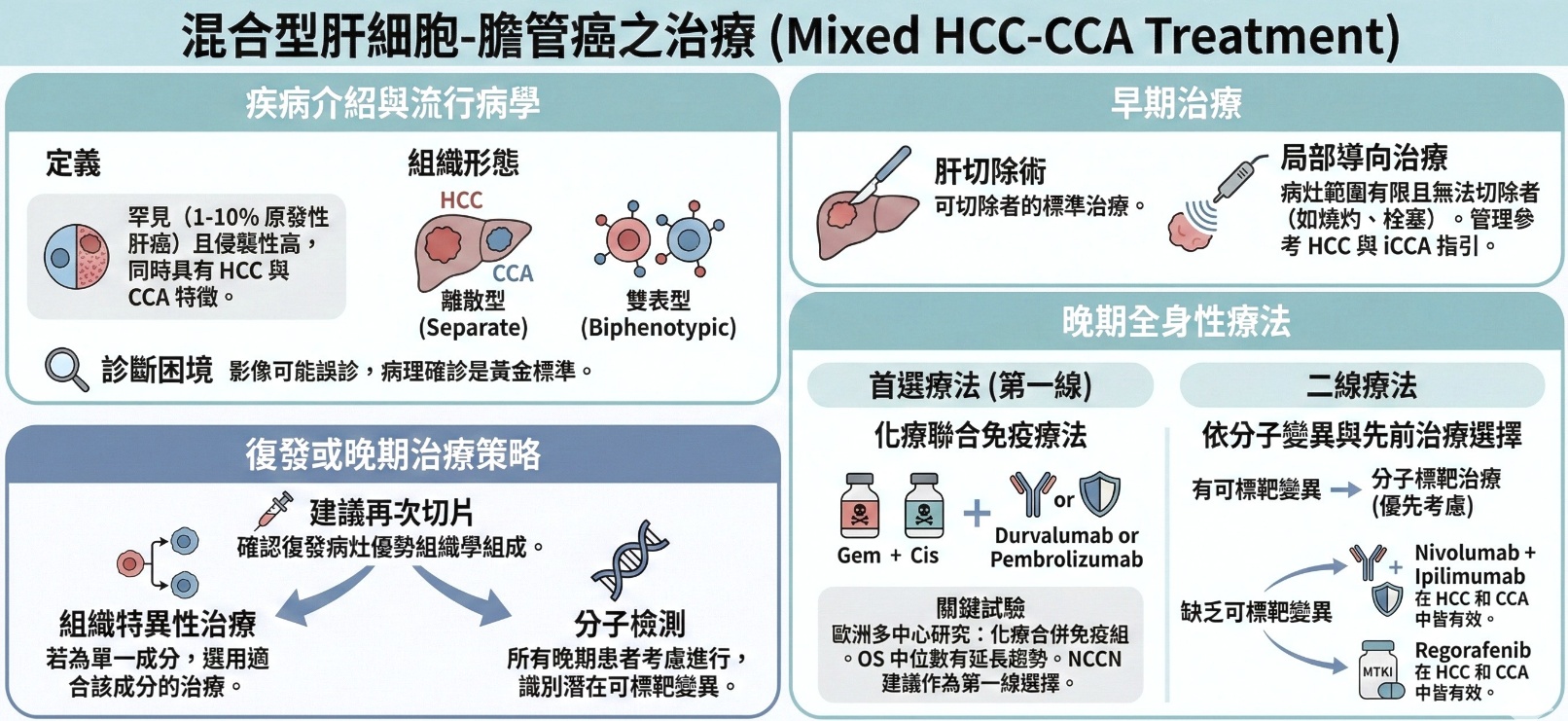
混合型 HCC-CCA 是一種罕見 (佔原發性肝癌 1-10%) 且侵襲性高的腫瘤,同時具有肝細胞癌與膽管癌的特徵。(1)
組織形態:
離散型:部分病例在腫瘤的不同區域分別含有獨立的 HCC 和 CCA 組織病灶。
雙表型:同一細胞同時表現獨立與HCC和CCA相關的免疫組化標記。
基因學:混合型HCC-CCA的次世代定序顯示,基因變異的流行率與HCC較為接近 (例如常見TP53和TERT啟動子突變),這在伴隨HCV感染的患者中尤為明顯,但受限於樣本數較少,相關結果仍需謹慎解讀。
診斷困境:影像學可能同時呈現HCC的「快進快出」與CCA的「延遲強化」,導致誤診。病理確診是黃金標準。
8.2 混合型肝細胞-膽管癌之早期治療
肝切除術。可切除混合型HCC-CCA的標準治療。(1)
局部導向治療:雖然缺乏前瞻性數據,但對於病灶範圍有限且無法手術切除的肝病,肝臟導向局部治療 (如燒灼術或栓塞術) 可能是合適的選擇,其管理流程可參考HCC與肝內膽管癌 (iCCA) 的指引。
8.3 混合型肝細胞-膽管癌之復發或晚期治療
復發與轉移:建議再次切片。若患者在手術或局部治療後出現轉移或局部進展,建議考慮進行再次切片,以確認復發病灶中的優勢組織學組成。(1)
組織特異性治療:若切片顯示為單一的HCC或CCA成分,指引建議選用適合該組織成分的全身性治療方案 。分子檢測:所有晚期混合型 HCC-CCA 患者均應考慮進行腫瘤分子分析 ,以識別可能與 CCA 相關的潛在可標靶基因變異。
8.3.1 晚期首選療法:免疫合併化學療法
試驗設計。Gemcitabine + Cisplatin聯合Durvalumab或Pembrolizumab。
歐洲多中心回顧性研究納入101名混合型HCC-CCA患者,並比較化療合併免疫療法 (如 Gemcitabine/Cisplatin加上Durvalumab或Pembrolizumab) 相對於非化療 (如 Sorafenib) 的治療效果。(68)關鍵結果:化療組的OS中位數有延長趨勢 (15.5 個月 vs 5.3 個月; p=0.052),但未達統計上顯著差異,可能是樣本數不足導致之結果。
建議:基於此數據及Gemcitabine/Cisplatin在膽管癌的療效,NCCN指引建議 Gemcitabine + Cisplatin聯合免疫檢查點抑制劑 (如 Durvalumab或 Pembrolizumab) 作為第一線全身性治療選擇。
8.3.2 晚期二線療法
分子標靶治療。若腫瘤帶有可標靶變異,應優先考慮。
缺乏可標靶變異之後線治療:Nivolumab + Ipilimumab 或 Regorafenib為在HCC和CCA中皆證實有效的方案。
總結 (Summary)
篩檢的必要性:上海大型對照試驗確立了超音波合併AFP篩檢能降低37%死亡率的黃金標準,強調了對高危族群進行監測的倫理義務。
客觀肝功能評估:ALBI 分級的引入修正了 Child Pugh class 系統的主觀誤差,為臨床醫師提供了更精準的工具來預測患者對治療的耐受性。
早期疾病:首選手術切除與移植仍是首選根治手段,但需結合FLR計算與門靜脈高壓評估進行嚴格篩選。對於小腫瘤,消融療法亦可視為根治性治療。
肝臟移植需遵循Milan或UNOS標準,降期治療成功後的移植預後與初始符合標準者相當,是重要的挽救策略。
中期疾病:動脈導向治療 (TACE/TARE) 為主,SBRT提供了另一種局部控制手段。
晚期疾病:免疫聯合療法 (Atezolizumab + Bevacizumab, Tremelimumab + Durvalumab) 已徹底改變了以往Sorafenib的一線治療標準,顯著延長了存活期。後線治療則有 TKI (Cabozantinib, Regorafenib) 與其他免疫藥物等選擇。
作者:傅彥崴 藥師 2026.01.01
References:
National Comprehensive Cancer Network. Hepatocellular Carcinoma (NCCN Clinical Practice Guidelines in Oncology). Version 2.2025. Published October 22, 2025. Accessed December 27, 2025. https://www.nccn.org/professionals/physician_gls/pdf/hcc.pdf.
El Dika I, Mayer RJ, Venook AP, et al. A Multicenter Randomized Three-Arm Phase II Study of (1) Everolimus, (2) Estrogen Deprivation Therapy (EDT) with Leuprolide + Letrozole, and (3) Everolimus + EDT in Patients with Unresectable Fibrolamellar Carcinoma. Oncologist. 2020;25(11):925-e1603.
Kim E, Viatour P. Hepatocellular carcinoma: old friends and new tricks. Exp Mol Med. 2020;52(12):1898-1907.
Ministry of Health and Welfare, Taiwan. 2023 Statistics of Causes of Death. Ministry of Health and Welfare website. Published June 2024. Accessed December 27, 2025. https://www.mohw.gov.tw/cp-16-79126-1.html.
Thiele M, Gluud LL, Fialla AD, Dahl EK, Krag A. Large variations in risk of hepatocellular carcinoma and mortality in treatment naïve hepatitis B patients: systematic review with meta-analyses. PLoS One. 2014;9(9):e107177. Published 2014 Sep 16.
Kim WR, Loomba R, Berg T, et al. Impact of long-term tenofovir disoproxil fumarate on incidence of hepatocellular carcinoma in patients with chronic hepatitis B. Cancer. 2015;121(20):3631-3638.
Zhang BH, Yang BH, Tang ZY. Randomized controlled trial of screening for hepatocellular carcinoma. J Cancer Res Clin Oncol. 2004;130(7):417-422.
Tzartzeva K, Obi J, Rich NE, et al. Surveillance Imaging and Alpha Fetoprotein for Early Detection of Hepatocellular Carcinoma in Patients With Cirrhosis: A Meta-analysis. Gastroenterology. 2018;154(6):1706-1718.e1.
Forner A, Vilana R, Ayuso C, et al. Diagnosis of hepatic nodules 20 mm or smaller in cirrhosis: Prospective validation of the noninvasive diagnostic criteria for hepatocellular carcinoma. Hepatology. 2008;47(1):97-104.
Johnson PJ, Pinato DJ, Kalyuzhnyy A, Toyoda H. Breaking the Child-Pugh Dogma in Hepatocellular Carcinoma. J Clin Oncol. 2022;40(19):2078-2082.
Amin MB, Greene FL, Edge SB, et al. The Eighth Edition AJCC Cancer Staging Manual: Continuing to build a bridge from a population-based to a more "personalized" approach to cancer staging. CA Cancer J Clin. 2017;67(2):93-99.
Reig M, Forner A, Rimola J, et al. BCLC strategy for prognosis prediction and treatment recommendation: The 2022 update. J Hepatol. 2022;76(3):681-693.
Berzigotti A, Reig M, Abraldes JG, Bosch J, Bruix J. Portal hypertension and the outcome of surgery for hepatocellular carcinoma in compensated cirrhosis: a systematic review and meta-analysis. Hepatology. 2015;61(2):526-536.
Santambrogio R, Kluger MD, Costa M, et al. Hepatic resection for hepatocellular carcinoma in patients with Child-Pugh's A cirrhosis: is clinical evidence of portal hypertension a contraindication?. HPB (Oxford). 2013;15(1):78-84.
Kishi Y, Abdalla EK, Chun YS, et al. Three hundred and one consecutive extended right hepatectomies: evaluation of outcome based on systematic liver volumetry. Ann Surg. 2009;250(4):540-548.
Boubaddi M, Marichez A, Adam JP, et al. Comprehensive Review of Future Liver Remnant (FLR) Assessment and Hypertrophy Techniques Before Major Hepatectomy: How to Assess and Manage the FLR. Ann Surg Oncol. 2024;31(13):9205-9220.
Marron TU, Fiel MI, Hamon P, et al. Neoadjuvant cemiplimab for resectable hepatocellular carcinoma: a single-arm, open-label, phase 2 trial. Lancet Gastroenterol Hepatol. 2022;7(3):219-229.
Kaseb AO, Hasanov E, Cao HST, et al. Perioperative nivolumab monotherapy versus nivolumab plus ipilimumab in resectable hepatocellular carcinoma: a randomised, open-label, phase 2 trial. Lancet Gastroenterol Hepatol. 2022;7(3):208-218.
Bruix J, Takayama T, Mazzaferro V, et al. Adjuvant sorafenib for hepatocellular carcinoma after resection or ablation (STORM): a phase 3, randomised, double-blind, placebo-controlled trial. Lancet Oncol. 2015;16(13):1344-1354.
LBA39 Updated efficacy and safety data from IMbrave050: Phase III study of adjuvant atezolizumab (atezo) + bevacizumab (bev) vs active surveillance in patients (pts) with resected or ablated high-risk hepatocellular carcinoma (HCC) Yopp, A. et al. Annals of Oncology, Volume 35, S1230.
Li SH, Mei J, Cheng Y, et al. Postoperative Adjuvant Hepatic Arterial Infusion Chemotherapy With FOLFOX in Hepatocellular Carcinoma With Microvascular Invasion: A Multicenter, Phase III, Randomized Study. J Clin Oncol. 2023;41(10):1898-1908.
Xia BW, Zhang YC, Wang J, Ding FH, He XD. Efficacy of antiviral therapy with nucleotide/nucleoside analogs after curative treatment for patients with hepatitis B virus-related hepatocellular carcinoma: A systematic review and meta-analysis. Clin Res Hepatol Gastroenterol. 2015;39(4):458-468.
Manthravadi S, Paleti S, Pandya P. Impact of sustained viral response postcurative therapy of hepatitis C-related hepatocellular carcinoma: a systematic review and meta-analysis. Int J Cancer. 2017;140(5):1042-1049.
Furtado R, Crawford M, Sandroussi C. Systematic review and meta-analysis of adjuvant i(131) lipiodol after excision of hepatocellular carcinoma. Ann Surg Oncol. 2014;21(8):2700-2707.
Lee JH, Lee JH, Lim YS, et al. Adjuvant immunotherapy with autologous cytokine-induced killer cells for hepatocellular carcinoma. Gastroenterology. 2015;148(7):1383-91.e6.
Mazzaferro V, Regalia E, Doci R, et al. Liver transplantation for the treatment of small hepatocellular carcinomas in patients with cirrhosis. N Engl J Med. 1996;334(11):693-699.
OPTN/UNOS policy notice modification to hepatocellular carcinoma (HCC) extension criteria. Available at: https://optn.transplant.hrsa.gov/media/2411/modification-to-hcc-autoapproval- criteria_policy-notice.pdf.
Xing M, Sakaria S, Dhanasekaran R, et al. Bridging Locoregional Therapy Prolongs Survival in Patients Listed for Liver Transplant with Hepatocellular Carcinoma. Cardiovasc Intervent Radiol. 2017;40(3):410-420.
Brunello F, Veltri A, Carucci P, et al. Radiofrequency ablation versus ethanol injection for early hepatocellular carcinoma: A randomized controlled trial. Scand J Gastroenterol. 2008;43(6):727-735.
Lin SM, Lin CJ, Lin CC, Hsu CW, Chen YC. Randomised controlled trial comparing percutaneous radiofrequency thermal ablation, percutaneous ethanol injection, and percutaneous acetic acid injection to treat hepatocellular carcinoma of 3 cm or less. Gut. 2005;54(8):1151-1156.
Orlando A, Leandro G, Olivo M, Andriulli A, Cottone M. Radiofrequency thermal ablation vs. percutaneous ethanol injection for small hepatocellular carcinoma in cirrhosis: meta-analysis of randomized controlled trials. Am J Gastroenterol. 2009;104(2):514-524.
Huang J, Yan L, Cheng Z, et al. A randomized trial comparing radiofrequency ablation and surgical resection for HCC conforming to the Milan criteria. Ann Surg. 2010;252(6):903-912.
Feng K, Yan J, Li X, et al. A randomized controlled trial of radiofrequency ablation and surgical resection in the treatment of small hepatocellular carcinoma. J Hepatol. 2012;57(4):794-802.
Llovet JM, Real MI, Montaña X, et al. Arterial embolisation or chemoembolisation versus symptomatic treatment in patients with unresectable hepatocellular carcinoma: a randomised controlled trial. Lancet. 2002;359(9319):1734-1739.
Brown KT, Do RK, Gonen M, et al. Randomized Trial of Hepatic Artery Embolization for Hepatocellular Carcinoma Using Doxorubicin-Eluting Microspheres Compared With Embolization With Microspheres Alone. J Clin Oncol. 2016;34(17):2046-2053.
Lammer J, Malagari K, Vogl T, et al. Prospective randomized study of doxorubicin-eluting-bead embolization in the treatment of hepatocellular carcinoma: results of the PRECISION V study. Cardiovasc Intervent Radiol. 2010;33(1):41-52.
Lobo L, Yakoub D, Picado O, et al. Unresectable Hepatocellular Carcinoma: Radioembolization Versus Chemoembolization: A Systematic Review and Meta-analysis. Cardiovasc Intervent Radiol. 2016;39(11):1580-1588.
Ludwig JM, Zhang D, Xing M, Kim HS. Meta-analysis: adjusted indirect comparison of drug-eluting bead transarterial chemoembolization versus 90Y-radioembolization for hepatocellular carcinoma. Eur Radiol. 2017;27(5):2031-2041.
Vilgrain V, Pereira H, Assenat E, et al. Efficacy and safety of selective internal radiotherapy with yttrium-90 resin microspheres compared with sorafenib in locally advanced and inoperable hepatocellular carcinoma (SARAH): an open-label randomised controlled phase 3 trial. Lancet Oncol. 2017;18(12):1624-1636.
Chow PKH, Gandhi M, Tan SB, et al. SIRveNIB: Selective Internal Radiation Therapy Versus Sorafenib in Asia-Pacific Patients With Hepatocellular Carcinoma. J Clin Oncol. 2018;36(19):1913-1921.
Salem R, Johnson GE, Kim E, et al. Yttrium-90 Radioembolization for the Treatment of Solitary, Unresectable HCC: The LEGACY Study. Hepatology. 2021;74(5):2342-2352.
Lencioni R, Llovet JM, Han G, et al. Sorafenib or placebo plus TACE with doxorubicin-eluting beads for intermediate stage HCC: The SPACE trial. J Hepatol. 2016;64(5):1090-1098.
Peng Z, Fan W, Zhu B, et al. Lenvatinib Combined With Transarterial Chemoembolization as First-Line Treatment for Advanced Hepatocellular Carcinoma: A Phase III, Randomized Clinical Trial (LAUNCH). J Clin Oncol. 2023;41(1):117-127.
Sangro B, Kudo M, Erinjeri JP, et al. Durvalumab with or without bevacizumab with transarterial chemoembolisation in hepatocellular carcinoma (EMERALD-1): a multiregional, randomised, double-blind, placebo-controlled, phase 3 study. Lancet. 2025;405(10474):216-232.
Dawson LA, Winter KA, Knox JJ, et al. Stereotactic Body Radiotherapy vs Sorafenib Alone in Hepatocellular Carcinoma: The NRG Oncology/RTOG 1112 Phase 3 Randomized Clinical Trial. JAMA Oncol. 2025;11(2):136-144.
Kim TH, Koh YH, Kim BH, et al. Proton beam radiotherapy vs. radiofrequency ablation for recurrent hepatocellular carcinoma: A randomized phase III trial. J Hepatol. 2021;74(3):603-612.
Cheng AL, Qin S, Ikeda M, et al. Updated efficacy and safety data from IMbrave150: Atezolizumab plus bevacizumab vs. sorafenib for unresectable hepatocellular carcinoma. J Hepatol. 2022;76(4):862-873.
Rimassa L, Chan SL, Sangro B, et al. Five-year overall survival update from the HIMALAYA study of tremelimumab plus durvalumab in unresectable HCC. J Hepatol. 2025;83(4):899-908.
Llovet JM, Ricci S, Mazzaferro V, et al. Sorafenib in advanced hepatocellular carcinoma. N Engl J Med. 2008;359(4):378-390.
Cheng AL, Kang YK, Chen Z, et al. Efficacy and safety of sorafenib in patients in the Asia-Pacific region with advanced hepatocellular carcinoma: a phase III randomised, double-blind, placebo-controlled trial. Lancet Oncol. 2009;10(1):25-34.
Marrero JA, Kudo M, Venook AP, et al. Observational registry of sorafenib use in clinical practice across Child-Pugh subgroups: The GIDEON study. J Hepatol. 2016;65(6):1140-1147.
Yamashita T, Kudo M, Ikeda K, et al. REFLECT-a phase 3 trial comparing efficacy and safety of lenvatinib to sorafenib for the treatment of unresectable hepatocellular carcinoma: an analysis of Japanese subset. J Gastroenterol. 2020;55(1):113-122.
Qin S, Kudo M, Meyer T, et al. Tislelizumab vs Sorafenib as First-Line Treatment for Unresectable Hepatocellular Carcinoma: A Phase 3 Randomized Clinical Trial. JAMA Oncol. 2023;9(12):1651-1659.
Yau T, Galle PR, Decaens T, et al. Nivolumab plus ipilimumab versus lenvatinib or sorafenib as first-line treatment for unresectable hepatocellular carcinoma (CheckMate 9DW): an open-label, randomised, phase 3 trial. Lancet. 2025;405(10492):1851-1864.
Kudo M, Finn RS, Edeline J, et al. Updated efficacy and safety of KEYNOTE-224: a phase II study of pembrolizumab in patients with advanced hepatocellular carcinoma previously treated with sorafenib. Eur J Cancer. 2022;167:1-12.
Abou-Alfa GK, Meyer T, Cheng AL, et al. Cabozantinib in Patients with Advanced and Progressing Hepatocellular Carcinoma. N Engl J Med. 2018;379(1):54-63.
Bruix J, Qin S, Merle P, et al. Regorafenib for patients with hepatocellular carcinoma who progressed on sorafenib treatment (RESORCE): a randomised, double-blind, placebo-controlled, phase 3 trial. Lancet. 2017;389(10064):56-66.
Zhu AX, Kang YK, Yen CJ, et al. Ramucirumab after sorafenib in patients with advanced hepatocellular carcinoma and increased α-fetoprotein concentrations (REACH-2): a randomised, double-blind, placebo-controlled, phase 3 trial. Lancet Oncol. 2019;20(2):282-296.
Yau T, Kang YK, Kim TY, et al. Efficacy and Safety of Nivolumab Plus Ipilimumab in Patients With Advanced Hepatocellular Carcinoma Previously Treated With Sorafenib: The CheckMate 040 Randomized Clinical Trial. JAMA Oncol. 2020;6(11):e204564.
Finn RS, Ryoo BY, Merle P, et al. Pembrolizumab As Second-Line Therapy in Patients With Advanced Hepatocellular Carcinoma in KEYNOTE-240: A Randomized, Double-Blind, Phase III Trial. J Clin Oncol. 2020;38(3):193-202.
Qin S, Chen Z, Fang W, et al. Pembrolizumab Versus Placebo as Second-Line Therapy in Patients From Asia With Advanced Hepatocellular Carcinoma: A Randomized, Double-Blind, Phase III Trial. J Clin Oncol. 2023;41(7):1434-1443.
André T, Berton D, Curigliano G, et al. Antitumor Activity and Safety of Dostarlimab Monotherapy in Patients With Mismatch Repair Deficient Solid Tumors: A Nonrandomized Controlled Trial. JAMA Netw Open. 2023;6(11):e2341165. Published 2023 Nov 1.
Subbiah V, Wolf J, Konda B, et al. Tumour-agnostic efficacy and safety of selpercatinib in patients with RET fusion-positive solid tumours other than lung or thyroid tumours (LIBRETTO-001): a phase 1/2, open-label, basket trial. Lancet Oncol. 2022;23(10):1261-1273.
Drilon A, Laetsch TW, Kummar S, et al. Efficacy of Larotrectinib in TRK Fusion-Positive Cancers in Adults and Children. N Engl J Med. 2018;378(8):731-739.
Doebele RC, Drilon A, Paz-Ares L, et al. Entrectinib in patients with advanced or metastatic NTRK fusion-positive solid tumours: integrated analysis of three phase 1-2 trials. Lancet Oncol. 2020;21(2):271-282.
Solomon, B.J. et al. Repotrectinib in patients (pts) with NTRK fusion-positive (NTRK+) advanced solid tumors, including NSCLC: Update from the phase I/II TRIDENT-1 trial Annals of Oncology, Volume 34, S787 - S788 1372P.
Llovet JM, Kudo M, Merle P, et al. Lenvatinib plus pembrolizumab versus lenvatinib plus placebo for advanced hepatocellular carcinoma (LEAP-002): a randomised, double-blind, phase 3 trial. Lancet Oncol. 2023;24(12):1399-1410.
Pomej K, Balcar L, Shmanko K, et al. Clinical characteristics and outcome of patients with combined hepatocellular-cholangiocarcinoma-a European multicenter cohort. ESMO Open. 2023;8(1):100783.
整本手冊的 PDF 與重點簡報摘要在手冊首頁。