
第八章、支持性療法與特殊毒性管理
發布日期:2026-01-21
鑑於ALL治療的高度複雜性,完善的支持性療法是確保療效的基礎。
8.1 腫瘤溶解症候群 (TLS)
TLS成因:化療導致血癌細胞大量崩解,釋放細胞內物質鉀、尿酸與磷進入血液。
臨床影響:電解質異常、心律不整、癲癇、急性腎衰竭甚至死亡。
TLS預防:水分補充 (Hydration)、使用Allopurinol或Febuxostat。
高風險者:如高尿酸血症、腎功能受損、母細胞快速增加,應考慮使用Rasburicase快速降解尿酸。
8.2 特定藥物毒性與處置
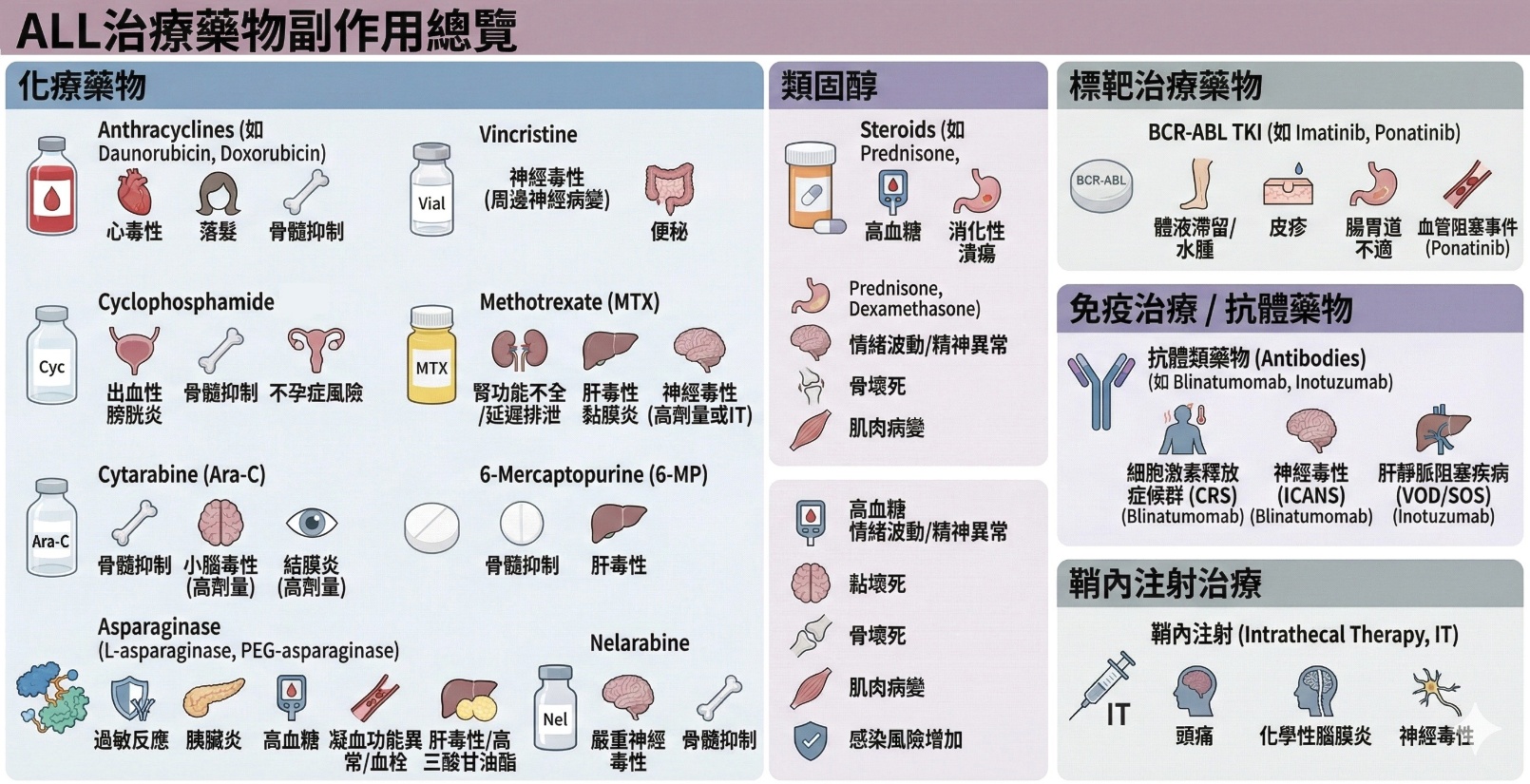
8.2.1 Asparaginase (1)
Asparaginase是ALL治療的基石,但伴隨顯著副作用,其中以過敏反應最為常見。
過敏反應:而發生嚴重過敏,應改用不同來源的如Erwinia asparaginase。
建議進行SAA (serum asparaginase activity 血清活性) 監測。若患者出現1或2級反應但SAA活性足夠,可考慮Rechallenge;若出現3或4級嚴重過敏或過敏性休克,則必須永久停藥。Silent Inactivation:代表患者已產生針對Asparaginase的抗體,使得藥物失效,此時患者大多沒有任何症狀。
製劑選擇:
PEG-asparaginase:目前的主流首選,免疫原性較原生型低。
Calaspargase pegol (cal-PEG):較新的劑型 (適用≤21歲以下患者),因半衰期更長,可減少給藥頻率。研究顯示其血清活性在第25天仍高於 PEG 型。
Erwinia-derived:對E. coli來源 (PEG) 產生嚴重過敏患者的替代方案。
代謝毒性:需監測高血糖、高三酸甘油酯血症及胰臟炎。
表8.2 ALL常見藥物副作用
| 藥物 | 常見副作用 | 預防監測與處置建議 |
|---|---|---|
| Doxorubicin or Daunorubicin | 落髮 心毒性骨髓抑制 | 治療期間持續監測心臟超音波 |
| Methotrexate (MTX) | 口腔黏膜言 腎毒性 肝毒性骨髓抑制 | 1. 給藥期間暫停TMP/SMX 2. 預防性給予Leucovorin rescue 3. 監測MTX濃度 |
| Asparaginase | 過敏反應 高血糖 凝血功能異常 肝毒性 胰臟炎 | 密集監測過敏反應、血糖、肝指數、TG。 |
| Vincristine | 神經毒性 便秘 | 預防性給予軟便藥物。 |
| Steroids | 高血糖 消化性潰瘍 情緒波動 骨壞死 | 1. 監測血糖。 2. 使用H2受體拮抗劑或PPI預防潰瘍 (注意PPI與MTX的交互作用)。 3. 精神症狀可用抗精神病藥。 |
| 6-MP | 骨髓抑制 | 監測全血球數值 |
| Inotuzumab ozagamicin | 骨髓抑制 肝毒性 VOD/SOS | 後續計畫異體幹細胞移植患者,避免使用兩種烷化劑。預防考慮使用Ursodiol |
| Blinatumomab | 輸注反應 感染 胰臟炎 細胞激素釋放症候群 神經毒性 | 監測CRS症狀 (發燒、低血壓、缺氧)、神經學症狀 (意識模糊、失語、震顫、癲癇) |
| Revumenib | 分化症候群 感染 QTc延長 | 一旦懷疑有分化症候群症狀(發燒、呼吸困難、週邊水腫、低血壓或AKI) 立即給予類固醇與輸液治療 |
8.3 藥物基因學考量 (6-MP)
6-MP的代謝受TPMT (Thiopurine methyltransferase) 基因多型性影響顯著。
TPMT 缺陷者 (Homozygous deficient):佔人口約0.3%,需減少6-MP劑量10-15 倍以避免致死性骨髓抑制。
雜合子 (Heterozygous):佔約10%,需減少劑量10-15%。
NUDT15變異:在亞洲人種中較常見,同樣影響6-MP耐受性。
臨床建議:建議進行TPMT (及NUDT15) 基因型檢測以優化劑量。依從性是維持治療成功的關鍵,若患者白血球計數未出現預期的下降,需懷疑患者是否按時服藥。
8.4 免疫療法相關毒性 (CRS & ICANS)
細胞激素釋放症候群 (CRS):表現為發燒、低血壓、缺氧。處理藥物為Tocilizumab (IL-6 受體拮抗劑)。
免疫系統相關神經毒性 (ICANS):表現為震顫、失語、意識混亂、癲癇。處理藥物為Dexamethasone。Blinatumomab引起的神經毒性通常可逆,但需暫停給藥。
結語
ALL治療從「一體適用」的化療模式,轉向高度個人化、風險導向及免疫治療整合的精準醫療模式。
精確診斷與分群是前提: 每位患者須進行完整的遺傳學 (包括 FISH, PCR, NGS) 與免疫表型分析,以識別Ph-like、Ph (+)、iAMP21等關鍵亞型,以此區分不同風險亞型。
MRD 驅動的動態治療: 利用MRD作為最強大的動態風險指標。治療期間的MRD監測結果應直接影響是否進行異體移植或改變治療強度的決策。而Blinatumomab等免疫療法已成功進入前線鞏固治療。
對於 Ph (+) B-ALL,TKI的精準應用已使化療強度得以降低,甚至在部分患者中實現「無化療」治療。Ponatinib於一線治療展現了優越的MRD清除能力。
對於 Ph (-) B-ALL:AYA患者應優先考慮療效更佳的兒科導向療法;高風險患者需在早期緩解後儘快評估異體幹細胞移植資格。
復發/難治性疾病:後線CAR-T細胞療法與新一代標靶藥物 (如 Revumenib, Inotuzumab) 提供了第二次緩解的新契機,但也帶來了新的毒性管理挑戰 (如 VOD, ICANS)。若能達成二次緩解,需考量異體幹細胞移植做為唯一可能治癒之手段。
精細的支持療法:治療期間需嚴密監測類固醇引起的代謝副作用 (高血糖、骨壞死) 、Asparaginase的過敏與胰臟炎風險、鞘內注射的神經毒性,並針對 6-MP 進行藥物基因學指導下的劑量調整。
References:
National Comprehensive Cancer Network. NCCN Clinical Practice Guidelines in Oncology (NCCN Guidelines®): Acute Lymphoblastic Leukemia. Version 2.2025. Published February 2025. Accessed January 2, 2026. https://www.nccn.org.
Stock W, Douer D, DeAngelo DJ. Acute lymphoblastic leukemia in adults. In: Hoffman R, Benz EJ, Silberstein LE, et al, eds. Hematology: Basic Principles and Practice. 8th ed. Elsevier; 2023:chap 66.
Howlader N NA, Krapcho M, Miller D, Brest A, Yu M, Ruhl J, Tatalovich Z, Mariotto A, Lewis DR, Chen HS, Feuer EJ, Cronin KA. SEER Cancer Statistics Review 1975-2018. National Cancer Institute 2021. Available at: https://seer.cancer.gov/csr/1975_2018/.
Health Promotion Administration, Ministry of Health and Welfare, Taiwan. Cancer Registry Annual Report.
Alaggio R, Amador C, Anagnostopoulos I, et al. The 5th edition of the World Health Organization Classification of Haematolymphoid Tumours: Lymphoid Neoplasms. Leukemia. 2022;36(7):1720-1748.
Pui CH, Relling MV, Downing JR. Acute lymphoblastic leukemia. N Engl J Med. 2004;350(15):1535-1548.
Buckley M, Yeung DT, White DL, Eadie LN. T-cell acute lymphoblastic leukaemia: subtype prevalence, clinical outcome, and emerging targeted treatments. Leukemia. 2025;39(6):1294-1310.
Moorman AV, Harrison CJ, Buck GA, et al. Karyotype is an independent prognostic factor in adult acute lymphoblastic leukemia (ALL): analysis of cytogenetic data from patients treated on the Medical Research Council (MRC) UKALLXII/Eastern Cooperative Oncology Group (ECOG) 2993 trial. Blood. 2007;109(8):3189-3197.
Raetz EA, Devidas M, Carroll AJ, et al. Cytogenetic and early-response characteristics of adolescents and young adults with acute lymphoblastic leukemia (ALL): a Children's Oncology Group (COG) study [abstract]. J Clin Oncol. 2010;28(15 suppl):Abstract 9509.
Rowe JM, Buck G, Burnett AK, et al. Induction therapy for adults with acute lymphoblastic leukemia: results of more than 1500 patients from the international ALL trial: MRC UKALL XII/ECOG E2993. Blood. 2005;106(12):3760-3767.
Trinquand A, Tanguy-Schmidt A, Ben Abdelali R, et al. Toward a NOTCH1/FBXW7/RAS/PTEN-based oncogenetic risk classification of adult T-cell acute lymphoblastic leukemia: a Group for Research in Adult Acute Lymphoblastic Leukemia study. J Clin Oncol. 2013;31(34):4333-4342.
Buchmann S, Schrappe M, Baruchel A, et al. Remission, treatment failure, and relapse in pediatric ALL: an international consensus of the Ponte-di-Legno Consortium. Blood. 2022;139(12):1785-1793.
Seibel NL. Acute lymphoblastic leukemia: an historical perspective. Hematology Am Soc Hematol Educ Program. 2008;365.
Jabbour E, Short NJ, Jain N, et al. The evolution of acute lymphoblastic leukemia research and therapy at MD Anderson over four decades. J Hematol Oncol. 2023;16(1):22. Published 2023 Mar 16.
Huguet F, Leguay T, Raffoux E, et al. Pediatric-inspired therapy in adults with Philadelphia chromosome-negative acute lymphoblastic leukemia: the GRAALL-2003 study. J Clin Oncol. 2009;27(6):911-918.
Larson RA, Dodge RK, Burns CP, et al. A five-drug remission induction regimen with intensive consolidation for adults with acute lymphoblastic leukemia: cancer and leukemia group B study 8811. Blood. 1995;85(8):2025-2037.
Teuffel O, Kuster SP, Hunger SP, et al. Dexamethasone versus prednisone for induction therapy in childhood acute lymphoblastic leukemia: a systematic review and meta-analysis. Leukemia. 2011;25(8):1232-1238.
Pui CH. Central nervous system disease in acute lymphoblastic leukemia: prophylaxis and treatment. Hematology Am Soc Hematol Educ Program. 2006;142-146.
Seibel NL, Steinherz PG, Sather HN, et al. Early postinduction intensification therapy improves survival for children and adolescents with high-risk acute lymphoblastic leukemia: a report from the Children's Oncology Group. Blood. 2008;111(5):2548-2555.
Aricò M, Valsecchi MG, Camitta B, et al. Outcome of treatment in children with Philadelphia chromosome-positive acute lymphoblastic leukemia. N Engl J Med. 2000;342(14):998-1006.
Schultz KR, Carroll A, Heerema NA, et al. Long-term follow-up of imatinib in pediatric Philadelphia chromosome-positive acute lymphoblastic leukemia: Children's Oncology Group study AALL0031. Leukemia. 2014;28(7):1467-1471.
Daver N, Thomas D, Ravandi F, et al. Final report of a phase II study of imatinib mesylate with hyper-CVAD for the front-line treatment of adult patients with Philadelphia chromosome-positive acute lymphoblastic leukemia. Haematologica. 2015;100(5):653-661.
Ravandi F, O'Brien SM, Cortes JE, et al. Long-term follow-up of a phase 2 study of chemotherapy plus dasatinib for the initial treatment of patients with Philadelphia chromosome-positive acute lymphoblastic leukemia. Cancer. 2015;121(23):4158-4164.
Jabbour E, Kantarjian H, Ravandi F, et al. Combination of hyper-CVAD with ponatinib as first-line therapy for patients with Philadelphia chromosome-positive acute lymphoblastic leukaemia: a single-centre, phase 2 study. Lancet Oncol. 2015;16(15):1547-1555.
Jabbour E, Kantarjian HM, Aldoss I, et al. Ponatinib vs Imatinib in Frontline Philadelphia Chromosome-Positive Acute Lymphoblastic Leukemia: A Randomized Clinical Trial. JAMA. 2024;331(21):1814-1823.
Kantarjian H, Thomas D, O'Brien S, et al. Long-term follow-up results of hyperfractionated cyclophosphamide, vincristine, doxorubicin, and dexamethasone (Hyper-CVAD), a dose-intensive regimen, in adult acute lymphocytic leukemia. Cancer. 2004;101(12):2788-2801.
Foà R, Bassan R, Vitale A, et al. Dasatinib-Blinatumomab for Ph-Positive Acute Lymphoblastic Leukemia in Adults. N Engl J Med. 2020;383(17):1613-1623.
Nicholas J. Short, Hagop Kantarjian; Blinatumomab and Ponatinib for Adults with Newly Diagnosed Philadelphia Chromosome-Positive Acute Lymphoblastic Leukemia: Updated Results and Predictors of Relapse. Blood 2024; 144 (Supplement 1): 837.
Chalandon Y, Thomas X, Hayette S, et al. Randomized study of reduced-intensity chemotherapy combined with imatinib in adults with Ph-positive acute lymphoblastic leukemia. Blood. 2015;125(24):3711-3719.
Rousselot P, Coudé MM, Gokbuget N, et al. Dasatinib and low-intensity chemotherapy in elderly patients with Philadelphia chromosome-positive ALL. Blood. 2016;128(6):774-782.
Foà R, Vitale A, Vignetti M, et al. Dasatinib as first-line treatment for adult patients with Philadelphia chromosome-positive acute lymphoblastic leukemia. Blood. 2011;118(25):6521-6528.
Martinelli G, Boissel N, Chevallier P, et al. Long-term follow-up of blinatumomab in patients with relapsed/refractory Philadelphia chromosome-positive B-cell precursor acute lymphoblastic leukaemia: Final analysis of ALCANTARA study. Eur J Cancer. 2021;146:107-114.
Kantarjian HM, DeAngelo DJ, Stelljes M, et al. Inotuzumab Ozogamicin versus Standard Therapy for Acute Lymphoblastic Leukemia. N Engl J Med. 2016;375(8):740-753.
Shah BD, Ghobadi A, Oluwole OO, et al. KTE-X19 for relapsed or refractory adult B-cell acute lymphoblastic leukaemia: phase 2 results of the single-arm, open-label, multicentre ZUMA-3 study. Lancet. 2021;398(10299):491-502.
Roddie C, Sandhu KS, Tholouli E, et al. Obecabtagene Autoleucel in Adults with B-Cell Acute Lymphoblastic Leukemia. N Engl J Med. 2024;391(23):2219-2230.
Maude SL, Laetsch TW, Buechner J, et al. Tisagenlecleucel in Children and Young Adults with B-Cell Lymphoblastic Leukemia. N Engl J Med. 2018;378(5):439-448.
Bachanova V, Marks DI, Zhang MJ, et al. Ph+ ALL patients in first complete remission have similar survival after reduced intensity and myeloablative allogeneic transplantation: impact of tyrosine kinase inhibitor and minimal residual disease. Leukemia. 2014;28(3):658-665.
de Bont JM, Holt Bv, Dekker AW, van der Does-van den Berg A, Sonneveld P, Pieters R. Significant difference in outcome for adolescents with acute lymphoblastic leukemia treated on pediatric vs adult protocols in the Netherlands. Leukemia. 2004;18(12):2032-2035.
Huguet F, Leguay T, Raffoux E, et al. Pediatric-inspired therapy in adults with Philadelphia chromosome-negative acute lymphoblastic leukemia: the GRAALL-2003 study. J Clin Oncol. 2009;27(6):911-918.
Stock W, Luger SM, Advani AS, et al. A pediatric regimen for older adolescents and young adults with acute lymphoblastic leukemia: results of CALGB 10403. Blood. 2019;133(14):1548-1559.
DaSilva B, Darwin A, Zhang A, et al. Real-world performance of the CALGB 10403 regimen in young adults in the United States. Blood Neoplasia. 2025;2(3):100111. Published 2025 May 12.
DeAngelo DJ, Stevenson KE, Dahlberg SE, et al. Long-term outcome of a pediatric-inspired regimen used for adults aged 18-50 years with newly diagnosed acute lymphoblastic leukemia. Leukemia. 2015;29(3):526-534.
Thomas DA, O'Brien S, Faderl S, et al. Chemoimmunotherapy with a modified hyper-CVAD and rituximab regimen improves outcome in de novo Philadelphia chromosome-negative precursor B-lineage acute lymphoblastic leukemia. J Clin Oncol. 2010;28(24):3880-3889.
Huguet F, Chevret S, Leguay T, et al. Intensified Therapy of Acute Lymphoblastic Leukemia in Adults: Report of the Randomized GRAALL-2005 Clinical Trial. J Clin Oncol. 2018;36(24):2514-2523.
Nicolas Boissel, Francoise Huguet, et al. In Adults with Ph-Negative Acute Lymphoblastic Leukemia (ALL), Age-Adapted Chemotherapy Intensity and MRD-Driven Transplant Indication Significantly Reduces Treatment-Related Mortality (TRM) and Improves Overall Survival -Results from the Graall-2014 Trial. Blood 2022; 140 (Supplement 1): 112–114.
Geyer MB, Ritchie EK, Rao AV, et al. Pediatric-inspired chemotherapy incorporating pegaspargase is safe and results in high rates of minimal residual disease negativity in adults up to age 60 with Philadelphia chromosome-negative acute lymphoblastic leukemia. Haematologica. 2021;106(8):2086-2094. Published 2021 Aug 1.
Litzow MR, Sun Z, Mattison RJ, et al. Blinatumomab for MRD-Negative Acute Lymphoblastic Leukemia in Adults. N Engl J Med. 2024;391(4):320-333.
Matthew Joseph Wieduwilt et al. Chemotherapy-free treatment with inotuzumab ozogamicin and blinatumomab for older adults with newly diagnosed, Ph-negative, CD22-positive, B-cell acute lymphoblastic leukemia: Alliance A041703.. J Clin Oncol 41, 7006-7006(2023).
Hardisty RM, McElwain TJ, Darby CW. Vincristine and prednisone for the induction of remissions in acute childhood leukaemia. Br Med J. 1969;2(5658):662-665.
Berry DH, Pullen J, George S, Vietti TJ, Sullivan MP, Fernbach D. Comparison of prednisolone, vincristine, methotrexate, and 6-mercaptopurine vs. vincristine and prednisone induction therapy in childhood acute leukemia. Cancer. 1975;36(1):98-102.
Thomas X, Boiron JM, Huguet F, et al. Outcome of treatment in adults with acute lymphoblastic leukemia: analysis of the LALA-94 trial. J Clin Oncol. 2004;22(20):4075-4086.
Ribera JM, Ortega JJ, Oriol A, et al. Comparison of intensive chemotherapy, allogeneic, or autologous stem-cell transplantation as postremission treatment for children with very high risk acute lymphoblastic leukemia: PETHEMA ALL-93 Trial. J Clin Oncol. 2007;25(1):16-24.
Cornelissen JJ, van der Holt B, Verhoef GE, et al. Myeloablative allogeneic versus autologous stem cell transplantation in adult patients with acute lymphoblastic leukemia in first remission: a prospective sibling donor versus no-donor comparison. Blood. 2009;113(6):1375-1382.
Fielding AK, Richards SM, Chopra R, et al. Outcome of 609 adults after relapse of acute lymphoblastic leukemia (ALL); an MRC UKALL12/ECOG 2993 study. Blood. 2007;109(3):944-950.
Oriol A, Vives S, Hernández-Rivas JM, et al. Outcome after relapse of acute lymphoblastic leukemia in adult patients included in four consecutive risk-adapted trials by the PETHEMA Study Group. Haematologica. 2010;95(4):589-596.
Kantarjian H, Stein A, Gökbuget N, et al. Blinatumomab versus Chemotherapy for Advanced Acute Lymphoblastic Leukemia. N Engl J Med. 2017;376(9):836-847.
Issa GC, Aldoss I, Thirman MJ, et al. Menin Inhibition With Revumenib for KMT2A-Rearranged Relapsed or Refractory Acute Leukemia (AUGMENT-101). J Clin Oncol. 2025;43(1):75-84.
Rowe JM, Buck G, Burnett AK, et al. Induction therapy for adults with acute lymphoblastic leukemia: results of more than 1500 patients from the international ALL trial: MRC UKALL XII/ECOG E2993. Blood. 2005;106(12):3760-3767.
Duval M, Klein JP, He W, et al. Hematopoietic stem-cell transplantation for acute leukemia in relapse or primary induction failure. J Clin Oncol. 2010;28(23):3730-3738.
Dunsmore KP, Winter SS, Devidas M, et al. Children's Oncology Group AALL0434: A Phase III Randomized Clinical Trial Testing Nelarabine in Newly Diagnosed T-Cell Acute Lymphoblastic Leukemia. J Clin Oncol. 2020;38(28):3282-3293.
Candoni A, Lazzarotto D, Ferrara F, et al. Nelarabine as salvage therapy and bridge to allogeneic stem cell transplant in 118 adult patients with relapsed/refractory T-cell acute lymphoblastic leukemia/lymphoma. A CAMPUS ALL study. Am J Hematol. 2020;95(12):1466-1472.
Bonda A, Punatar S, Gokarn A, et al. Daratumumab at the frontiers of post-transplant refractory T-acute lymphoblastic leukemia-a worthwhile strategy?. Bone Marrow Transplant. 2018;53(11):1487-1489.
Nitin Jain, Kristen E. Stevenson, et al; A Multicenter Phase I Study Combining Venetoclax with Mini-Hyper-CVD in Older Adults with Untreated and Relapsed/Refractory Acute Lymphoblastic Leukemia. Blood 2019; 134 (Supplement_1): 3867.
Horton TM, Whitlock JA, Lu X, et al. Bortezomib reinduction chemotherapy in high-risk ALL in first relapse: a report from the Children's Oncology Group. Br J Haematol. 2019;186(2):274-285.
整本手冊的 PDF 與重點簡報摘要在手冊首頁。