
第八章、少見組織型態卵巢癌之臨床處置
發布日期:2026-03-30
本章目錄
- 8.1 臨床診斷程序與初期檢查評估
- 8.2 少見組織型態卵巢癌之通用手術原則
- 8.3 卵巢透明細胞腺癌 (Ovarian Clear Cell Carcinoma, OCCC)
- 8.4 黏液性卵巢癌 (Ovarian Mucinous Carcinoma)
- 8.5 低惡性度漿液性癌 (Low-Grade Serous Carcinoma)
- 副作用
- 8.5.4 BRAF V600E突變與標靶治療
- 8.6 卵巢生殖細胞腫瘤 (Ovarian Germ Cell Tumors)
- 8.7 惡性性索基質腫瘤 (Malignant Sex Cord Stromal Cell Tumors)
- 8.8 癌肉瘤 (Carcinosarcomas)
- 8.9 邊緣性上皮腫瘤 (Borderline Epithelial Tumors)
- 總結
- References:
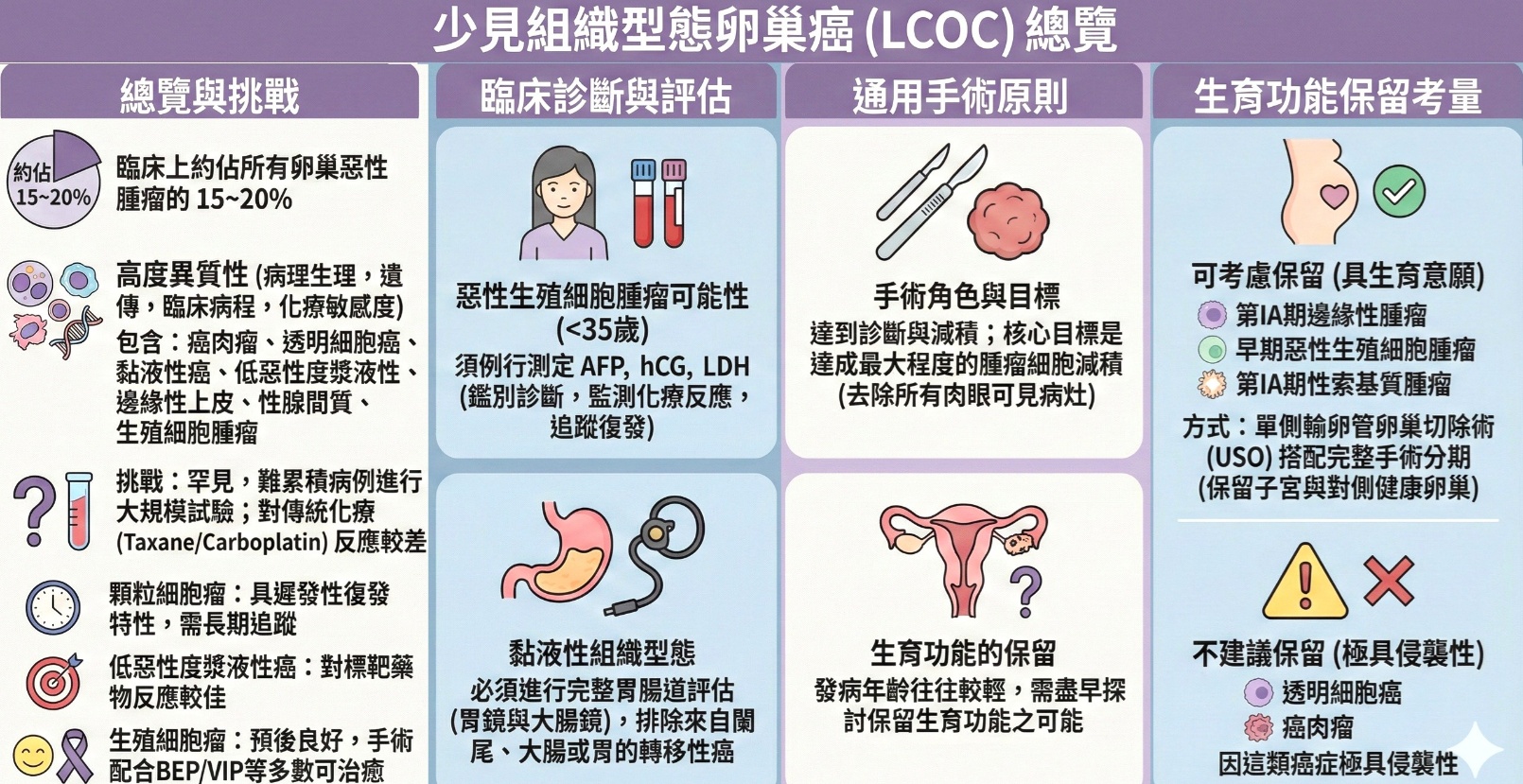
少見組織型態卵巢癌 (Less Common Ovarian Cancers, LCOC) 在臨床上約佔所有卵巢惡性腫瘤的15~20%。相較於最常見的高惡性度漿液性癌,這些亞型在病理生理學、遺傳驅動因素、臨床病程以及對化學治療的敏感度上表現出高度的異質性。(註:子宮內膜樣上皮癌的治療與傳統高惡性度漿液性癌相同,故不在第八章重複說明)[9]
癌肉瘤 (Carcinosarcomas, 又稱MMMTs)
透明細胞癌 (Clear cell carcinoma)
黏液性癌 (Mucinous carcinoma)
低惡性度漿液性 (Low-grade serous carcinoma)
邊緣性上皮腫瘤 (Borderline epithelial tumors)
性腺間質腫瘤 (Sex cord-stromal tumors)
生殖細胞腫瘤 (Germ cell tumors)
由於這些疾病的罕見性,難以累積足夠的病例進行大規模臨床試驗。且部分型態癌症對傳統的Taxane與Carboplatin組合反應較差,甚至表現出完全不同的進展模式:
顆粒細胞瘤:具遲發性復發特性,需長期追蹤。
低惡性度漿液性癌:對標靶藥物反應較佳。
生殖細胞瘤:預後良好,利用手術配合BEP/VIP等療法多數患者可治癒。
8.1 臨床診斷程序與初期檢查評估
惡性生殖細胞腫瘤可能性:對於年齡小於三十五歲的患者,須例行測定AFP、hCG以及LDH 。這些指標不僅有助於鑑別診斷,更是監測化療反應與追蹤復發的重要基準。
黏液性組織型態:若病理切片或臨床表現傾向於黏液性組織型態,則必須進行完整的胃腸道評估,包括胃鏡與大腸鏡檢查,以排除來自闌尾、大腸或胃的轉移性癌。許多初步診斷為卵巢原發黏液性癌的病例,最終被證實為轉移癌。
8.2 少見組織型態卵巢癌之通用手術原則
手術的角色:可達到診斷與減積,與高分化漿液性癌相似,其核心目標是達成最大程度的腫瘤細胞減積,理想情況下應去除所有肉眼可見的病灶。
生育功能的保留:這類患者的發病年齡往往較輕,需盡早探討生育功能的保留之可能。
第IA期的邊緣性腫瘤、早期惡性生殖細胞腫瘤、第IA期的性索基質腫瘤:對於具生育意願的女性,可以考慮僅進行單側輸卵管卵巢切除術 (Unilateral Salpingo-Oophorectomy) 並搭配完整的手術分期,保留子宮與對側健康的卵巢。
透明細胞癌、癌肉瘤:不建議保留生育能力,因為這類癌症極具侵襲性。
8.3 卵巢透明細胞腺癌 (Ovarian Clear Cell Carcinoma, OCCC)
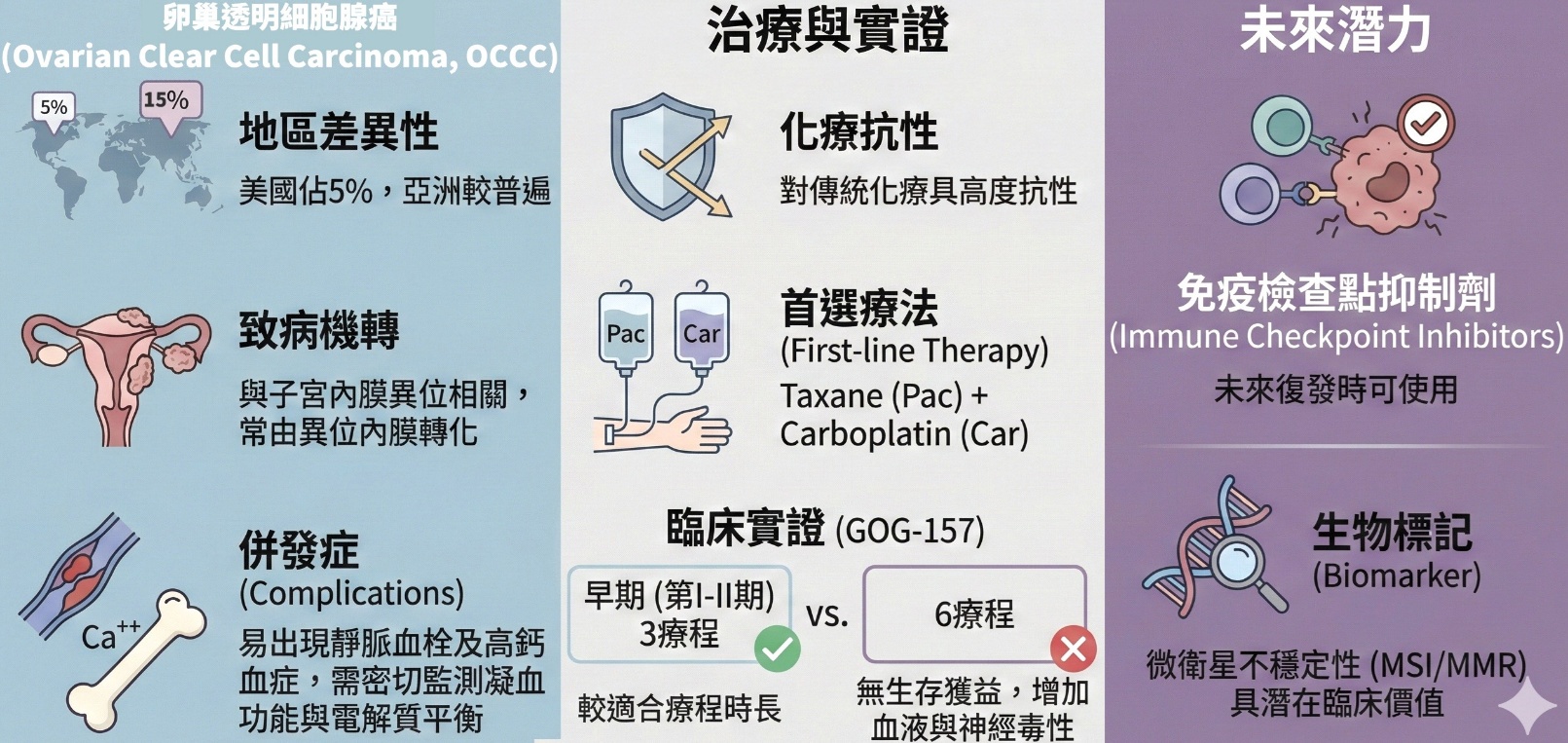
地區差異性:卵巢透明細胞癌在美國雖然僅佔卵巢癌的5%,但在亞洲地區卻是較為普遍的亞型。其與子宮內膜異位有著類似的致病機轉,常被視為由異位內膜轉化而來。
併發症:這類病患更容易出現靜脈血栓及高鈣血症等併發症,應密切監測患者的凝血功能與電解質平衡。
8.3.1 輔助治療與週期選擇的實證分析
化療抗性:卵巢透明細胞癌被公認為對傳統化學治療具有高度抗性。雖然目前指引建議Taxane聯合Carboplatin為首選療法,但其反應率往往不及漿液性癌的一半。
臨床實證:GOG-157試驗的子群分析顯示,早期 (第I-II期) 透明細胞癌患者接受PCb療法共6療程,相較於3療程並無生存獲益,反而提升血液與神經毒性。故3週期為透明細胞癌患者較適合的療程時長。[55]
免疫檢查點抑制劑:微衛星不穩定性 (MSI/MMR) 在透明細胞癌中也具備潛在的臨床價值,未來在復發時可使用免疫檢查點抑制劑。
8.4 黏液性卵巢癌 (Ovarian Mucinous Carcinoma)
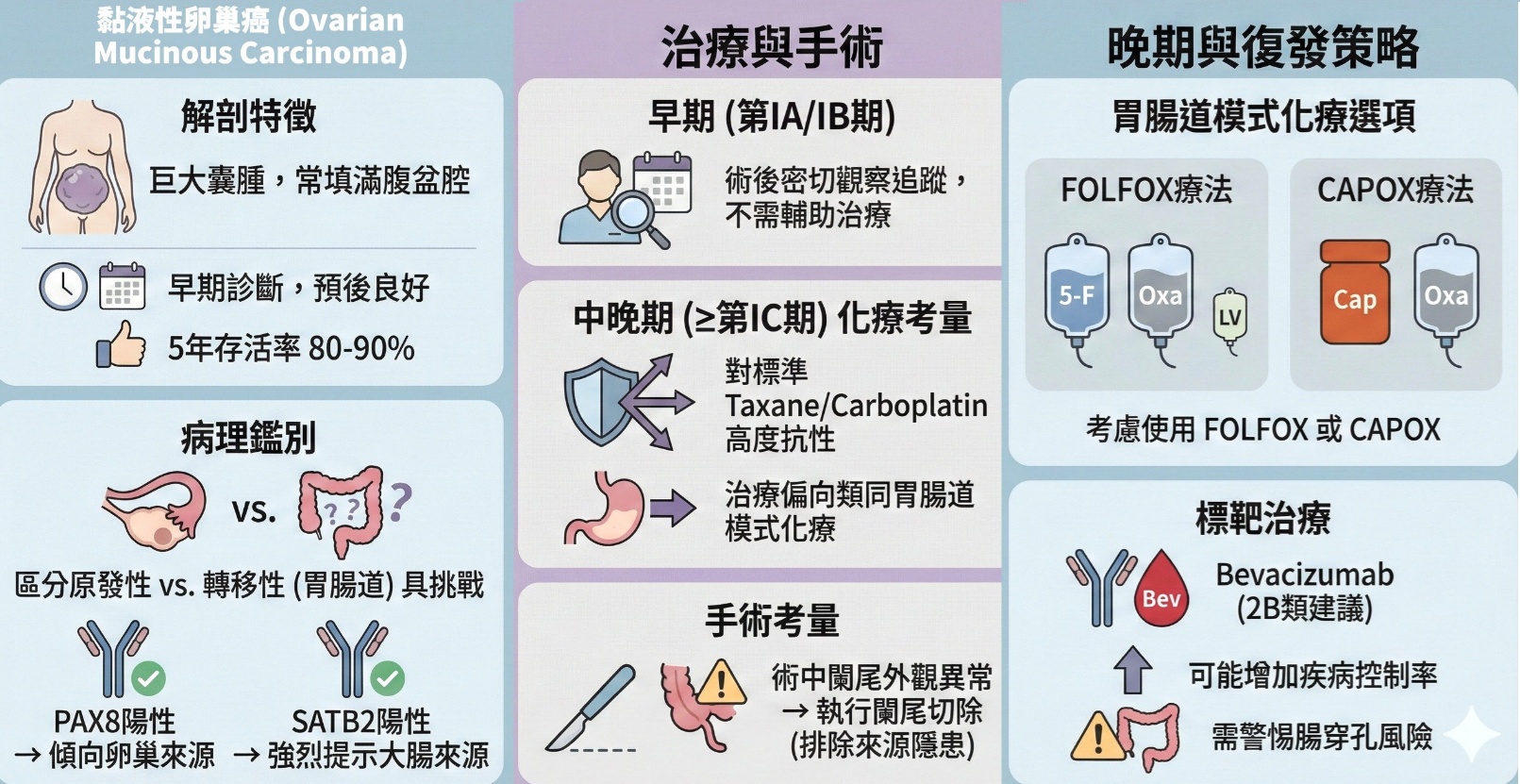
解剖特徵:黏液性卵巢癌 (Ovarian Mucinous Carcinoma) 的臨床表現以巨大的囊腫為特徵,甚至能填滿整個腹部及骨盆。通常於疾病早期就被診斷出來,預後相當良好。5年存活率高達80-90%。
病理特徵:在病理學上,要區分原發性卵巢黏液性腺癌與來自胃腸道的轉移性癌極具挑戰。PAX8陽性傾向於卵巢來源,而 SATB2陽性則強烈提示大腸來源。
8.4.1 治療療法的個體化選擇
黏液性癌在晚期或復發階段表現出對標準Taxane/Carboplatin的高度抗性。藥理研究顯示,黏液性卵巢癌細胞對於5-FU或Oxaliplatin具有良好的反應率。因此,對於第IC期或更高分期的患者,治療偏向類同胃腸道模式的化療療法。[56]
第IA與IB期:術後進行密切觀察與追蹤,不需進行輔助治療。
晚期與復發:考慮使用胃腸道癌症常用化療:FOLFOX或Capecitabine、CAPOX。
Bevacizumab:在復發性黏液性癌的治療中,加入Bevacizumab被列為2B類建議,臨床數據顯示其可能增加疾病控制率,但也需警惕腸穿孔的風險。
8.4.2 手術治療
闌尾切除:若手術中觀察到闌尾外觀異常,應執行闌尾切除以排除來源隱患。
8.5 低惡性度漿液性癌 (Low-Grade Serous Carcinoma)
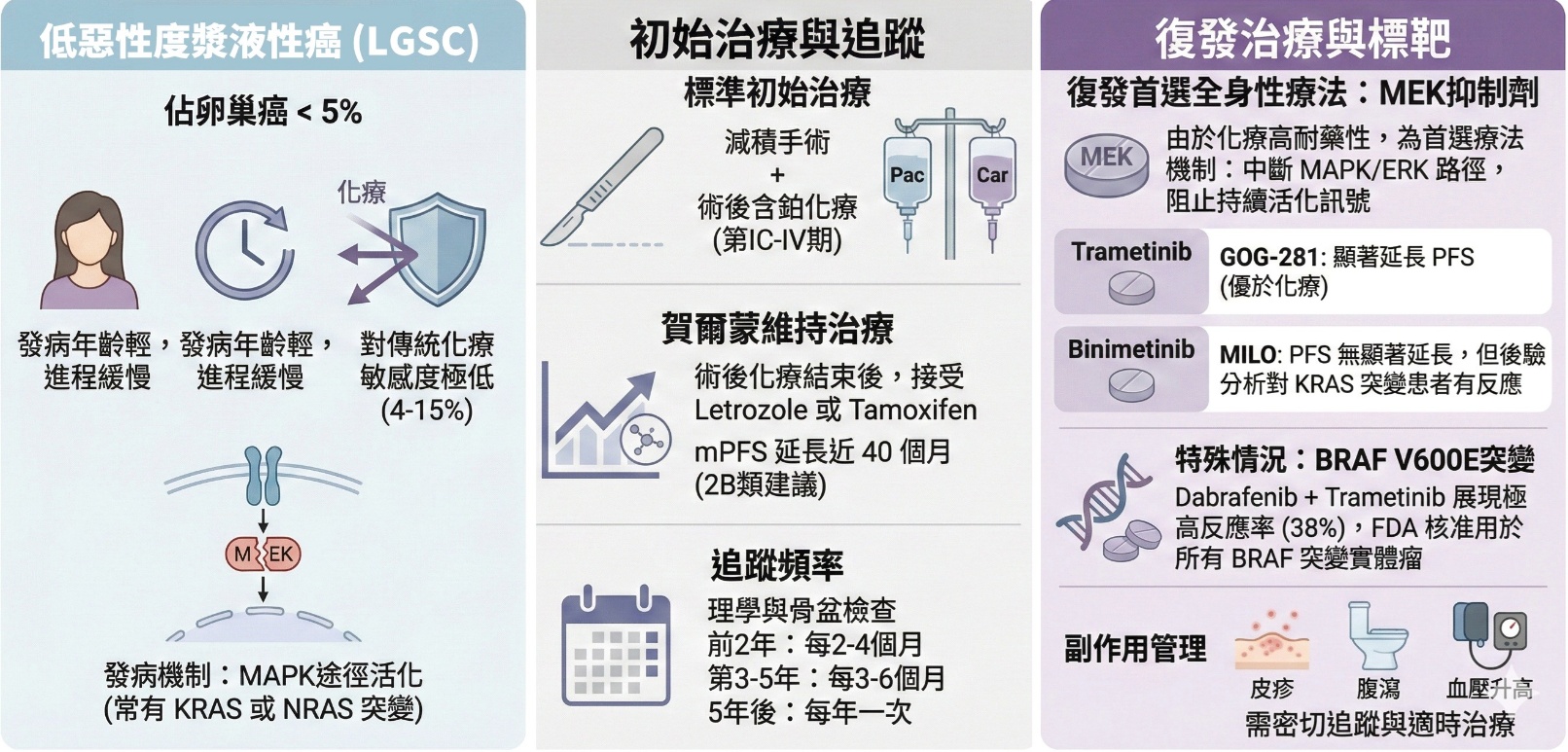
低惡性度漿液性癌 (Low-Grade Serous Carcinoma, LGSC) 雖然在所有卵巢癌中佔比 < 5%,但其臨床管理卻經歷了天翻地覆的變革。
特徵:發病年齡輕、進程相對緩慢、對傳統化療敏感度極低 (僅約4-15%),但其發病機制與MAPK途徑的活化相關。
8.5.1 初始治療與賀爾蒙維持治療
LGSC的標準初始治療為完整的減積手術;第IC-IV期患者建議加上術後含鉑化療 (如Paclitaxel/Carboplatin)。
賀爾蒙維持治療:一項大型回顧性研究指出,LGSC患者在術後輔助化療結束後,接受Letrozole或Tamoxifen的賀爾蒙維持治療,其mPFS較僅觀察者延長了近40個月,但mOS無顯著差異。基於PFS的顯著結果,賀爾蒙維持治療仍為2B類建議選項。[57]
8.5.2 LGSC之追蹤
建議追蹤:理學檢查與骨盆檢查。
追蹤頻率:
前2年:每2至4個月回診一次。
第3至5年: 每3至6個月回診一次。
5 年之後:每年回診一次。
8.5.3 復發LGSC之療法
二次手術條件:對於滿足以下條件的患者,可考慮進行二次減瘤手術:
具有較長的無病間隔
影像學顯示為孤立性腫塊而非彌漫性疾病
出現腸阻塞症狀
LGSC復發首選全身性療法:由於對LGSC化療的高耐藥性,MEK抑制劑為首選療法。
MEK抑制劑抗癌機制:
MEK生理功能:MAPK/ERK訊息傳遞路徑與細胞生長、增殖與存活相關,上游為RTK-RAS/RAF的訊號,之後通過中游的節點的MEK蛋白傳遞訊息至ERK,最後影響DNA表現。多數LGSC患者帶有KRAS或NRAS突變,而使該路徑處於持續活化的狀態,導致癌細胞不斷分裂。
MEK抑制劑機制:能中斷MAPK/ERK路徑中的MEK蛋白,阻止持續活化的訊息傳遞,並妨礙癌細胞生存所需訊號。
關鍵實證:
Trametinib:GOG-281/ LOGS第II/III期試驗顯示,Trametinib於復發後LGSC患者相較於傳統化療或賀爾蒙療法,能顯著延長PFS中位數。Trametinib是首個在復發後LGSC中證明優於化療的標靶藥物。[58]
Binimetinib:MILO/ ENGOT-ov11第II期試驗顯示,Binimetinib於此類患者無法顯著延長PFS中位數;但後驗分析顯示對KRAS突變患者仍有反應,且化療組表現比歷史數據更好。因此對於KRAS突變患者仍適合使用Binimetinib。[59]
副作用
皮疹:3-4級發生率達13%,需密切追蹤。
腹瀉:3-4級發生率達10%,適時給予止瀉藥與電解質溶液治療。
血壓升高:3-4級發生率達10%,適時給予降壓藥物。
8.5.4 BRAF V600E突變與標靶治療
Dabrafenib + Trametinib:NCI-MATCH試驗分析帶有BRAF V600E突變的罕見LGSC病例,雙標靶治療展現了極高的反應率 (38%),高於歷史上其他藥物之反應率 (5%)。目前FDA核准此組合療法,用於所有BRAF突變的實體瘤 (不分癌別)。[60]
表8.5 LGSC治療相關試驗與研究
| 試驗/對照組 | 試驗名稱 | 納入族群 | 關鍵結果 |
| Maintenance Letrozole或Tamoxifen vs. 觀察 | 回顧性研究 [57] | 70位LGSC患者在術後輔助化療後接受維持療法 133位僅觀察 |
mPFS: 64.9 vs. 26.4個月 (p< 0.001)* mOS: 102.7 vs. 115.7個月 |
| Trametinib (2mg QD) vs. 醫師選擇化療/荷爾蒙 | GOG-281/ LOGS, phase II/III RCT [58] | 260名經至少一次含鉑化療R/R LGSC患者 | mPFS: 13.0 vs. 7.2個月 (HR: 0.48, P<0.0001)* mOS: 37.6 vs. 29.2 個月 (HR: 0.76, p= 0.056) |
| Binimetinib (45mg BID) vs. 醫師選擇化療 | MILO/ ENGOT-ov11, phase III RCT [59] | 303位R/R LGSC患者 | mPFS: 9.1 vs. 10.6個月 (HR 1.21) ORR: 16% vs. 13% |
| Dabrafenib + Trametinib | NCI-MATCH 子療法H (EAY131-H) [60] | 35位BRAF V600E突變的各種晚期實體瘤 (含5例LGSC) | ORR: 38% mPFS: 11.4個月 |
HR: hazard ratio; LGSC: Low-grade serous carcinoma; mOS: median overall survival; mPFS: median progression-free survival; ORR: objective response rate; RCT: randomized controlled trial; R/R: relapsed/refractory/
8.6 卵巢生殖細胞腫瘤 (Ovarian Germ Cell Tumors)
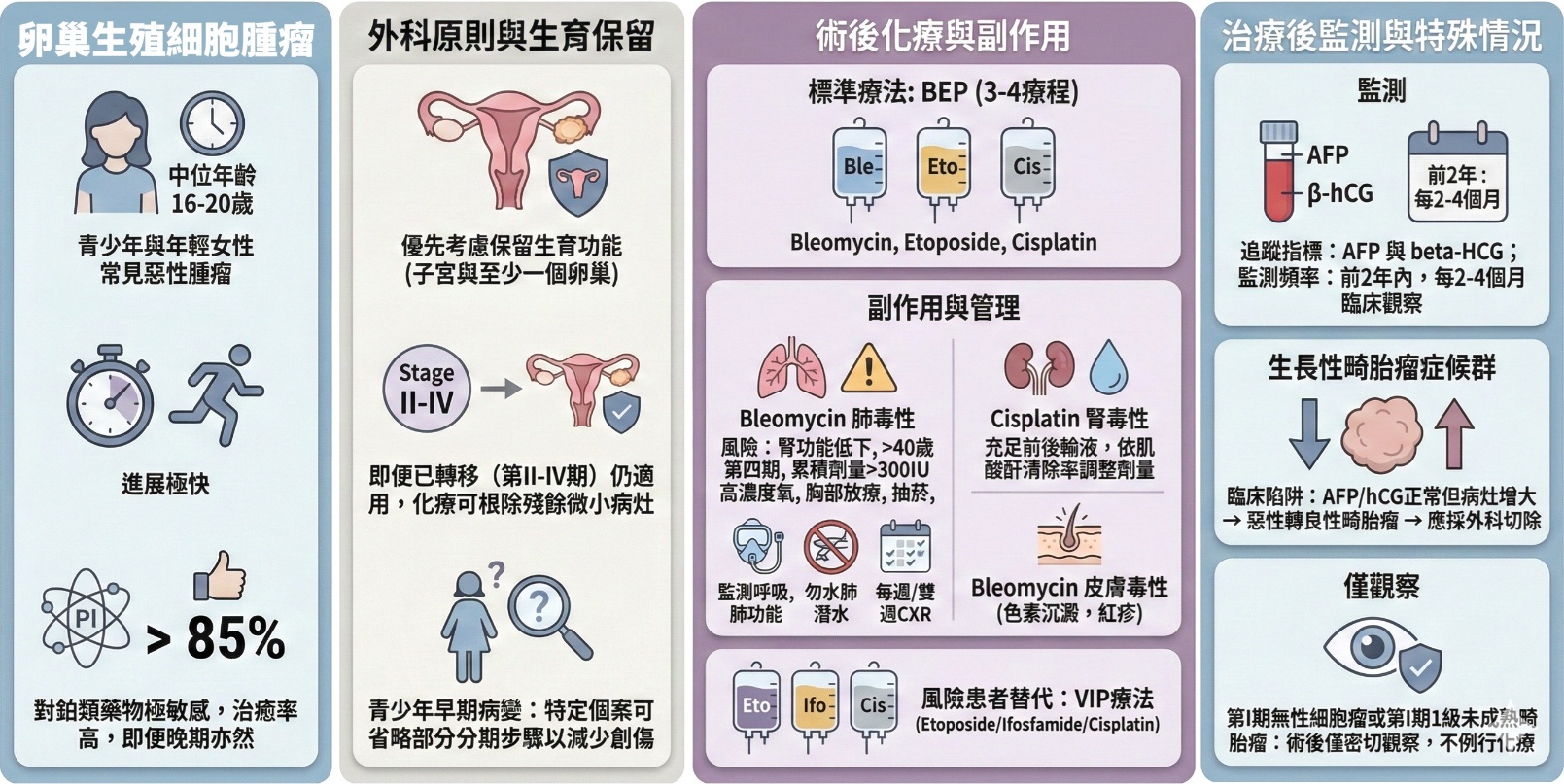
惡性生殖細胞腫瘤在臨床上相對少見,但卻是青少年與年輕女性最常見的卵巢惡性腫瘤,發病中位年齡僅為16至20歲。[6]
臨床特徵:這類腫瘤雖然進展極快,但對鉑類藥物具有極高的敏感度,即便分期較晚,治癒率仍可超過85%。
8.6.1 外科原則:可保留生育功能
可保留生育功能:與上皮癌不同,即便生殖細胞腫瘤已發生轉移 (第II-IV期),仍優先考慮保留子宮與至少一個卵巢,因為剩餘的微小病灶通常能透過後續化療徹底根除。
青少年患者,若臨床高度懷疑為早期病變且影像學正常,特定個案討論下省略部分手術分期步驟以減少創傷。
8.6.2 術後輔助化療:BEP療法
術後輔助化療通常採用生殖細胞癌的標準療法-BEP (Bleomycin、Etoposide、Cisplatin) 3至4療程。此療法的療效顯著,但也伴隨著特定的毒性。[61]
Bleomycin肺毒性 [62]
風險因子:腎功能低下、> 40歲、第四期癌症、Bleomycin累積劑量> 300 IU、高濃度氧氣、胸部放射線治療、抽菸、G-CSF的使用。
追蹤:治療期間,每週至每兩週進行一次CXR;指導患者監測呼吸短促、乾咳等初期症狀,並定期安排肺功能檢查 (DLCO)。
預防措施:嚴格核算累積劑量;避免於用藥期間使用非必要性的G-CSF;提醒患者勿進行水肺潛水,以避免壓力與氧氣濃度變化對肺部造成額外負擔。
針對具風險因子之患者,可考慮換用VIP療法 (etoposide/ifosfamide/cisplatin)
Bleomycin皮膚毒性:包括皮膚色素沉澱、紅疹、角質化等。
腎功能:Cisplatin具有強烈的腎毒性。住院醫師應開立充足的前後輸液,藥師應根據肌酸酐清除率評估劑量調整。
生長性畸胎瘤症候群 (Growing Teratoma Syndrome) :這是一個臨床上的陷阱。若患者化療後AFP/hCG指標已恢復正常,但影像檢查發現殘餘病灶正在增大,這通常代表惡性成分已轉化為良性畸胎瘤,此時應採外科切除而非繼續化療。
對於第I期無性細胞瘤或第I期1級未成熟畸胎瘤,目前的證據支持術後僅進行密切觀察,而非例行化療,以減少患者暴露於長期毒性的風險。
8.6.3 治療後的監測
對於接受化療後達到完全臨床緩解的患者:
追蹤指標:需追蹤AFP與beta-HCG
監測頻率:前2年內,每2至4個月進行一次臨床觀察
8.7 惡性性索基質腫瘤 (Malignant Sex Cord Stromal Cell Tumors)
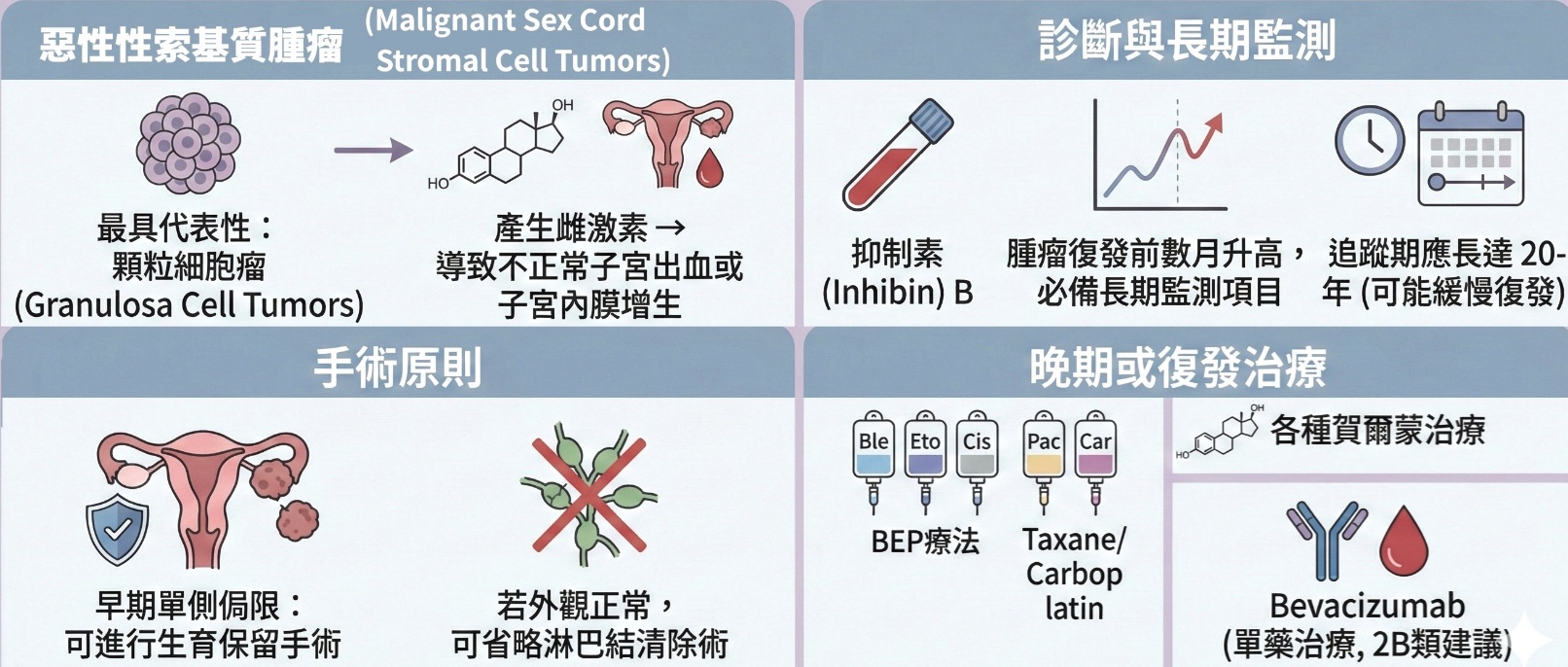
惡性性索基質腫瘤中最具代表性的是顆粒細胞瘤 (Granulosa Cell Tumors) 。這類腫瘤會產生雌激素,常導致不正常子宮出血或子宮內膜增生,這些症狀往往是診斷的契機。[6]
8.7.1 診斷指標與追蹤策略
抑制素 (Inhibin):是顆粒細胞瘤最重要的生化標記。研究顯示,Inhibin B在腫瘤復發前數月即可觀察到升高現象,因此建議將其作為長期監測的必備項目。
Inhibin追蹤期:顆粒細胞瘤的追蹤期應長達20至30年,因為該疾病可能在數十年後才緩慢復發,與一般卵巢癌不同。
8.7.2 手術與藥物選擇
對於侷限於單側卵巢的早期顆粒細胞瘤,可以進行生育保留手術,且若外觀正常,可省略淋巴結清除術。
晚期或復發病患治療:BEP療法、Taxane/Carboplatin療法或各種賀爾蒙治療。
Bevacizumab單藥治療:對復發性顆粒細胞瘤具有臨床活性 (2B類建議)。
8.8 癌肉瘤 (Carcinosarcomas)
臨床特性:卵巢癌肉瘤,過去被稱為惡性混合苗勒氏瘤 (MMMT) ,目前被病理學界定義為分化極差、且經歷了上皮-間質轉化 (EMT) 的上皮性癌亞型。這是所有卵巢惡性腫瘤中預後最差、侵襲性最強的一種,診斷時往往已處於晚期。[6]
外科手術:由於惡性度高應採取最激進的減積策略,且不建議進行生育保留手術。
術後輔助化療:比照高級別漿液性癌,但反應時間往往較短。NCCN指引也列出了Ifosfamide聯合Taxane或Cisplatin作為備選療法,但主要基於二期試驗的數據。[63]
8.9 邊緣性上皮腫瘤 (Borderline Epithelial Tumors)
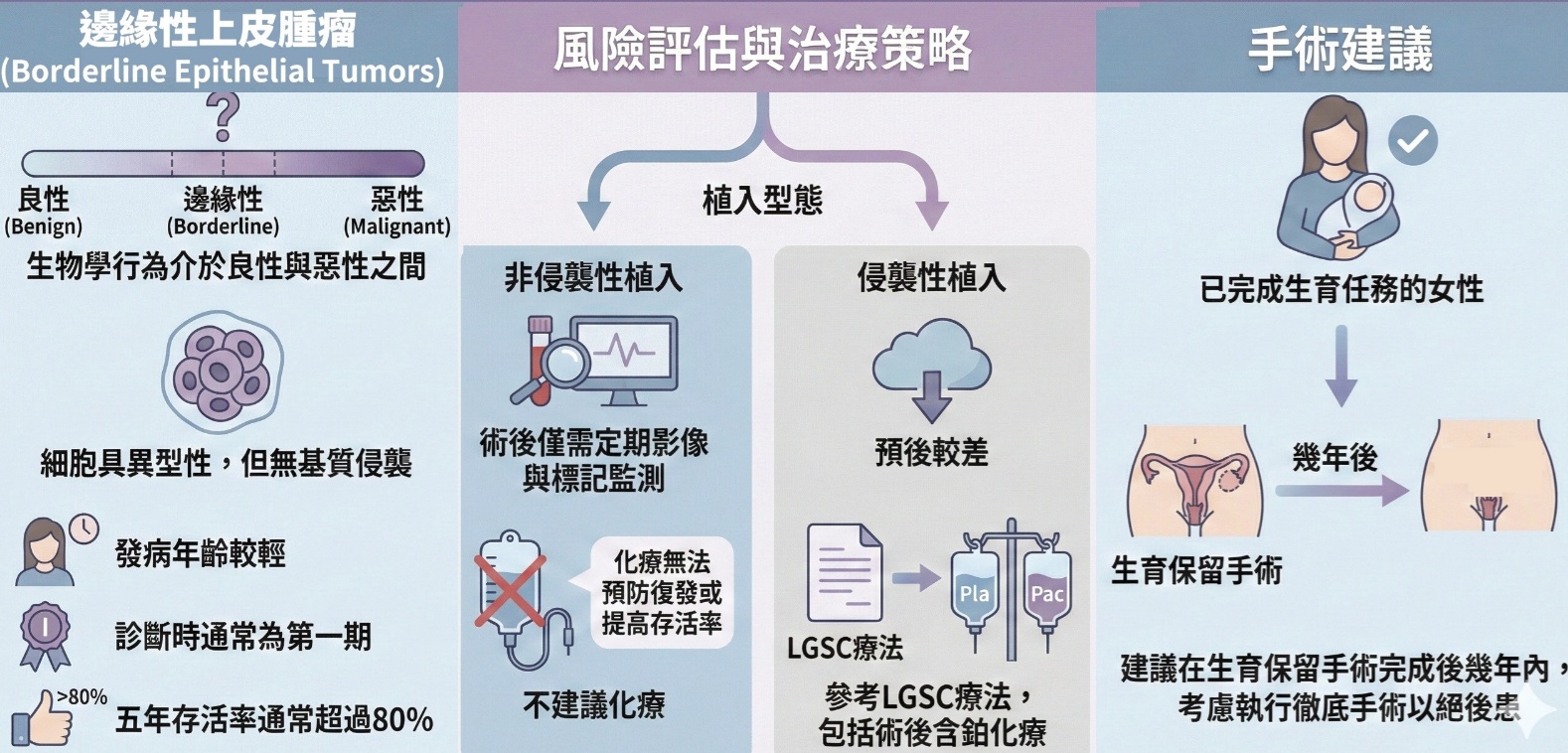
邊緣性上皮腫瘤在生物學行為上介於良性與惡性之間,其定義特徵是細胞具備異型性但無基質侵襲。[6]
特性:發病年齡較輕,診斷時通常為第一期,五年存活率通常超過80%。
8.9.1 邊緣性上皮腫瘤的風險評估與治療
非侵襲性植入:術後僅需定期影像與標記監測,不建議化療,因為化療並不能預防復發或提高存活率。
侵襲性植入:這類患者的預後較差,治療應參考LGSC的療法,包括術後含鉑化療。
手術建議:對於已完成生育任務的女性,指引建議在生育保留手術完成後幾年內考慮執行徹底手術以絕後患。
總結
卵巢癌並非僅起源於卵巢,多數高惡性度漿液性癌實則源於輸卵管遠端上皮(STIC)。臨床診斷雖依賴影像,但最終必須透過精確的 FIGO 手術分期來確立治療基準;準確的分期是決定後續輔助治療強度與範圍的重要依據。
手術預後與殘餘腫瘤大小呈直接正相關,是提升生存率的最佳手段。第一線化療應以鉑類為基礎的合併療法 (如Carboplatin + Paclitaxel),針對高腫瘤負荷患者,採用劑量密集 (Dose-dense) 方案可進一步強化存活獲益。
對於廣泛轉移且難以達成R0的晚期患者,術前輔助化療能在不減損總存活率的前提下,顯著降低手術併發症與病死率。進入維持治療階段後,根據BRCA與HRD狀態選用 PARP 抑制劑已成為標準療法。
復發治療的決策核心在於鉑類藥物敏感性的判定。針對鉑類敏感者,二次手術與再次含鉑化療是首選;針對鉑類抗藥性患者,傳統化療療效有限,臨床應積極導入新型 ADC 藥物 (如MIRV),針對特定分子標記 (如FRα) 達成精準打擊,以突破治療瓶頸。
作者:癌症諮詢雜貨店 傅彥崴 藥師
References:
Gibson E, Mahdy H. Anatomy, Abdomen and Pelvis, Ovary. [Updated 2023 Jul 24]. In: StatPearls [Internet]. Treasure Island (FL): StatPearls Publishing; 2025 Jan-. Available from: https://www.ncbi.nlm.nih.gov/books/NBK545187/
National Comprehensive Cancer Network. NCCN Guidelines for Patients®: Ovarian Cancer. Version 2025. National Comprehensive Cancer Network; 2025. Accessed January 31, 2026. https://www.nccn.org/patients/guidelines/content/PDF/ovarian.pdf.
Labidi-Galy SI, Papp E, Hallberg D, et al. High grade serous ovarian carcinomas originate in the fallopian tube. Nat Commun. 2017;8(1):1093. Published 2017 Oct 23.
Smolarz B, Biernacka K, Łukasiewicz H, et al. Ovarian Cancer-Epidemiology, Classification, Pathogenesis, Treatment, and Estrogen Receptors' Molecular Backgrounds. Int J Mol Sci. 2025;26(10):4611. Published 2025 May 12.
Health Promotion Administration, Ministry of Health and Welfare, Taiwan. 2023 Cancer Registry Report. Ministry of Health and Welfare; 2025. Accessed January 31, 2026. https://www.hpa.gov.tw/Pages/List.aspx?nodeid=119.
National Comprehensive Cancer Network. NCCN Clinical Practice Guidelines in Oncology (NCCN Guidelines®): Ovarian Cancer Including Fallopian Tube Cancer and Primary Peritoneal Cancer. Version 3.2025. National Comprehensive Cancer Network; 2025. Accessed January 31, 2026. https://www.nccn.org/professionals/physician_gls/pdf/ovarian.pdf.
Menon U, Gentry-Maharaj A, Burnell M, et al. Ovarian cancer population screening and mortality after long-term follow-up in the UK Collaborative Trial of Ovarian Cancer Screening (UKCTOCS): a randomised controlled trial. Lancet. 2021;397(10290):2182-2193.
Buys SS, Partridge E, Black A, et al. Effect of screening on ovarian cancer mortality: the Prostate, Lung, Colorectal and Ovarian (PLCO) Cancer Screening Randomized Controlled Trial. JAMA. 2011;305(22):2295-2303.
WHO Classification of Tumours Editorial Board. Female Genital Tumours. 5th ed. International Agency for Research on Cancer; 2020. WHO Classification of Tumours; vol 4.
Amin MB, Greene FL, Edge SB, et al. The Eighth Edition AJCC Cancer Staging Manual: Continuing to build a bridge from a population-based to a more "personalized" approach to cancer staging. CA Cancer J Clin. 2017;67(2):93-99.
Harter P, Sehouli J, Lorusso D, et al. A Randomized Trial of Lymphadenectomy in Patients with Advanced Ovarian Neoplasms. N Engl J Med. 2019;380(9):822-832.
Rutten MJ, van Meurs HS, van de Vrie R, et al. Laparoscopy to Predict the Result of Primary Cytoreductive Surgery in Patients With Advanced Ovarian Cancer: A Randomized Controlled Trial. J Clin Oncol. 2017;35(6):613-621.
Ozols RF, Bundy BN, Greer BE, et al. Phase III trial of carboplatin and paclitaxel compared with cisplatin and paclitaxel in patients with optimally resected stage III ovarian cancer: a Gynecologic Oncology Group study. J Clin Oncol. 2003;21(17):3194-3200.
International Collaborative Ovarian Neoplasm Group. Paclitaxel plus carboplatin versus standard chemotherapy with either single-agent carboplatin or cyclophosphamide, doxorubicin, and cisplatin in women with ovarian cancer: the ICON3 randomised trial. Lancet. 2002;360(9332):505-515.
Katsumata N, Yasuda M, Isonishi S, et al. Long-term results of dose-dense paclitaxel and carboplatin versus conventional paclitaxel and carboplatin for treatment of advanced epithelial ovarian, fallopian tube, or primary peritoneal cancer (JGOG 3016): a randomised, controlled, open-label trial. Lancet Oncol. 2013;14(10):1020-1026.
Clamp AR, James EC, McNeish IA, et al. Weekly dose-dense chemotherapy in first-line epithelial ovarian, fallopian tube, or primary peritoneal carcinoma treatment (ICON8): primary progression free survival analysis results from a GCIG phase 3 randomised controlled trial. Lancet. 2019;394(10214):2084-2095.
Pignata S, Scambia G, Katsaros D, et al. Carboplatin plus paclitaxel once a week versus every 3 weeks in patients with advanced ovarian cancer (MITO-7): a randomised, multicentre, open-label, phase 3 trial. Lancet Oncol. 2014;15(4):396-405.
Pignata S, Scambia G, Ferrandina G, et al. Carboplatin plus paclitaxel versus carboplatin plus pegylated liposomal doxorubicin as first-line treatment for patients with ovarian cancer: the MITO-2 randomized phase III trial. J Clin Oncol. 2011;29(27):3628-3635.
Armstrong DK, Bundy B, Wenzel L, et al. Intraperitoneal cisplatin and paclitaxel in ovarian cancer. N Engl J Med. 2006;354(1):34-43.
Walker JL, Brady MF, Wenzel L, et al. Randomized Trial of Intravenous Versus Intraperitoneal Chemotherapy Plus Bevacizumab in Advanced Ovarian Carcinoma: An NRG Oncology/Gynecologic Oncology Group Study. J Clin Oncol. 2019;37(16):1380-1390.
Burger RA, Brady MF, Bookman MA, et al. Incorporation of bevacizumab in the primary treatment of ovarian cancer. N Engl J Med. 2011;365(26):2473-2483.
Perren TJ, Swart AM, Pfisterer J, et al. A phase 3 trial of bevacizumab in ovarian cancer. N Engl J Med. 2011;365(26):2484-2496.
Santorsola M, Capuozzo M, Nasti G, et al. Exploring the Spectrum of VEGF Inhibitors' Toxicities from Systemic to Intra-Vitreal Usage in Medical Practice. Cancers (Basel). 2024;16(2):350. Published 2024 Jan 13.
Falandry C, Weber B, Savoye AM, et al. Development of a geriatric vulnerability score in elderly patients with advanced ovarian cancer treated with first-line carboplatin: a GINECO prospective trial. Ann Oncol. 2013;24(11):2808-2813.
Falandry C, Rousseau F, Mouret-Reynier MA, et al. Efficacy and Safety of First-line Single-Agent Carboplatin vs Carboplatin Plus Paclitaxel for Vulnerable Older Adult Women With Ovarian Cancer: A GINECO/GCIG Randomized Clinical Trial. JAMA Oncol. 2021;7(6):853-861.
Fagotti A, Ferrandina G, Fanfani F, et al. A laparoscopy-based score to predict surgical outcome in patients with advanced ovarian carcinoma: a pilot study. Ann Surg Oncol. 2006;13(8):1156-1161.
Vergote I, Tropé CG, Amant F, et al. Neoadjuvant chemotherapy or primary surgery in stage IIIC or IV ovarian cancer. N Engl J Med. 2010;363(10):943-953.
Kehoe S, Hook J, Nankivell M, et al. Primary chemotherapy versus primary surgery for newly diagnosed advanced ovarian cancer (CHORUS): an open-label, randomised, controlled, non-inferiority trial. Lancet. 2015;386(9990):249-257.
Fagotti A, Ferrandina MG, Vizzielli G, et al. Randomized trial of primary debulking surgery versus neoadjuvant chemotherapy for advanced epithelial ovarian cancer (SCORPION-NCT01461850). Int J Gynecol Cancer. 2020;30(11):1657-1664.
Onda T, Satoh T, Saito T, et al. Comparison of treatment invasiveness between upfront debulking surgery versus interval debulking surgery following neoadjuvant chemotherapy for stage III/IV ovarian, tubal, and peritoneal cancers in a phase III randomised trial: Japan Clinical Oncology Group Study JCOG0602. Eur J Cancer. 2016;64:22-31.
Nick AM, Coleman RL, Ramirez PT, Sood AK. A framework for a personalized surgical approach to ovarian cancer. Nat Rev Clin Oncol. 2015;12(4):239-245.
Filis P, Mauri D, Markozannes G, Tolia M, Filis N, Tsilidis K. Hyperthermic intraperitoneal chemotherapy (HIPEC) for the management of primary advanced and recurrent ovarian cancer: a systematic review and meta-analysis of randomized trials. ESMO Open. 2022;7(5):100586.
Lim MC, Chang SJ, Park B, et al. Survival After Hyperthermic Intraperitoneal Chemotherapy and Primary or Interval Cytoreductive Surgery in Ovarian Cancer: A Randomized Clinical Trial. JAMA Surg. 2022;157(5):374-383.
van Driel WJ, Koole SN, Sikorska K, et al. Hyperthermic Intraperitoneal Chemotherapy in Ovarian Cancer. N Engl J Med. 2018;378(3):230-240.
Rustin GJ, van der Burg ME, Griffin CL, et al. Early versus delayed treatment of relapsed ovarian cancer (MRC OV05/EORTC 55955): a randomised trial. Lancet. 2010;376(9747):1155-1163.
Yamamoto H, Hirasawa A. Homologous Recombination Deficiencies and Hereditary Tumors. Int J Mol Sci. 2021;23(1):348. Published 2021 Dec 29.
Lord CJ, Ashworth A. PARP inhibitors: Synthetic lethality in the clinic. Science. 2017;355(6330):1152-1158.
Moore K, Colombo N, Scambia G, et al. Maintenance Olaparib in Patients with Newly Diagnosed Advanced Ovarian Cancer. N Engl J Med. 2018;379(26):2495-2505.
Ray-Coquard I, Leary A, Pignata S, et al. Olaparib plus bevacizumab first-line maintenance in ovarian cancer: final overall survival results from the PAOLA-1/ENGOT-ov25 trial. Ann Oncol. 2023;34(8):681-692.
González-Martín A, Pothuri B, Vergote I, et al. Niraparib in Patients with Newly Diagnosed Advanced Ovarian Cancer. N Engl J Med. 2019;381(25):2391-2402.
Coleman RL, Fleming GF, Brady MF, et al. Veliparib with First-Line Chemotherapy and as Maintenance Therapy in Ovarian Cancer. N Engl J Med. 2019;381(25):2403-2415.
LaFargue CJ, Dal Molin GZ, Sood AK, Coleman RL. Exploring and comparing adverse events between PARP inhibitors. Lancet Oncol. 2019;20(1):e15-e28.
Lee CW, Matulonis UA, Castells MC. Carboplatin hypersensitivity: a 6-h 12-step protocol effective in 35 desensitizations in patients with gynecological malignancies and mast cell/IgE-mediated reactions. Gynecol Oncol. 2004;95(2):370-376.
Lee CW, Matulonis UA, Castells MC. Rapid inpatient/outpatient desensitization for chemotherapy hypersensitivity: standard protocol effective in 57 patients for 255 courses. Gynecol Oncol. 2005;99(2):393-399.
Bristow RE, Puri I, Chi DS. Cytoreductive surgery for recurrent ovarian cancer: a meta-analysis. Gynecol Oncol. 2009;112(1):265-274.
Aghajanian C, Blank SV, Goff BA, et al. OCEANS: a randomized, double-blind, placebo-controlled phase III trial of chemotherapy with or without bevacizumab in patients with platinum-sensitive recurrent epithelial ovarian, primary peritoneal, or fallopian tube cancer. J Clin Oncol. 2012;30(17):2039-2045.
Coleman RL, Brady MF, Herzog TJ, et al. Bevacizumab and paclitaxel-carboplatin chemotherapy and secondary cytoreduction in recurrent, platinum-sensitive ovarian cancer (NRG Oncology/Gynecologic Oncology Group study GOG-0213): a multicentre, open-label, randomised, phase 3 trial. Lancet Oncol. 2017;18(6):779-791.
Pujade-Lauraine E, Ledermann JA, Selle F, et al. Olaparib tablets as maintenance therapy in patients with platinum-sensitive, relapsed ovarian cancer and a BRCA1/2 mutation (SOLO2/ENGOT-Ov21): a double-blind, randomised, placebo-controlled, phase 3 trial. Lancet Oncol. 2017;18(9):1274-1284.
Ledermann JA, Oza AM, Lorusso D, et al. Rucaparib for maintenance treatment of platinum-sensitive, recurrent ovarian carcinoma: Final results of the phase 3, randomized, placebo-controlled ARIEL3 trial. Eur J Cancer. 2025;225:115584.
Mirza MR, Monk BJ, Herrstedt J, et al. Niraparib Maintenance Therapy in Platinum-Sensitive, Recurrent Ovarian Cancer. N Engl J Med. 2016;375(22):2154-2164.
Bax HJ, Chauhan J, Stavraka C, et al. Folate receptor alpha in ovarian cancer tissue and patient serum is associated with disease burden and treatment outcomes. Br J Cancer. 2023;128(2):342-353.
Pujade-Lauraine E, Hilpert F, Weber B, et al. Bevacizumab combined with chemotherapy for platinum-resistant recurrent ovarian cancer: The AURELIA open-label randomized phase III trial. J Clin Oncol. 2014;32(13):1302-1308.
Moore KN, Angelergues A, Konecny GE, et al. Mirvetuximab Soravtansine in FRα-Positive, Platinum-Resistant Ovarian Cancer. N Engl J Med. 2023;389(23):2162-2174.
Matsuo K, Lin YG, Roman LD, Sood AK. Overcoming platinum resistance in ovarian carcinoma. Expert Opin Investig Drugs. 2010;19(11):1339-1354.
Chan JK, Tian C, Fleming GF, et al. The potential benefit of 6 vs. 3 cycles of chemotherapy in subsets of women with early-stage high-risk epithelial ovarian cancer: an exploratory analysis of a Gynecologic Oncology Group study. Gynecol Oncol. 2010;116(3):301-306.
Sato S, Itamochi H, Kigawa J, et al. Combination chemotherapy of oxaliplatin and 5-fluorouracil may be an effective regimen for mucinous adenocarcinoma of the ovary: a potential treatment strategy. Cancer Sci. 2009;100(3):546-551.
Gershenson DM, Bodurka DC, Coleman RL, Lu KH, Malpica A, Sun CC. Hormonal Maintenance Therapy for Women With Low-Grade Serous Cancer of the Ovary or Peritoneum. J Clin Oncol. 2017;35(10):1103-1111.
Gershenson DM, Miller A, Brady WE, et al. Trametinib versus standard of care in patients with recurrent low-grade serous ovarian cancer (GOG 281/LOGS): an international, randomised, open-label, multicentre, phase 2/3 trial. Lancet. 2022;399(10324):541-553.
Monk BJ, Grisham RN, Banerjee S, et al. MILO/ENGOT-ov11: Binimetinib Versus Physician's Choice Chemotherapy in Recurrent or Persistent Low-Grade Serous Carcinomas of the Ovary, Fallopian Tube, or Primary Peritoneum. J Clin Oncol. 2020;38(32):3753-3762.
Salama AKS, Li S, Macrae ER, et al. Dabrafenib and Trametinib in Patients With Tumors With BRAFV600E Mutations: Results of the NCI-MATCH Trial Subprotocol H. J Clin Oncol. 2020;38(33):3895-3904.
Gershenson DM, Morris M, Cangir A, et al. Treatment of malignant germ cell tumors of the ovary with bleomycin, etoposide, and cisplatin. J Clin Oncol. 1990;8(4):715-720.
Watson RA, De La Peña H, Tsakok MT, et al. Development of a best-practice clinical guideline for the use of bleomycin in the treatment of germ cell tumours in the UK. Br J Cancer. 2018;119(9):1044-1051.
整本手冊的 PDF 與重點簡報摘要在手冊首頁。