
第九章、遺傳性腎細胞癌症候群之篩檢與診治
發布日期:2026-01-24
本章目錄
約3-5%的腎細胞癌源於遺傳性基因突變。辨識這些症候群不僅影響患者本身的治療 (如避免切除整個腎臟),更關乎家族成員的早期篩檢與預防。
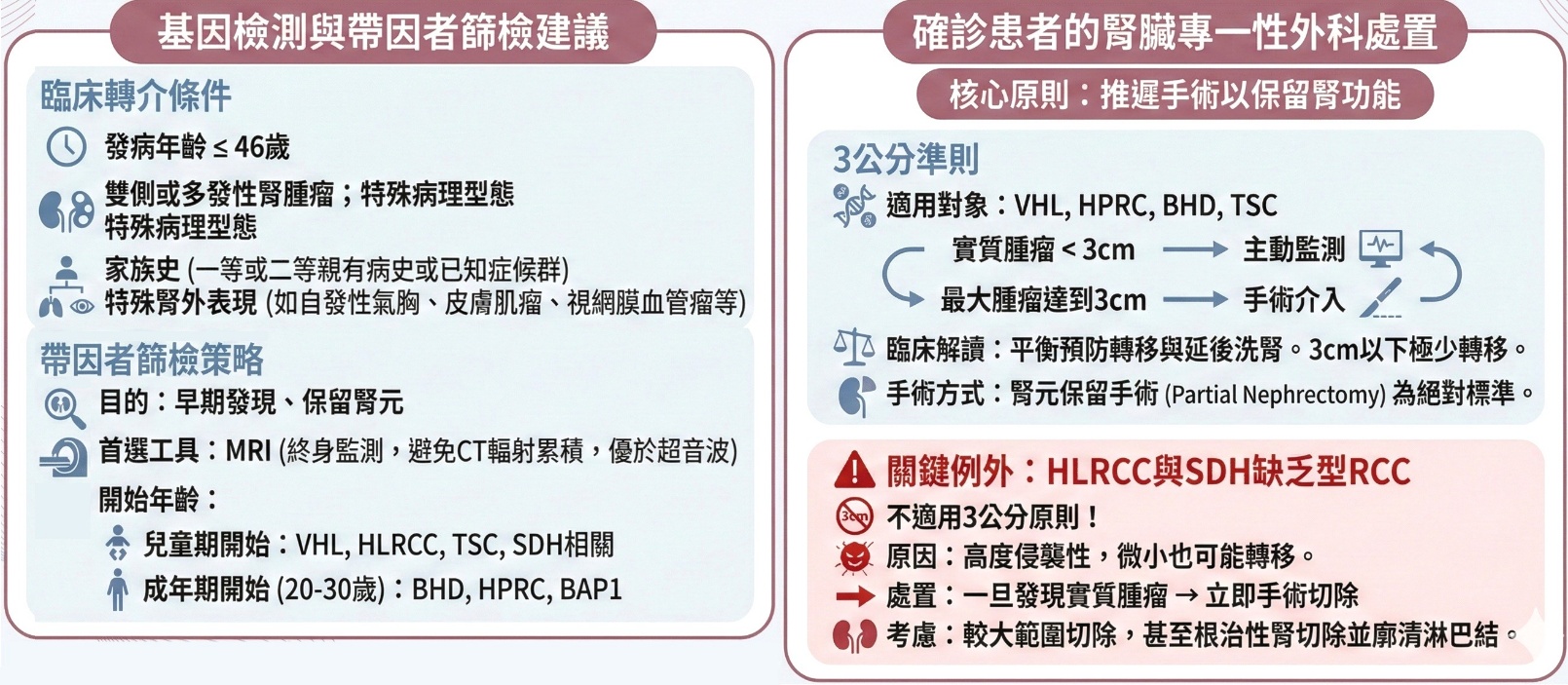
9.1 遺傳性腎癌的基因檢測與篩檢建議
住院醫師在臨床問診時,若發現患者符合以下任一條件,應轉介遺傳諮詢:
發病年齡: 診斷出腎癌時年齡 ≤ 46歲。
病理特徵: 雙側或多發性腎腫瘤;或具有特殊的病理型態 (如SDH缺乏型、混合型嗜酸細胞瘤) 。
家族史: 一等或二等親中有腎癌病史,或有已知的遺傳性腎癌綜合症。
臨床表徵: 合併有相關的腎外表現 (如自發性氣胸、多發性皮膚肌瘤、早發性子宮肌瘤、視網膜血管母細胞瘤) 。
9.1.1 帶因者的篩檢策略
對於已確診帶有致病突變但尚未發病的個體,篩檢的目的是「早期發現、保留腎元」。
影像工具:MRI是終身監測的首選工具。
這些患者需要從年輕時進行數十年的影像追蹤,MRI可避免CT帶來的累積輻射暴露風險,且MRI對於鑑別囊腫與實質腫瘤優於超音波。開始年齡:
兒童期開始:VHL, HLRCC, TSC, SDH相關症候群。腫瘤可能在兒童或青少年出現。
成年期開始:BHD, HPRC, BAP1症候群。通常建議從20-30歲開始篩檢。
9.2 確診遺傳性腎癌患者的腎臟專一性外科處置
對於遺傳性腎癌,手術決策與散發性腎癌截然不同。核心原則是推遲手術以保留腎功能。
9.2.1 3 公分準則 (The 3 cm Rule)
適用對象:VHL、HPRC、BHD、TSC患者。
執行方式:當實質腫瘤直徑小於3公分時,採取主動監測。直到最大腫瘤達到3公分時,才進行手術介入。
臨床解讀:因這些患者終其一生會不斷長出新腫瘤。若見影就開刀,患者將迅速面臨無腎狀態並依賴透析。研究顯示,這些症候群的腫瘤在3公分以下極少轉移。因此,3公分是一個安全閾值,旨在平衡預防轉移與延後洗腎。
手術方式:腎元保留手術 (Partial Nephrectomy) 是絕對標準。應避免根治性腎切除。
9.2.2 關鍵例外:HLRCC與SDH缺乏型RCC
不適用3公分原則:對於HLRCC (FH 突變) 與SDH缺乏型患者不適用。
立即手術:腫瘤具有高度侵襲性,即便微小也可能轉移。一旦影像學發現實質腫瘤,應立即手術切除,且需要較大範圍的切除邊界,甚至考慮根治性腎切除並廓清淋巴結。
9.3 確診遺傳性腎癌患者的腎臟專一性全身性治療
這是近年來進展最快的領域,從單純的手術切除轉向了精準藥物治療。
9.3.1 Von Hippel-Lindau (VHL)氏病:HIF-2α抑制劑的革命
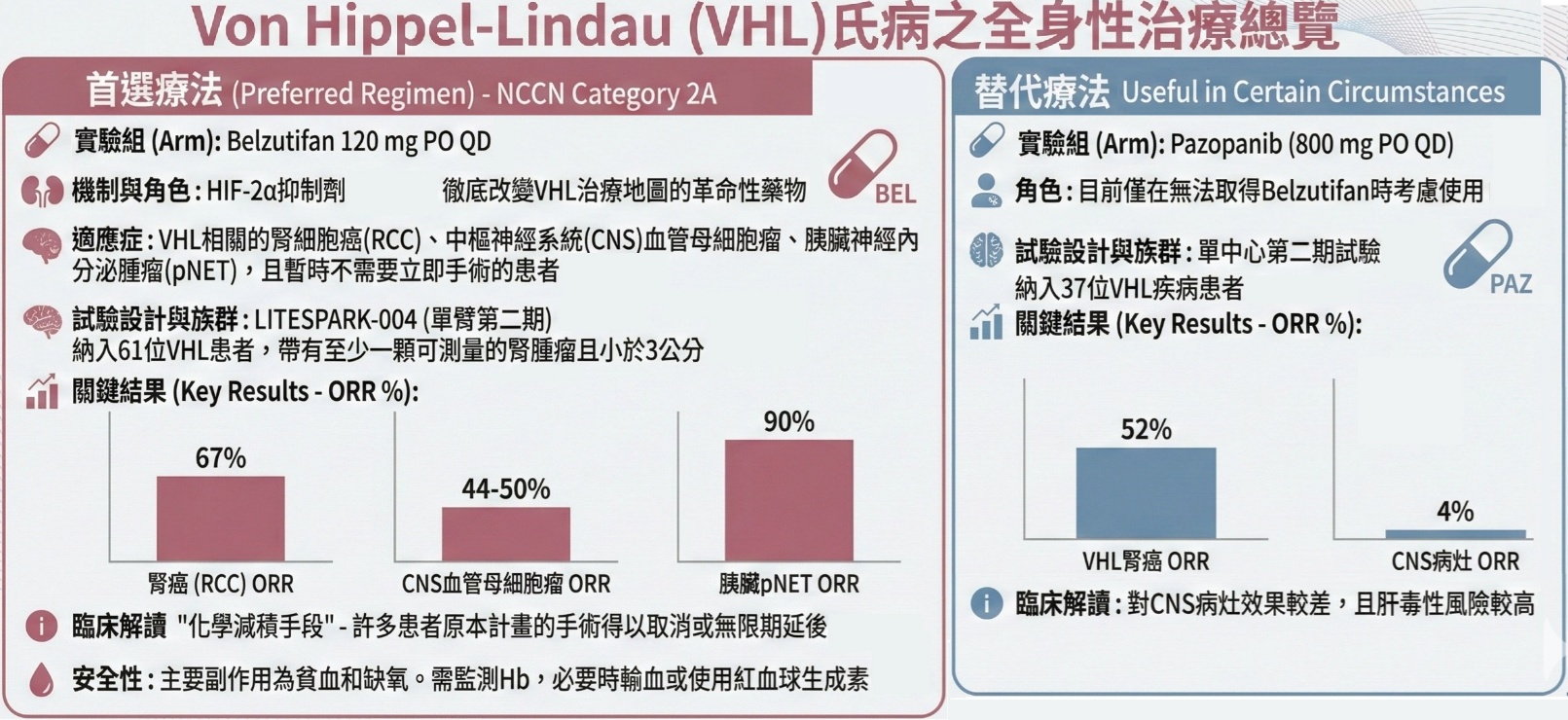
Belzutifan (Welireg)的問世徹底改變了VHL的治療地圖。
推薦等級:Category 2A, Preferred Regimen (首選療法)。(36)
適應症:用於治療VHL相關的腎細胞癌、中樞神經系統血管母細胞瘤、或胰臟神經內分泌腫瘤 (pNET),且暫時不需要立即手術的患者。
試驗設計:單臂第二期LITESPARK-004試驗,納入61位VHL疾病患者,帶有至少一顆可測量的腎腫瘤且小於3公分;並給予Belzutifan 120 mg PO QD治療。
關鍵結果:腎癌ORR: 67%;CNS血管母細胞瘤ORR: 44-50%;胰臟pNET ORR:90%。
免除手術之可能: 許多患者在服用Belzutifan後,原本計畫的手術得以取消或無限期延後。這被視為一種化學減積手段。
安全性:主要副作用為貧血和缺氧。需監測Hb,必要時需輸血或使用紅血球生成素。
替代療法:Pazopanib (Category 2A, Useful in Certain Circumstances)
試驗設計:一項單中心第二期試驗納入37位VHL疾病患者;並給予Pazopanib (800 mg PO QD) 治療。
關鍵結果:Pazopanib在VHL腎癌中有52%的反應率,但對CNS病灶效果較差 (僅4%),且肝毒性風險較高。目前僅在無法取得Belzutifan時考慮使用。(37)
9.3.2 Hereditary Leiomyomatosis and RCC (HLRCC)
這類患者的腫瘤具有高度侵襲性,阻斷VEGF與EGFR能有效控制此類腫瘤
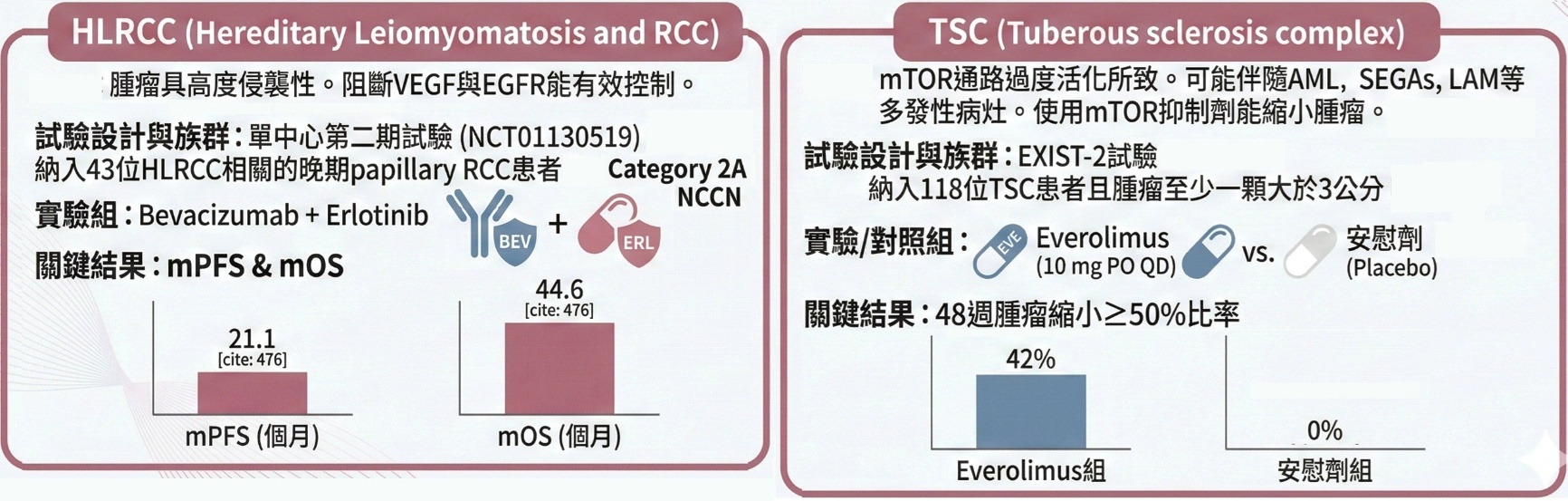
推薦療法:Bevacizumab + Erlotinib (Category 2A)。
試驗設計:一項單中心第二期試驗 (NCT01130519) 納入43位HLRCC相關的晚期papillary RCC患者。(38)
關鍵結果:mPFS: 21.1 個月;mOS: 44.6個月。
9.3.3 結節性硬化症 (TSC, Tuberous sclerosis complex)
結節性硬化症為罕見疾病,可能導致嚴重失能,並伴隨多發性病灶,包括:腎血管平滑肌脂肪瘤 (AML)、腦部室管膜下巨細胞星狀細胞瘤 (SEGAs)、肺部淋巴管平滑肌瘤病 (LAM)。
TSC是由於mTOR通路過度活化所致。使用mTOR抑制劑能縮小腎臟血管肌肉脂肪瘤的體積,預防破裂出血,並控制TSC相關的腎細胞癌。
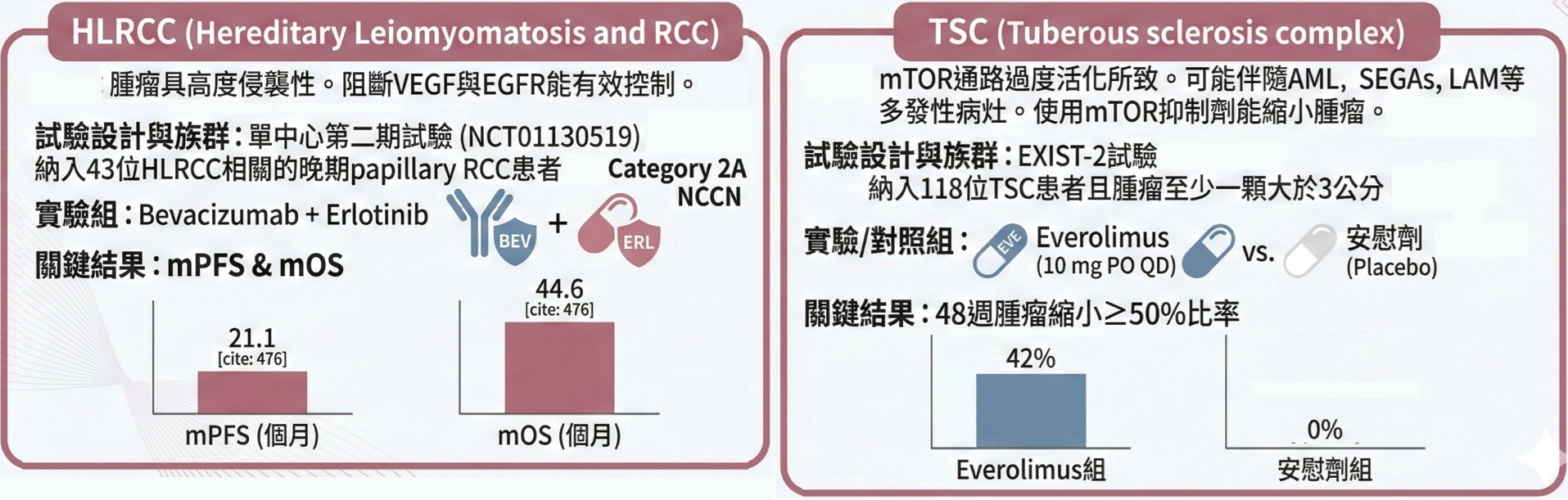
推薦療法:Everolimus。
試驗設計:EXIST-2試驗納入118位TSC患者且腫瘤至少一顆大於3公分,並讓患者隨機分派到Everolimus (10 mg PO QD) 或是安慰劑治療。(39)
關鍵結果:48週腫瘤體積縮小至少50%之比率為:42% vs 0%。
總結 (Conclusion)
手術策略的精準化: 腎元保留手術 (PN) 已確立為T1期腫瘤的標準治療。而對於小型腎腫瘤 (<4 cm),主動監測為避免過度治療的積極策略。
輔助治療的典範轉移: KEYNOTE-564試驗的成功,確立了Pembrolizumab在高風險ccRCC術後輔助治療的標準地位,這與過去TKI時代的挫敗形成了鮮明對比。
轉移性ccRCC的治療首選:所有風險患者建議使用VEGFR TKI+IO組合療法;而中高風險首選患者可選擇雙免疫。
後線治療新武器:除了轉換TKI,Belzutifan為ccRCC提供了精準打擊的新選擇。
非透明細胞癌的曙光:Cabozantinib成為首個具有高等級證據的標準治療。
對於VHL遺傳性腎癌,Belzutifan的出現讓患者有了免於手術的新希望。
References:
National Comprehensive Cancer Network. NCCN Clinical Practice Guidelines in Oncology (NCCN Guidelines®). Kidney Cancer. Version 1.2026. https://www.nccn.org/professionals/physician_gls/pdf/kidney.pdf. Published 2025. Accessed January 19, 2026.
Choueiri TK, Motzer RJ. Systemic Therapy for Metastatic Renal-Cell Carcinoma. N Engl J Med. 2017;376(4):354-366.
National Comprehensive Cancer Network. NCCN Guidelines for Patients®. Kidney Cancer. 2025 Edition. https://www.nccn.org/patients/guidelines/content/PDF/kidney-patient.pdf. Published 2025. Accessed January 19, 2026.
Muglia VF, Prando A. Renal cell carcinoma: histological classification and correlation with imaging findings. Radiol Bras. 2015;48(3):166-174.
Hsieh JJ, Purdue MP, Signoretti S, et al. Renal cell carcinoma. Nat Rev Dis Primers. 2017;3:17009. Published 2017 Mar 9.
Health Promotion Administration, Ministry of Health and Welfare, Taiwan. 2021 Cancer Registry Report. Taipei, Taiwan: Health Promotion Administration; 2023.
Amin MB, Greene FL, Edge SB, et al. The Eighth Edition AJCC Cancer Staging Manual: Continuing to build a bridge from a population-based to a more "personalized" approach to cancer staging. CA Cancer J Clin. 2017;67(2):93-99.
Blom JH, van Poppel H, Maréchal JM, et al. Radical nephrectomy with and without lymph-node dissection: final results of European Organization for Research and Treatment of Cancer (EORTC) randomized phase 3 trial 30881. Eur Urol. 2009;55(1):28-34.
Haas NB, Manola J, Uzzo RG, et al. Adjuvant sunitinib or sorafenib for high-risk, non-metastatic renal-cell carcinoma (ECOG-ACRIN E2805): a double-blind, placebo-controlled, randomised, phase 3 trial. Lancet. 2016;387(10032):2008-2016.
Ravaud A, Motzer RJ, Pandha HS, et al. Adjuvant Sunitinib in High-Risk Renal-Cell Carcinoma after Nephrectomy. N Engl J Med. 2016;375(23):2246-2254.
Motzer RJ, Haas NB, Donskov F, et al. Randomized Phase III Trial of Adjuvant Pazopanib Versus Placebo After Nephrectomy in Patients With Localized or Locally Advanced Renal Cell Carcinoma. J Clin Oncol. 2017;35(35):3916-3923.
Gross-Goupil M, Kwon TG, Eto M, et al. Axitinib versus placebo as an adjuvant treatment of renal cell carcinoma: results from the phase III, randomized ATLAS trial. Ann Oncol. 2018;29(12):2371-2378.
Choueiri TK, Tomczak P, Park SH, et al. Overall Survival with Adjuvant Pembrolizumab in Renal-Cell Carcinoma. N Engl J Med. 2024;390(15):1359-1371.
Mekhail TM, Abou-Jawde RM, Boumerhi G, et al. Validation and extension of the Memorial Sloan-Kettering prognostic factors model for survival in patients with previously untreated metastatic renal cell carcinoma. J Clin Oncol. 2005;23(4):832-841.
Heng DY, Xie W, Regan MM, et al. Prognostic factors for overall survival in patients with metastatic renal cell carcinoma treated with vascular endothelial growth factor-targeted agents: results from a large, multicenter study. J Clin Oncol. 2009;27(34):5794-5799.
Méjean A, Ravaud A, Thezenas S, et al. Sunitinib Alone or after Nephrectomy in Metastatic Renal-Cell Carcinoma. N Engl J Med. 2018;379(5):417-427.
Rini BI, Plimack ER, Stus V, et al. Pembrolizumab plus axitinib versus sunitinib for advanced clear cell renal cell carcinoma: 5-year survival and biomarker analyses of the phase 3 KEYNOTE-426 trial. Nat Med. 2025;31(10):3475-3484.
Choueiri TK, Powles T, Burotto M, et al. Nivolumab plus Cabozantinib versus Sunitinib for Advanced Renal-Cell Carcinoma. N Engl J Med. 2021;384(9):829-841.
Motzer R, Alekseev B, Rha SY, et al. Lenvatinib plus Pembrolizumab or Everolimus for Advanced Renal Cell Carcinoma. N Engl J Med. 2021;384(14):1289-1300.
Motzer RJ, Tannir NM, McDermott DF, et al. Nivolumab plus Ipilimumab versus Sunitinib in Advanced Renal-Cell Carcinoma. N Engl J Med. 2018;378(14):1277-1290.
Choueiri TK, Hessel C, Halabi S, et al. Cabozantinib versus sunitinib as initial therapy for metastatic renal cell carcinoma of intermediate or poor risk (Alliance A031203 CABOSUN randomised trial): Progression-free survival by independent review and overall survival update. Eur J Cancer. 2018;94:115-125.
Choueiri TK, Escudier B, Powles T, et al. Cabozantinib versus everolimus in advanced renal cell carcinoma (METEOR): final results from a randomised, open-label, phase 3 trial. Lancet Oncol. 2016;17(7):917-927.
Rini BI, Pal SK, Escudier BJ, et al. Tivozanib versus sorafenib in patients with advanced renal cell carcinoma (TIVO-3): a phase 3, multicentre, randomised, controlled, open-label study. Lancet Oncol. 2020;21(1):95-104.
Powles T, Albiges L, Rini B. Belzutifan versus Everolimus for Advanced Renal-Cell Carcinoma. Reply. N Engl J Med. 2024;391(21):2062-2063.
Motzer RJ, Hutson TE, Glen H, et al. Lenvatinib, everolimus, and the combination in patients with metastatic renal cell carcinoma: a randomised, phase 2, open-label, multicentre trial. Lancet Oncol. 2015;16(15):1473-1482.
Motzer RJ, Escudier B, McDermott DF, et al. Nivolumab versus Everolimus in Advanced Renal-Cell Carcinoma. N Engl J Med. 2015;373(19):1803-1813.
Choueiri TK, Kluger H, George S, et al. FRACTION-RCC: nivolumab plus ipilimumab for advanced renal cell carcinoma after progression on immuno-oncology therapy. J Immunother Cancer. 2022;10(11):e005780.
Pal SK, Tangen C, Thompson IM Jr, et al. A comparison of sunitinib with cabozantinib, crizotinib, and savolitinib for treatment of advanced papillary renal cell carcinoma: a randomised, open-label, phase 2 trial. Lancet. 2021;397(10275):695-703.
Albiges L, Gurney H, Atduev V, et al. Pembrolizumab plus lenvatinib as first-line therapy for advanced non-clear-cell renal cell carcinoma (KEYNOTE-B61): a single-arm, multicentre, phase 2 trial. Lancet Oncol. 2023;24(8):881-891.
Lee CH, Voss MH, Carlo MI, et al. Phase II Trial of Cabozantinib Plus Nivolumab in Patients With Non-Clear-Cell Renal Cell Carcinoma and Genomic Correlates. J Clin Oncol. 2022;40(21):2333-2341.
McDermott DF, Lee JL, Ziobro M, et al. Open-Label, Single-Arm, Phase II Study of Pembrolizumab Monotherapy as First-Line Therapy in Patients With Advanced Non-Clear Cell Renal Cell Carcinoma. J Clin Oncol. 2021;39(9):1029-1039.
Tykodi SS, Gordan LN, Alter RS, et al. Safety and efficacy of nivolumab plus ipilimumab in patients with advanced non-clear cell renal cell carcinoma: results from the phase 3b/4 CheckMate 920 trial. J Immunother Cancer. 2022;10(2):e003844.
Armstrong AJ, Halabi S, Eisen T, et al. Everolimus versus sunitinib for patients with metastatic non-clear cell renal cell carcinoma (ASPEN): a multicentre, open-label, randomised phase 2 trial. Lancet Oncol. 2016;17(3):378-388.
Tannir NM, Jonasch E, Albiges L, et al. Everolimus Versus Sunitinib Prospective Evaluation in Metastatic Non-Clear Cell Renal Cell Carcinoma (ESPN): A Randomized Multicenter Phase 2 Trial. Eur Urol. 2016;69(5):866-874.
Santorsola M, Capuozzo M, Nasti G, et al. Exploring the Spectrum of VEGF Inhibitors' Toxicities from Systemic to Intra-Vitreal Usage in Medical Practice. Cancers (Basel). 2024;16(2):350. Published 2024 Jan 13.
Srinivasan R, Iliopoulos O, Beckermann KE, et al. Belzutifan for von Hippel-Lindau disease-associated renal cell carcinoma and other neoplasms (LITESPARK-004): 50 months follow-up from a single-arm, phase 2 study. Lancet Oncol. 2025;26(5):571-582.
Jonasch E, McCutcheon IE, Gombos DS, et al. Pazopanib in patients with von Hippel-Lindau disease: a single-arm, single-centre, phase 2 trial. Lancet Oncol. 2018;19(10):1351-1359.
Srinivasan R, Gurram S, Singer EA, et al. Bevacizumab and Erlotinib in Hereditary and Sporadic Papillary Kidney Cancer. N Engl J Med. 2025;392(23):2346-2356.
Sooriakumaran P, Anderson CJ. Everolimus for renal angiomyolipoma in tuberous sclerosis. Lancet. 2013;381(9869):783-785.
整本手冊的 PDF 與重點簡報摘要在手冊首頁。