
第九章、非尿路上皮膀胱癌
發布日期:2026-01-31
本章目錄
組織學特性與診斷建議:膀胱癌中約有 5–10% 屬於非尿路上皮組織型態,此類亞型通常具有較高侵略性,且對標準治療的反應差異較大。NCCN 指引建議,對於疑似非尿路上皮組織型態的病例,應儘可能諮詢專科病理醫師以確認診斷。 [4]
晚期療法選項:Nivolumab 合併 Ipilimumab(Nivolumab:3 mg/kg;Ipilimumab:1 mg/kg,IV Q3W × 4 療程,之後接續 Nivolumab 維持治療 480 mg IV Q4W)。一項納入 19 位非尿路上皮組織型態之膀胱癌或泌尿道癌患者的研究顯示,其整體反應率(ORR)可達 37%。然而,此類患者族群罕見且高度異質,試驗樣本數有限,現階段仍無法全面確認其療效。 [58]
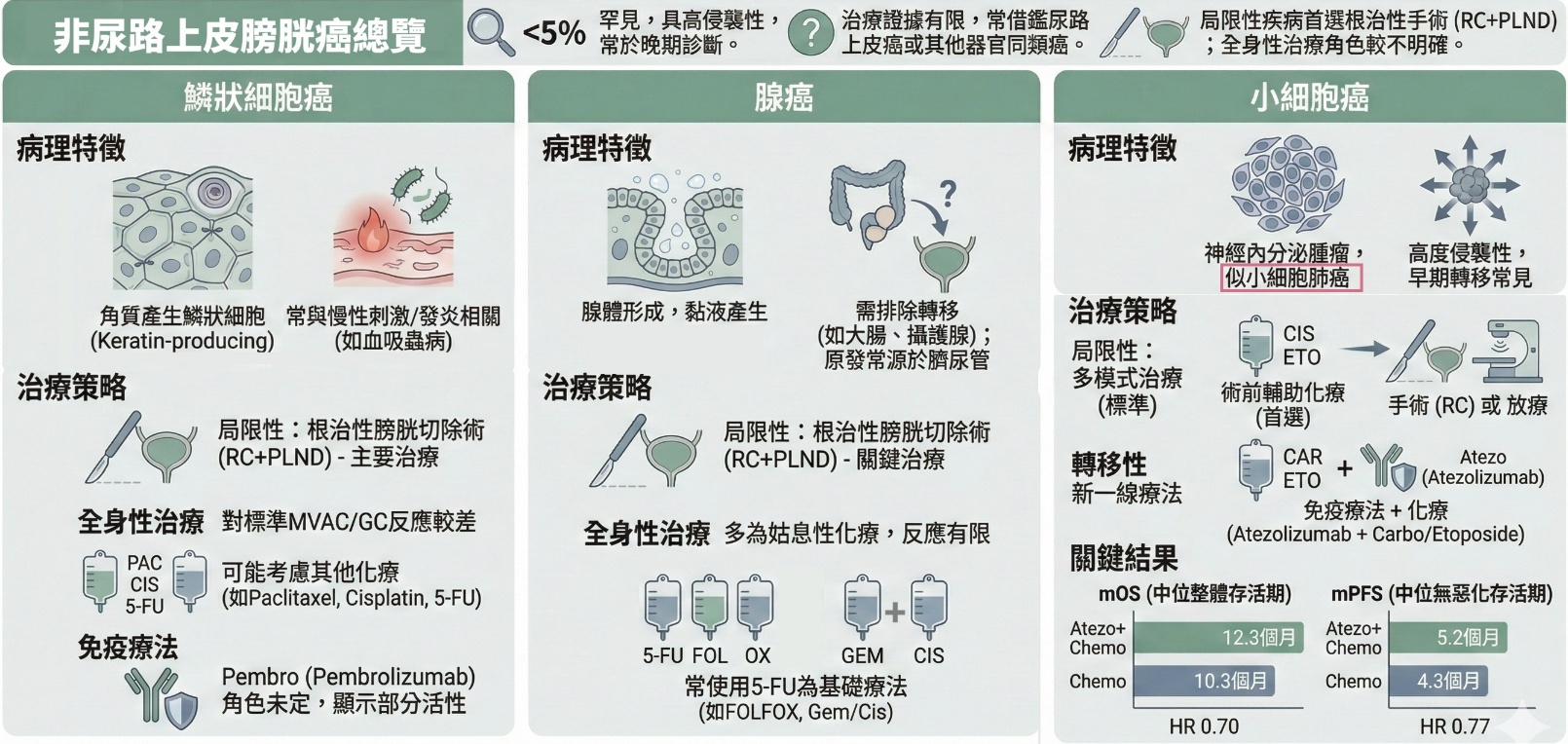
9.1 小細胞/神經內分泌癌 (Small Cell/Neuroendocrine)
特性:極具侵略性,常早期轉移,生物學行為類似小細胞肺癌 (SCLC)。
治療原則:[4]
全身性治療:不應使用膀胱癌的標準化療,而應採用類似小細胞肺癌的化療療法,如 Etoposide + Cisplatin (EP)或與Ifosfamide + Doxorubicin交替使用。
局部治療:對於侷限性疾病,術前輔助化療後接續手術或放射治療是標準做法。
腦部預防:由於高腦轉移風險,建議進行腦部 MRI 篩檢。
9.2 純鱗狀細胞癌 (Pure Squamous Cell Carcinoma)
特性:與慢性刺激 (如血吸蟲感染、長期導尿管、結石) 有關。對傳統化療及免疫治療反應差。
治療原則:[4]
局部疾病:以根除性膀胱切除術為主。術前/術後化療的角色不明確。
轉移性疾病:目前無標準化療療法,可考慮Paclitaxel, Ifosfamide, Cisplatin等藥物,或鼓勵參加臨床試驗。
9.3 純腺癌 (Pure Adenocarcinoma)
包括:臍尿管腺癌 (Urachal carcinoma) 及非臍尿管腺癌。
治療原則[4]
臍尿管腺癌:首選部分或根除性膀胱切除術,並需整塊切除臍尿管韌帶及肚臍 (En-bloc resection) 。
轉移性疾病:化療療法通常參考大腸直腸癌的治療指引 (如 FOLFOX, FOLFIRI) 或使用 5-FU, Gemcitabine, Cisplatin。因為這些腫瘤在基因表現上更接近腸道腫瘤。
總結與展望
根據區域效應學說(field cancerization theory),尿路上皮細胞長期暴露並浸泡於含致癌物質的尿液中,因而逐漸產生癌變。臨床上,膀胱癌依腫瘤侵犯深度由內而外分為三大類:非肌肉侵犯性膀胱癌(NMIBC)、肌肉侵犯性膀胱癌(MIBC),以及轉移性膀胱癌(MBC)。
診斷流程需整合膀胱鏡檢查、經尿道膀胱腫瘤切除術 (TURBT) 與病理切片,並應特別警覺如微乳頭狀、漿細胞樣或小細胞癌等具備高度侵襲性的特殊組織亞型。
NMIBC的治療核心在於完整的手術切除腫瘤病灶,並配合卡介苗(BCG)或化學治療藥物(如 Gemcitabine)進行膀胱內灌注治療,以因應其高復發風險,並預防疾病進展至肌肉侵犯階段。
針對MIBC,黃金標準治療為根治性膀胱切除術合併淋巴結清除,且強烈建議配合術前輔助化療 (ddMVAC) 或新型的EV + Pembrolizumab 圍手術期療法以降低微觀轉移風險 。
轉移性膀胱癌的一線治療已迎來重大變革,EV + Pembrolizumab (EV+P) 組合療法顯著突破了生存屏障,成為不論患者是否適合順鉑 (Cisplatin) 的新一代黃金標準。
精準醫療在後線治療中扮演關鍵角色,透過基因檢測篩選FGFR變異或HER2表達的患者,可選用 Erdafitinib 或標靶抗體藥物複合體 (ADC) 提供更有效的個體化選擇。
除了對不同分期的患者實施長期的影像與內視鏡監測外,針對罕見的非尿路上皮癌 (如鱗狀細胞癌或腺癌),則需跳脫傳統尿路上皮癌的治療框架,採取更具針對性的個別化處置策略。
作者:癌症資訊雜貨店 傅彥崴 藥師
References:
Bolla SR, Odeluga N, Amraei R, et al. Histology, Bladder. [Updated 2023 Feb 25]. In: StatPearls [Internet]. Treasure Island (FL): StatPearls Publishing; 2025 Jan-. Available from: https://www.ncbi.nlm.nih.gov/books/NBK540963/.
Castillo-Martin M, Domingo-Domenech J, Karni-Schmidt O, Matos T, Cordon-Cardo C. Molecular pathways of urothelial development and bladder tumorigenesis. Urol Oncol. 2010;28(4):401-408.
Jones TD, Wang M, Eble JN, et al. Molecular evidence supporting field effect in urothelial carcinogenesis. Clin Cancer Res. 2005;11(18):6512-6519.
National Comprehensive Cancer Network. NCCN Clinical Practice Guidelines in Oncology (NCCN Guidelines®): Bladder Cancer. Version 3.2025. Published December 19, 2025. Accessed January 23, 2026. https://www.nccn.org/professionals/physician_gls/pdf/bladder.pdf.
Jubber I, Ong S, Bukavina L, et al. Epidemiology of Bladder Cancer in 2023: A Systematic Review of Risk Factors. Eur Urol. 2023;84(2):176-190.
Travis LB, Curtis RE, Glimelius B, et al. Bladder and kidney cancer following cyclophosphamide therapy for non-Hodgkin's lymphoma. J Natl Cancer Inst. 1995;87(7):524-530.
Health Promotion Administration, Ministry of Health and Welfare, Taiwan. 111 nian ai zheng deng ji bao gao [2022 Cancer Registry Report]. Health Promotion Administration, Ministry of Health and Welfare; 2024. Accessed January 23, 2026. https://www.hpa.gov.tw/Pages/List.aspx?nodeid=119.
Compérat E, Amin MB, Cathomas R, et al. Current best practice for bladder cancer: a narrative review of diagnostics and treatments. Lancet. 2022;400(10364):1712-1721.
Soave A, Schmidt S, Dahlem R, et al. Clinical outcomes of patients with variant histology of urothelial carcinoma after radical cystectomy. Surg Oncol. 2015;24(4):322-331.
National Comprehensive Cancer Network. NCCN Guidelines for Patients: Bladder Cancer. 2025 version. Published 2025. Accessed January 23, 2026. https://www.nccn.org/patientguidelines.
Netto GJ, Amin MB, Berney DM, et al. The 2022 World Health Organization Classification of Tumors of the Urinary System and Male Genital Organs-Part B: Prostate and Urinary Tract Tumors. Eur Urol. 2022;82(5):469-482.
Amin MB, Greene FL, Edge SB, et al. The Eighth Edition AJCC Cancer Staging Manual: Continuing to build a bridge from a population-based to a more "personalized" approach to cancer staging. CA Cancer J Clin. 2017;67(2):93-99.
Baumgartner R, Chang S, Flick S, et al. Intravesical Administration of Therapeutic Medication for the Treatment of Bladder Cancer. American Urological Association; 2020. Accessed January 26, 2026. https://www.auanet.org/about-us/aua-statements/intravesical-administration-of-therapeutic-medication.
Messing EM, Tangen CM, Lerner SP, et al. Effect of Intravesical Instillation of Gemcitabine vs Saline Immediately Following Resection of Suspected Low-Grade Non-Muscle-Invasive Bladder Cancer on Tumor Recurrence: SWOG S0337 Randomized Clinical Trial. JAMA. 2018;319(18):1880-1888.
Redelman-Sidi G, Glickman MS, Bochner BH. The mechanism of action of BCG therapy for bladder cancer-a current perspective. Nat Rev Urol. 2014;11(3):153-162.
Herr HW, Morales A. History of bacillus Calmette-Guerin and bladder cancer: an immunotherapy success story. J Urol. 2008;179(1):53-56.
Sylvester RJ, Brausi MA, Kirkels WJ, et al. Long-term efficacy results of EORTC genito-urinary group randomized phase 3 study 30911 comparing intravesical instillations of epirubicin, bacillus Calmette-Guérin, and bacillus Calmette-Guérin plus isoniazid in patients with intermediate- and high-risk stage Ta T1 urothelial carcinoma of the bladder. Eur Urol. 2010;57(5):766-773.
Lamm DL, Blumenstein BA, Crissman JD, et al. Maintenance bacillus Calmette-Guerin immunotherapy for recurrent TA, T1 and carcinoma in situ transitional cell carcinoma of the bladder: a randomized Southwest Oncology Group Study. J Urol. 2000;163(4):1124-1129.
Oddens J, Brausi M, Sylvester R, et al. Final results of an EORTC-GU cancers group randomized study of maintenance bacillus Calmette-Guérin in intermediate- and high-risk Ta, T1 papillary carcinoma of the urinary bladder: one-third dose versus full dose and 1 year versus 3 years of maintenance. Eur Urol. 2013;63(3):462-472.
Grimm MO, van der Heijden AG, Colombel M, et al. Treatment of High-grade Non-muscle-invasive Bladder Carcinoma by Standard Number and Dose of BCG Instillations Versus Reduced Number and Standard Dose of BCG Instillations: Results of the European Association of Urology Research Foundation Randomised Phase III Clinical Trial "NIMBUS". Eur Urol. 2020;78(5):690-698.
Daneshmand S, Kamat AM, Shore ND, et al. Development of TAR-200: A novel targeted releasing system designed to provide sustained delivery of gemcitabine for patients with bladder cancer. Urol Oncol. 2025;43(5):286-296.
Daneshmand S, Van der Heijden MS, Jacob JM, et al. TAR-200 for Bacillus Calmette-Guérin-Unresponsive High-Risk Non-Muscle-Invasive Bladder Cancer: Results From the Phase IIb SunRISe-1 Study. J Clin Oncol. 2025;43(33):3578-3588.
Balar AV, Kamat AM, Kulkarni GS, et al. Pembrolizumab monotherapy for the treatment of high-risk non-muscle-invasive bladder cancer unresponsive to BCG (KEYNOTE-057): an open-label, single-arm, multicentre, phase 2 study. Lancet Oncol. 2021;22(7):919-930.
Boorjian SA, Alemozaffar M, Konety BR, et al. Intravesical nadofaragene firadenovec gene therapy for BCG-unresponsive non-muscle-invasive bladder cancer: a single-arm, open-label, repeat-dose clinical trial. Lancet Oncol. 2021;22(1):107-117.
Chamie K, Chang SS, Kramolowsky E, et al. IL-15 Superagonist NAI in BCG-Unresponsive Non-Muscle-Invasive Bladder Cancer. NEJM Evid. 2023;2(1):EVIDoa2200167.
Chang SS, Boorjian SA, Chou R, et al. Diagnosis and Treatment of Non-Muscle Invasive Bladder Cancer: AUA/SUO Guideline. J Urol. 2016;196(4):1021-1029.
Perera M, McGrath S, Sengupta S, Crozier J, Bolton D, Lawrentschuk N. Pelvic lymph node dissection during radical cystectomy for muscle-invasive bladder cancer. Nat Rev Urol. 2018;15(11):686-692.
Lerner SP, Tangen C, Svatek RS, et al. Standard or Extended Lymphadenectomy for Muscle-Invasive Bladder Cancer. N Engl J Med. 2024;391(13):1206-1216.
Hautmann RE, Hautmann SH, Hautmann O. Complications associated with urinary diversion. Nat Rev Urol. 2011;8(12):667-677. Published 2011 Nov 1.
Sternberg CN, Yagoda A, Scher HI, et al. Preliminary results of M-VAC (methotrexate, vinblastine, doxorubicin and cisplatin) for transitional cell carcinoma of the urothelium. J Urol. 1985;133(3):403-407.
von der Maase H, Hansen SW, Roberts JT, et al. Gemcitabine and cisplatin versus methotrexate, vinblastine, doxorubicin, and cisplatin in advanced or metastatic bladder cancer: results of a large, randomized, multinational, multicenter, phase III study. J Clin Oncol. 2000;18(17):3068-3077.
Grossman HB, Natale RB, Tangen CM, et al. Neoadjuvant chemotherapy plus cystectomy compared with cystectomy alone for locally advanced bladder cancer. N Engl J Med. 2003;349(9):859-866.
Pfister C, Gravis G, Flechon A, et al. Perioperative dose-dense methotrexate, vinblastine, doxorubicin, and cisplatin in muscle-invasive bladder cancer (VESPER): survival endpoints at 5 years in an open-label, randomised, phase 3 study. Lancet Oncol. 2024;25(2):255-264.
LBA2 Perioperative (periop) enfortumab vedotin (EV) plus pembrolizumab (pembro) in participants (pts) with muscle-invasive bladder cancer (MIBC) who are cisplatin-ineligible: The phase III KEYNOTE-905 study Vulsteke, C. et al. Annals of Oncology, Volume 36, S1648.
Galsky MD, Witjes JA, Gschwend JE, et al. Adjuvant Nivolumab in High-Risk Muscle-Invasive Urothelial Carcinoma: Expanded Efficacy From CheckMate 274. J Clin Oncol. 2025;43(1):15-21.
Bellmunt J, Hussain M, Gschwend JE, et al. Adjuvant atezolizumab versus observation in muscle-invasive urothelial carcinoma (IMvigor010): a multicentre, open-label, randomised, phase 3 trial. Lancet Oncol. 2021;22(4):525-537.
Leow JJ, Martin-Doyle W, Rajagopal PS, et al. Adjuvant chemotherapy for invasive bladder cancer: a 2013 updated systematic review and meta-analysis of randomized trials. Eur Urol. 2014;66(1):42-54.
Kimura T, Ishikawa H, Kojima T, et al. Bladder preservation therapy for muscle invasive bladder cancer: the past, present and future. Jpn J Clin Oncol. 2020;50(10):1097-1107.
James ND, Hussain SA, Hall E, et al. Radiotherapy with or without chemotherapy in muscle-invasive bladder cancer. N Engl J Med. 2012;366(16):1477-1488.
Mak RH, Hunt D, Shipley WU, et al. Long-term outcomes in patients with muscle-invasive bladder cancer after selective bladder-preserving combined-modality therapy: a pooled analysis of Radiation Therapy Oncology Group protocols 8802, 8903, 9506, 9706, 9906, and 0233. J Clin Oncol. 2014;32(34):3801-3809.
Coen JJ, Zhang P, Saylor PJ, et al. Bladder Preservation With Twice-a-Day Radiation Plus Fluorouracil/Cisplatin or Once Daily Radiation Plus Gemcitabine for Muscle-Invasive Bladder Cancer: NRG/RTOG 0712-A Randomized Phase II Trial. J Clin Oncol. 2019;37(1):44-51.
Choudhury A, Porta N, Hall E, et al. Hypofractionated radiotherapy in locally advanced bladder cancer: an individual patient data meta-analysis of the BC2001 and BCON trials. Lancet Oncol. 2021;22(2):246-255.
Hermans TJ, Fransen van de Putte EE, Horenblas S, et al. Pathological downstaging and survival after induction chemotherapy and radical cystectomy for clinically node-positive bladder cancer-Results of a nationwide population-based study. Eur J Cancer. 2016;69:1-8.
Picozzi S, Ricci C, Gaeta M, et al. Upper urinary tract recurrence following radical cystectomy for bladder cancer: a meta-analysis on 13,185 patients. J Urol. 2012;188(6):2046-2054.
Patel V, Collazo Lorduy A, Stern A, et al. Survival after Metastasectomy for Metastatic Urothelial Carcinoma: A Systematic Review and Meta-Analysis. Bladder Cancer. 2017;3(2):121-132. Published 2017 Apr 27.
Galsky MD, Hahn NM, Rosenberg J, et al. Treatment of patients with metastatic urothelial cancer "unfit" for Cisplatin-based chemotherapy. J Clin Oncol. 2011;29(17):2432-2438.
Chatterjee S, Sinha S, Kundu CN. Nectin cell adhesion molecule-4 (NECTIN-4): A potential target for cancer therapy. Eur J Pharmacol. 2021;911:174516.
Powles T, Valderrama BP, Gupta S, et al. Enfortumab Vedotin and Pembrolizumab in Untreated Advanced Urothelial Cancer. N Engl J Med. 2024;390(10):875-888.
van der Heijden MS, Sonpavde G, Powles T, et al. Nivolumab plus Gemcitabine-Cisplatin in Advanced Urothelial Carcinoma. N Engl J Med. 2023;389(19):1778-1789.
Vuky J, Balar AV, Castellano D, et al. Long-Term Outcomes in KEYNOTE-052: Phase II Study Investigating First-Line Pembrolizumab in Cisplatin-Ineligible Patients With Locally Advanced or Metastatic Urothelial Cancer. J Clin Oncol. 2020;38(23):2658-2666.
Powles T, Park SH, Voog E, et al. Avelumab Maintenance Therapy for Advanced or Metastatic Urothelial Carcinoma. N Engl J Med. 2020;383(13):1218-1230.
Ascione CM, Napolitano F, Esposito D, et al. Role of FGFR3 in bladder cancer: Treatment landscape and future challenges. Cancer Treat Rev. 2023;115:102530.
Loriot Y, Matsubara N, Park SH, et al. Erdafitinib or Chemotherapy in Advanced or Metastatic Urothelial Carcinoma. N Engl J Med. 2023;389(21):1961-1971.
Powles T, Rosenberg JE, Sonpavde GP, et al. Enfortumab Vedotin in Previously Treated Advanced Urothelial Carcinoma. N Engl J Med. 2021;384(12):1125-1135.
Loriot Y, Petrylak DP, Rezazadeh Kalebasty A, et al. TROPHY-U-01, a phase II open-label study of sacituzumab govitecan in patients with metastatic urothelial carcinoma progressing after platinum-based chemotherapy and checkpoint inhibitors: updated safety and efficacy outcomes. Ann Oncol. 2024;35(4):392-401.
Meric-Bernstam F, Makker V, Oaknin A, et al. Efficacy and Safety of Trastuzumab Deruxtecan in Patients With HER2-Expressing Solid Tumors: Primary Results From the DESTINY-PanTumor02 Phase II Trial. J Clin Oncol. 2024;42(1):47-58.
Bellmunt J, de Wit R, Vaughn DJ, et al. Pembrolizumab as Second-Line Therapy for Advanced Urothelial Carcinoma. N Engl J Med. 2017;376(11):1015-1026.
McGregor BA, Campbell MT, Xie W, et al. Results of a multicenter, phase 2 study of nivolumab and ipilimumab for patients with advanced rare genitourinary malignancies. Cancer. 2021;127(6):840-849.
整本手冊的 PDF 與重點簡報摘要在手冊首頁。