
十六、三陰性轉移性乳癌之治療選擇 (5)
發布日期:2025-12-01 更新日期:2025-12-23
本章目錄
- 16-1. TNBC 診斷與一線治療篩選依據
- 16-2. 一線治療:PD-L1抑制劑的角色與療效
- 16-3. PARP抑制劑及鉑類化療在 BRCA1/2 突變 TNBC 中的應用
- 16-4. 新型 ADC 藥物:Sacituzumab Govitecan
- 16-5. TNBC 轉移性乳癌核心臨床試驗數據彙整
- 乳癌治療總結
- 附錄1 乳癌抗癌藥物總覽
- 1. Hormone (Endocrine) Therapies
- 2. CDK4/6 Inhibitors
- 3. PI3K / AKT / mTOR Pathway Inhibitors
- 4. HER2-Targeted Therapies
- 5. Antibody-Drug Conjugates (ADCs)
- 6. Immunotherapy & PARP Inhibitors
- 7. Chemotherapy (Cytotoxic)
TNBC(ER-、PR-、HER2-)是一種侵襲性強的乳癌亞型,缺乏荷爾蒙受體和 HER2 的靶點,因此治療主要依賴化療、免疫檢查點抑制劑、PARP 抑制劑和新型抗體藥物複合體(ADC)。
16-1. TNBC 診斷與一線治療篩選依據
在診斷 TNBC 時,必須進行兩項關鍵的生物標誌物篩查:
PD-L1 狀態(Combined Positive Score, CPS): 用於評估免疫檢查點抑制劑(如 Pembrolizumab)的適用性。
Germline BRCA1/2 突變: 用於指導 PARP 抑制劑的應用。
16-2. 一線治療:PD-L1抑制劑的角色與療效
PD-L1 陽性(CPS ≥ 10)策略
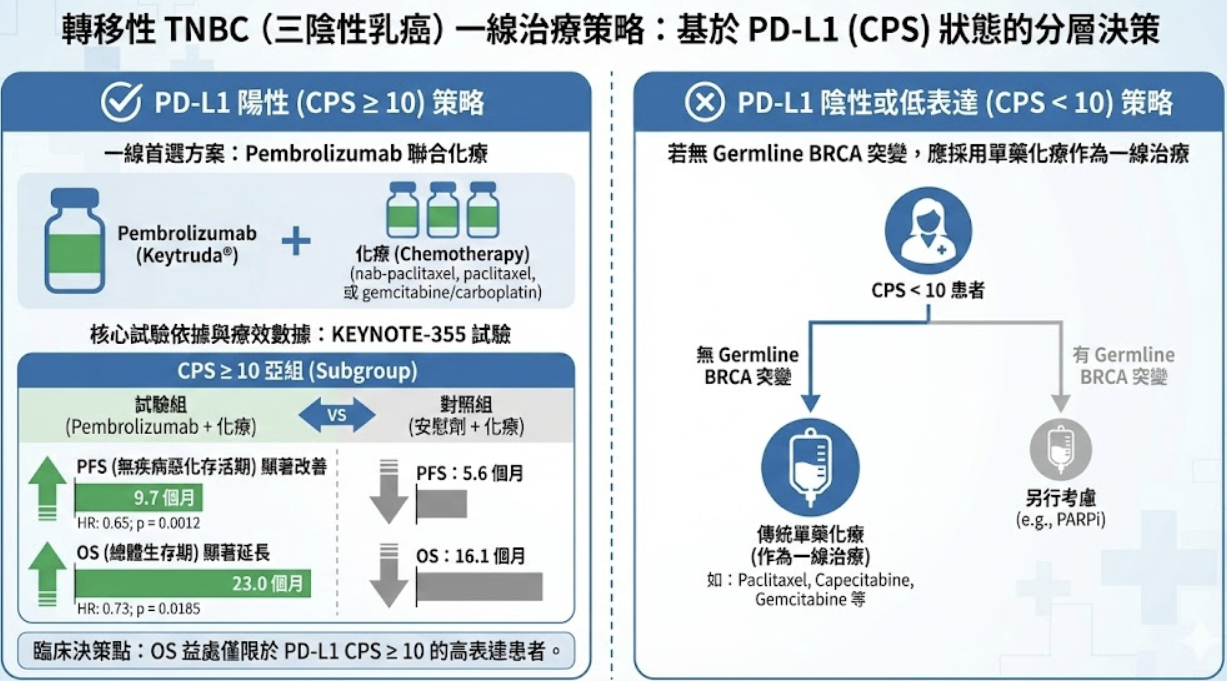
對於 PD-L1 狀態為 CPS ≥10 的患者,無論其 Germline BRCA 狀態如何,一線治療的首選是 Pembrolizumab (Keytruda®) 聯合化療。
核心試驗依據與療效數據:KEYNOTE-355 試驗 (40)
KEYNOTE-355 是一項 III 期試驗,比較 Pembrolizumab 聯合化療(nab-paclitaxel, paclitaxel, 或 gemcitabine/carboplatin)與安慰劑聯合化療在局部復發不可切除或轉移性 TNBC 患者中的療效。
CPS ≥ 10 亞組 PFS: Pembrolizumab 組合顯著改善 PFS (9.7 個月 vs 5.6 個月),HR: 0.65; p = 0.0012。
CPS ≥ 10 亞組 OS: 最終分析證實,Pembrolizumab 組合顯著延長 OS (23.0 個月 vs 16.1 個月),HR: 0.73; p = 0.0185。
臨床決策點: 該試驗確立了免疫治療的地位,但其 OS 益處僅限於 PD-L1 CPS ≥ 10 的高表達患者。
PD-L1 陰性或低表達(CPS < 10)策略
對於 PD-L1 CPS < 10 的患者,如果不存在 Germline BRCA 突變,則應採用傳統的單藥化療作為一線治療。
16-3. PARP抑制劑及鉑類化療在 BRCA1/2 突變 TNBC 中的應用
對於具有 Germline BRCA1/2 突變且 HER2-陰性的 MBC 患者,PARP 抑制劑(Olaparib, Talazoparib)是優先於單藥化療或鉑類化療的選擇 。NCCN 指南將 Olaparib 或 Talazoparib 列為 Category 1 優先選項。
Olaparib (Lynparza®):OlympiAD 試驗 (37)
試驗設計: 比較 Olaparib 與醫師選擇的化療 (PCC) 在 gBRCA 突變、HER2-陰性MBC 患者中的療效。
結果: Olaparib 顯著改善 PFS (7.0 個月 vs 4.2 個月),HR 0.58; p < 0.001。在未接受過化療的一線治療患者中,OS 益處建議更為顯著 (HR 0.51)。
Talazoparib (Talzenna®):EMBRACA 試驗 (38)
結果: Talazoparib 顯著改善 PFS (8.6 個月 vs 5.6 個月),HR 0.542; p < 0.0001。
毒性管理: 兩種 PARP 抑制劑的主要毒性是血液學毒性,包括貧血和中性粒細胞減少。
16-4. 新型 ADC 藥物:Sacituzumab Govitecan
Sacituzumab Govitecan (Trodelvy®, SG) 是一種靶向 Trop-2 抗原的 ADC,在 TNBC 的後線治療中發揮關鍵作用。
核心試驗依據與療效數據:ASCENT 試驗 (39)
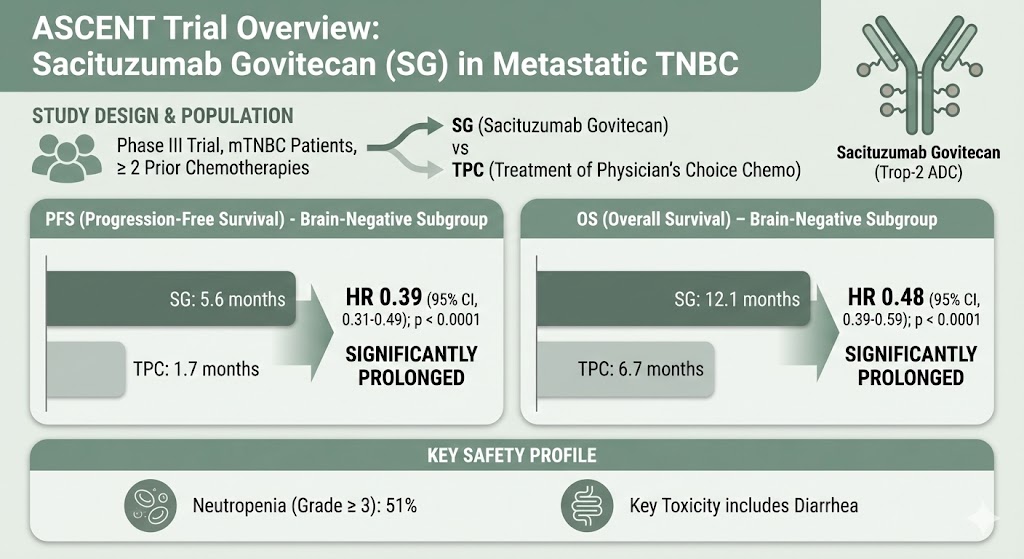
ASCENT 第III 期試驗,比較 SG 與醫師選擇的單藥化療 (TPC) 在 ≥ 2 線 TNBC 患者中的療效。
試驗收案族群: 適用於已接受至少 2 線化療的轉移性 TNBC 患者。
PFS (無腦轉移亞組): SG 顯著延長 PFS (5.6 個月 vs 1.7 個月),HR 0.39; p < 0.0001。
OS (無腦轉移亞組): SG 顯著延長 OS (12.1 個月 vs 6.7 個月),HR 0.48; p < 0.0001。
SG 的主要毒性包括中性粒細胞減少症(Grade ≥ 3 發生率 51%)和腹瀉。
16-5. TNBC 轉移性乳癌核心臨床試驗數據彙整
| 試驗名稱 | 標靶藥物/對照組 | 治療線數 | 選藥依據 | 中位 PFS(月) | PFS HR | 中位 OS (月) | OS HR |
| KEYNOTE-355 (40) | Pembrolizumab + Chemo vs Chemo | 一線 | PD-L1 CPS ≥ 10 | 9.7 vs 5.6 | 0.65 (P= 0.0012) | 23.0 vs 16.1 | 0.73 (P= 0.0185) |
| OlympiAD (37) | Olaparib vs standard therapy | 1-2 線 | gBRCA1/2 突變 | 7.0 vs 4.2 | 0.58 (P= <0.001) | 19.3 vs 19.6 | 0.90 (NS) |
| ASCENT (39) | Sacituzumab Govitecan | ≥ 2 線 | TNBC | 5.6 vs 1.7 | 0.39 (P< 0.0001) | 12.1 vs 6.7 | 0.48 (P <0.0001) |
乳癌治療總結
乳癌基礎、分期與臨床表現
乳癌的治療決策高度依賴病理分類與分子亞型。組織學上以浸潤性乳腺癌 (IDC) 最常見。臨床上依據 ER、PR、HER2 及 Ki-67 的表現分為四種亞型:Luminal A (預後佳,賀爾蒙治療為主)、Luminal B (可能需化療)、HER2 陽性 (具侵襲性,需標靶治療) 及三陰性乳癌 (TNBC,復發風險最高)。分期採用 TNM 系統,依據腫瘤大小、淋巴結轉移及遠處轉移分為 0-IV 期,第 I 期治癒率極高,第 IV 期則以延長存活為目標。臨床表現初期多為無痛腫塊,隨病程進展可能出現皮膚橘皮樣變化、乳頭凹陷或異常分泌物;若發生骨骼或肺部轉移,則伴隨相應器官的疼痛或呼吸困難。
早期乳癌治療策略與術前輔助化療 (Neoadjuvant Therapy) 決策
早期乳癌 (Stage I-III) 的治療目標為治癒。局部治療包含手術 (保留乳房手術或乳房切除) 與術後放射線治療。對於局部進階 (Stage III)、TNBC 或 HER2+ 患者,術前輔助治療為首選策略,旨在縮小腫瘤以利手術,目標達到病理完全緩解 (pCR)。全身性療法包括 TNBC 的 Pembrolizumab 結合化療 ,及 HER2+ 的雙標靶治療。
術後輔助治療 (Adjuvant Therapy):荷爾蒙、化學療法與 HER2 標靶治療
在術後輔助化療決策上,針對 HR+/HER2- 淋巴結陰性患者,建議使用基因檢測,依據復發分數 (RS) 決定是否化療;淋巴結陽性但停經後的低風險患者,化療亦可能無額外效益。
荷爾蒙受體陽性 (HR+) 患者需接受 5-10 年內分泌治療。停經前婦女以 Tamoxifen 為主,高風險者建議加上卵巢功能抑制 (OAS) 甚至合併芳香環轉化酶抑制劑 (AI);停經後婦女則首選 AI。針對高復發風險的 HR+ 患者,術後可選擇 CDK4/6 抑制劑 Abemaciclib 以降低復發率。
在 HER2 陽性早期乳癌方面,標準治療為化療合併 Trastuzumab 一年。對於高風險 (淋巴結陽性) 患者,建議加上 Pertuzumab 進行雙標靶輔助治療。若術前治療後仍有殘存病灶,則建議術後改用 ADC 藥物 T-DM1。
三陰性乳癌方面,則建議術後繼續使用Pembrolizumab 9個療程。
轉移性乳癌 (Stage IV) 的精準治療:
轉移性乳癌強調延長存活期與生活品質,治療策略依亞型而定。
HR+/HER2- 第一線標準治療為 CDK4/6 抑制劑 (如 Ribociclib) 合併內分泌治療;第二線後則依基因檢測 (ESR1, PIK3CA, AKT) 選擇標靶藥物,或針對 HER2-Low 患者使用 T-DXd。
HER2 陽性轉移性乳癌的第一線首選為 THP 雙標靶 (Trastuzumab+Pertuzumab) 與化療組合;第二線首選 T-DXd (Enhertu),療效優於 T-DM1。
三陰性乳癌 (TNBC) 若 PD-L1 陽性 (CPS≥10) 首選免疫治療 (Pembrolizumab) 合併化療;具 gBRCA 突變者優先使用 PARP 抑制劑;後線治療則可選用針對 Trop-2 的 ADC 藥物 (Sacituzumab Govitecan)。
附錄1 乳癌抗癌藥物總覽
1. Hormone (Endocrine) Therapies
主要用於 ER/PR 陽性癌症。常與其他標靶藥物(如 CDK4/6 抑制劑)合併使用
| Drug Name | Mechanism | ER/PR+ | HER2+ | TNBC | Setting | Major Side Effects |
|---|---|---|---|---|---|---|
Tamoxifen (Nolvadex®) |
SERM (Modulator) | ✓ | Risk Reduction, Adjuvant, Metastatic | Hot flashes, vaginal discharge/dryness, risk of blood clots, endometrial cancer risk. | ||
Raloxifene (Evista®) |
SERM | ✓ | Prevention only (High risk) | Hot flashes, leg cramps, blood clots (lower uterine cancer risk than Tamoxifen). | ||
Toremifene (Fareston®) |
SERM | ✓ | Metastatic | Hot flashes, sweating, nausea, QT prolongation. | ||
Fulvestrant (Faslodex®) |
SERD (Degrader) | ✓ | Adv/Metastatic | Injection site pain, hot flashes, fatigue, nausea, liver enzyme elevation. | ||
Elacestrant (Orserdu®) |
Oral SERD | ✓ | Adv/Metastatic (ESR1-mutated) | Nausea, fatigue, vomiting, decreased appetite, joint pain, cholesterol changes. | ||
Anastrozole (Arimidex®) Letrozole (Femara®) Exemestane (Aromasin®) |
Aromatase Inhibitors (AIs) | ✓ | Adjuvant, Neoadjuvant, Metastatic | Joint/muscle pain (arthralgia), bone thinning (osteoporosis), hot flashes, fatigue. | ||
Goserelin (Zoladex®) Leuprolide (Eligard®) |
Ovarian Suppression (LHRH Agonists) | ✓ | Adjuvant, Metastatic (Premenopausal) | Hot flashes, loss of libido, vaginal dryness, mood changes, bone density loss. |
2. CDK4/6 Inhibitors
與荷爾蒙療法合併使用於 HR 陽性(荷爾蒙受體陽性)乳癌,以停止細胞分裂。
| Drug Name | Mechanism | ER/PR+ | HER2+ | TNBC | Setting | Major Side Effects |
|---|---|---|---|---|---|---|
Abemaciclib (Verzenio®) |
CDK4/6 Inhibitor | ✓ | Adjuvant (High Risk), Metastatic | Diarrhea (very common), fatigue, neutropenia, liver enzyme elevation, blood clots. | ||
Ribociclib (Kisqali®) |
CDK4/6 Inhibitor | ✓ | Adjuvant (Stg II/III), Metastatic | QT prolongation (heart rhythm), neutropenia, liver enzyme elevation. | ||
Palbociclib (Ibrance®) |
CDK4/6 Inhibitor | ✓ | Metastatic | Neutropenia (low white blood cells), fatigue, infections, hair thinning. |
3. PI3K / AKT / mTOR Pathway Inhibitors
用於荷爾蒙治療後,疾病仍惡化時所使用的二線標靶療法。
| Drug Name | Mechanism | HR+ | HER2+ | TNBC | Setting | Major Side Effects |
|---|---|---|---|---|---|---|
Alpelisib (Piqray®) |
PI3K Inhibitor | ✓ | Metastatic (PIK3CA-mutated) | Hyperglycemia (high blood sugar), severe rash, diarrhea, fatigue. | ||
Inavolisib (Itovebi®) |
PI3K Inhibitor | ✓ | Metastatic (PIK3CA-mutated) | Hyperglycemia, diarrhea, rash, stomatitis (mouth sores). | ||
Capivasertib (Truqap®) |
AKT Inhibitor | ✓ | Metastatic (AKT-pathway mutated) | Diarrhea, rash, hyperglycemia. | ||
Everolimus (Afinitor®) |
mTOR Inhibitor | ✓ | Adv/Metastatic | Mouth sores (stomatitis), rash, fatigue, pneumonitis (lung inflammation), hyperglycemia. |
4. HER2-Targeted Therapies
專門針對 HER2 蛋白過度表現的癌症。
| Drug Name | Mechanism | HR+ | HER2+ | TNBC | Setting | Major Side Effects | |
|---|---|---|---|---|---|---|---|
Trastuzumab (Herceptin®) |
Monoclonal Antibody | (If HER2+) | ✓ | Neoadjuvant, Adjuvant, Metastatic | Cardiomyopathy (heart weakening), infusion reactions. | ||
Pertuzumab (Perjeta®) |
Monoclonal Antibody | (If HER2+) | ✓ | Neoadjuvant, Adjuvant, Metastatic | Diarrhea, hair loss, nausea, fatigue, heart weakening (rare). | ||
Margetuximab (Margenza®) |
Monoclonal Antibody | (If HER2+) | ✓ | Metastatic | Infusion reactions, fatigue, nausea, diarrhea. | ||
| Phesgo® | Fixed-dose Combo | (If HER2+) | ✓ | Neoadjuvant, Adjuvant, Metastatic | Injection site reactions; similar to Trastuzumab/Pertuzumab. | ||
Tucatinib (Tukysa®) |
Tyrosine Kinase Inhibitor | (If HER2+) | ✓ | Metastatic (inc. Brain Mets) | Diarrhea (can be severe), hand-foot syndrome, liver enzyme elevation. | ||
Neratinib (Nerlynx®) |
Tyrosine Kinase Inhibitor | (If HER2+) | ✓ | Extended Adjuvant, Metastatic | Severe Diarrhea, nausea, vomiting, fatigue. | ||
Lapatinib (Tykerb®) |
Tyrosine Kinase Inhibitor | (If HER2+) | ✓ | Metastatic | Diarrhea, hand-foot syndrome, rash, liver toxicity. | ||
5. Antibody-Drug Conjugates (ADCs)
抗體藥物複合體利用抗體將化療藥物直接遞送至癌細胞。
| Drug Name | Mechanism | HR+ | HER2+ | TNBC | Setting | Major Side Effects |
|---|---|---|---|---|---|---|
Trastuzumab Deruxtecan (T-DXd) (Enhertu®) |
Anti-HER2 + Topo I Inh. | ✓ (HER2-Low) | ✓ | ✓ (HER2-Low) | Metastatic | Interstitial Lung Disease (ILD) (can be fatal), nausea, neutropenia, hair loss. |
Trastuzumab Emtansine (T-DM1) (Kadcyla®) |
Anti-HER2 + Microtubule Inh. | ✓ | Adjuvant (residual disease), Metastatic | Platelet count drop (thrombocytopenia), liver enzyme elevation, neuropathy. | ||
Sacituzumab Govitecan (Trodelvy®) |
Anti-TROP2 + Topo I Inh. | ✓ | ✓ | Metastatic | Severe neutropenia, severe diarrhea, nausea, hair loss. | |
Datopotamab Deruxtecan (Datroway®) |
Anti-TROP2 + Topo I Inh. | ✓ | Metastatic | Stomatitis (mouth sores), nausea, fatigue, dry eye; lower rates of diarrhea/neutropenia than others. |
6. Immunotherapy & PARP Inhibitors
| Drug Name | Mechanism | HR+ | HER2+ | TNBC | Setting | Major Side Effects |
|---|---|---|---|---|---|---|
Pembrolizumab (Keytruda®) |
PD-1 Inhibitor (Immune Checkpoint) | ✓ | Neoadjuvant (High Risk), Metastatic (PD-L1+) | Immune-mediated events (colitis, pneumonitis, thyroid/adrenal issues), fatigue, rash. | ||
Olaparib (Lynparza®) |
PARP Inhibitor | ✓ (BRCA+) | ✓ (BRCA+) | Adjuvant, Metastatic | Anemia, nausea, fatigue, vomiting, small risk of blood cancers (MDS/AML). | |
Talazoparib (Talzenna®) |
PARP Inhibitor | ✓ (BRCA+) | ✓ (BRCA+) | Metastatic | Anemia (often requires transfusion), fatigue, nausea. |
7. Chemotherapy (Cytotoxic)
適用於所有亞型,通常是在腫瘤負荷(Tumor burden)高或疾病具侵襲性時使用。
| Drug Name | Class | HR+ | HER2+ | TNBC | Setting | Major Side Effects |
|---|---|---|---|---|---|---|
Paclitaxel (Taxol®) Docetaxel (Taxotere®) |
Taxanes | ✓ | ✓ | ✓ | Neo/Adjuvant, Metastatic | Neuropathy (numbness/tingling), total hair loss, allergic reactions, fluid retention (Docetaxel). |
Doxorubicin (Doxo®) Epirubicin (Ellence®) |
Anthracyclines | ✓ | ✓ | ✓ | Neo/Adjuvant, Metastatic | Cardiotoxicity (heart damage), hair loss, nausea, risk of leukemia. |
Carboplatin (Paraplatin ®) (Cisplatin®) |
Platinums | ✓ | Neoadjuvant, Metastatic | Bone marrow suppression, neuropathy, kidney damage (Cisplatin), nausea. | ||
Capecitabine (Xeloda®) |
Antimetabolite (Oral) | ✓ | ✓ | ✓ | Adjuvant (residual TNBC), Metastatic | Hand-Foot Syndrome (peeling/painful palms & soles), diarrhea. |
| Cyclophosphamide (Endoxan®) | Alkylating Agent | ✓ | ✓ | ✓ | Neo/Adjuvant, Metastatic | Nausea, hair loss, bladder irritation (cystitis), fertility loss. |
Eribulin (Halaven®) |
Microtubule Inhibitor | ✓ | ✓ | ✓ | Metastatic | Neuropathy, neutropenia, hair loss. |
Gemcitabine (Gemzae®) |
Antimetabolite | ✓ | ✓ | ✓ | Metastatic | Platelet drop, flu-like symptoms, liver enzyme elevation. |
Vinorelbine (Navelbine®) |
Microtubule Inhibitor | ✓ | ✓ | ✓ | Metastatic | Constipation, neuropathy, venous irritation, neutropenia. |
作者: 傅彥崴藥師編輯。
References:
NCCN Guidelines for Patients®: Breast Cancer — Invasive. National Comprehensive Cancer Network; 2025. Accessed November 29, 2025. https://www.nccn.org/patients/guidelines/content/PDF/breast-invasive-patient.pdf.
衛生福利部國民健康署. 民國 110 年癌症登記報告 [Cancer Registry Annual Report, 2021]. 臺北市:衛生福利部國民健康署;2023.
International Agency for Research on Cancer. Global Cancer Observatory: Breast Cancer Fact Sheet [Internet]. Lyon, France: World Health Organization; 2022. Available at: [https://gco.iarc.fr/]. Accessed November 29, 2025.
衛生福利部國民健康署. 我國乳癌防治與五年存活率統計 [Breast Cancer Prevention and Five-Year Survival Statistics in Taiwan]. 臺北市:衛生福利部國民健康署;2024.
Roman D. BREAST CANCER: Cardiotoxicity, Use of Bone Modifying Agents, Survivorship. Pittsburgh, PA: Allegheny Health Network Cancer Institute; 2024. Presented at: BCOP 2024 Certification Review Course, American Society of Health-System Pharmacists, Inc., and American College of Clinical Pharmacy.
Dunn BK, Ford LG. Breast cancer prevention: results of the National Surgical Adjuvant Breast and Bowel Project (NSABP) breast cancer prevention trial (NSABP P-1: BCPT). Eur J Cancer. 2000;36 Suppl 4:S49-S50.
Vogel VG, Costantino JP, Wickerham DL, et al. Effects of tamoxifen vs raloxifene on the risk of developing invasive breast cancer and other disease outcomes: the NSABP Study of Tamoxifen and Raloxifene (STAR) P-2 trial. JAMA. 2006;295(23):2727-2741.
Cuzick J, Sestak I, Forbes JF, et al. Use of anastrozole for breast cancer prevention (IBIS-II): long-term results of a randomised controlled trial. Lancet. 2020;395(10218):117-122.
Sparano JA, Gray RJ, Makower DF, et al. Adjuvant Chemotherapy Guided by a 21-Gene Expression Assay in Breast Cancer. N Engl J Med. 2018;379(2):111-121.
Kalinsky K, Barlow WE, Gralow JR, et al. 21-Gene Assay to Inform Chemotherapy Benefit in Node-Positive Breast Cancer. N Engl J Med. 2021;385(25):2336-2347.
Johnston SRD, Harbeck N, Hegg R, et al. Abemaciclib Combined With Endocrine Therapy for the Adjuvant Treatment of HR+, HER2-, Node-Positive, High-Risk, Early Breast Cancer (monarchE). J Clin Oncol. 2020;38(34):3987-3998.
Piccart M, Procter M, Fumagalli D, et al. Adjuvant Pertuzumab and Trastuzumab in Early HER2-Positive Breast Cancer in the APHINITY Trial: 6 Years' Follow-Up. J Clin Oncol. 2021;39(13):1448-1457.
Tutt ANJ, Garber JE, Kaufman B, et al. Adjuvant Olaparib for Patients with BRCA1- or BRCA2-Mutated Breast Cancer. N Engl J Med. 2021;384(25):2394-2405.
Masuda N, Lee SJ, Ohtani S, et al. Adjuvant Capecitabine for Breast Cancer after Preoperative Chemotherapy. N Engl J Med. 2017;376(22):2147-2159.
von Minckwitz G, Huang CS, Mano MS, et al. Trastuzumab Emtansine for Residual Invasive HER2-Positive Breast Cancer. N Engl J Med. 2019;380(7):617-628.
Blum JL, Flynn PJ, Yothers G, et al. Anthracyclines in Early Breast Cancer: The ABC Trials-USOR 06-090, NSABP B-46-I/USOR 07132, and NSABP B-49 (NRG Oncology). J Clin Oncol. 2017;35(23):2647-2655.
Sparano JA, Wang M, Martino S, et al. Weekly paclitaxel in the adjuvant treatment of breast cancer. N Engl J Med. Apr 17 2008;358(16):1663-71.
Citron ML, Berry DA, Cirrincione C, et al. Randomized trial of dose-dense versus conventionally scheduled and sequential versus concurrent combination chemotherapy as postoperative adjuvant treatment of node-positive primary breast cancer: first report of Intergroup Trial C9741/Cancer and Leukemia Group B Trial 9741. J Clin Oncol. 2003;21(8):1431-1439.
Schmid P, Cortes J, Pusztai L, et al. Pembrolizumab for Early Triple-Negative Breast Cancer. N Engl J Med. 2020;382(9):810-821.
Pagani O, Walley BA, Fleming GF, et al. Adjuvant Exemestane With Ovarian Suppression in Premenopausal Breast Cancer: Long-Term Follow-Up of the Combined TEXT and SOFT Trials. J Clin Oncol. 2023;41(7):1376-1382.
Davies C, Pan H, Godwin J, et al. Long-term effects of continuing adjuvant tamoxifen to 10 years versus stopping at 5 years after diagnosis of oestrogen receptor-positive breast cancer: ATLAS, a randomised trial. Lancet. 2013;381(9869):805-816.
Bartlett JMS, Sgroi DC, Treuner K, et al. Breast Cancer Index and prediction of benefit from extended endocrine therapy in breast cancer patients treated in the Adjuvant Tamoxifen-To Offer More? (aTTom) trial. Ann Oncol. 2019;30(11):1776-1783.
Goss PE, Ingle JN, Martino S, et al. Randomized trial of letrozole following tamoxifen as extended adjuvant therapy in receptor-positive breast cancer: updated findings from NCIC CTG MA.17. J Natl Cancer Inst. 2005;97(17):1262-1271.
Hortobagyi GN, Stemmer SM, Burris HA, et al. Updated results from MONALEESA-2, a phase III trial of first-line ribociclib plus letrozole versus placebo plus letrozole in hormone receptor-positive, HER2-negative advanced breast cancer. Ann Oncol. 2018;29(7):1541-1547.
Finn RS, Martin M, Rugo HS, et al. Palbociclib and Letrozole in Advanced Breast Cancer. N Engl J Med. 2016;375(20):1925-1936.
Sledge GW Jr, Toi M, Neven P, et al. MONARCH 2: Abemaciclib in Combination With Fulvestrant in Women With HR+/HER2- Advanced Breast Cancer Who Had Progressed While Receiving Endocrine Therapy. J Clin Oncol. 2017;35(25):2875-2884.
Bidard FC, Kaklamani VG, Neven P, et al. Elacestrant (oral selective estrogen receptor degrader) Versus Standard Endocrine Therapy for Estrogen Receptor-Positive, Human Epidermal Growth Factor Receptor 2-Negative Advanced Breast Cancer: Results From the Randomized Phase III EMERALD Trial. J Clin Oncol. 2022;40(28):3246-3256.
André F, Ciruelos E, Rubovszky G, et al. Alpelisib for PIK3CA-Mutated, Hormone Receptor-Positive Advanced Breast Cancer. N Engl J Med. 2019;380(20):1929-1940.
Turner NC, Oliveira M, Howell SJ, et al. Capivasertib in Hormone Receptor-Positive Advanced Breast Cancer. N Engl J Med. 2023;388(22):2058-2070.
Modi S, Jacot W, Yamashita T, et al. Trastuzumab Deruxtecan in Previously Treated HER2-Low Advanced Breast Cancer. N Engl J Med. 2022;387(1):9-20.
Swain SM, Miles D, Kim SB, et al. Pertuzumab, trastuzumab, and docetaxel for HER2-positive metastatic breast cancer (CLEOPATRA): end-of-study results from a double-blind, randomised, placebo-controlled, phase 3 study. Lancet Oncol. 2020;21(4):519-530.
Cortés J, Kim SB, Chung WP, et al. Trastuzumab Deruxtecan versus Trastuzumab Emtansine for Breast Cancer. N Engl J Med. 2022;386(12):1143-1154.
Verma S, Miles D, Gianni L, et al. Trastuzumab emtansine for HER2-positive advanced breast cancer. N Engl J Med. 2012;367(19):1783-1791.
Lin NU, Borges V, Anders C, et al. Intracranial Efficacy and Survival With Tucatinib Plus Trastuzumab and Capecitabine for Previously Treated HER2-Positive Breast Cancer With Brain Metastases in the HER2CLIMB Trial. J Clin Oncol. 2020;38(23):2610-2619.
Saura C, Oliveira M, Feng YH, et al. Neratinib Plus Capecitabine Versus Lapatinib Plus Capecitabine in HER2-Positive Metastatic Breast Cancer Previously Treated With ≥ 2 HER2-Directed Regimens: Phase III NALA Trial. J Clin Oncol. 2020;38(27):3138-3149.
Rugo HS, Im SA, Cardoso F, et al. Efficacy of Margetuximab vs Trastuzumab in Patients With Pretreated ERBB2-Positive Advanced Breast Cancer: A Phase 3 Randomized Clinical Trial. JAMA Oncol. 2021;7(4):573-584.
Robson M, Im SA, Senkus E, et al. Olaparib for Metastatic Breast Cancer in Patients with a Germline BRCA Mutation. N Engl J Med. 2017;377(6):523-533.
Litton JK, Rugo HS, Ettl J, et al. Talazoparib in Patients with Advanced Breast Cancer and a Germline BRCA Mutation. N Engl J Med. 2018;379(8):753-763.
Bardia A, Hurvitz SA, Tolaney SM, et al. Sacituzumab Govitecan in Metastatic Triple-Negative Breast Cancer. N Engl J Med. 2021;384(16):1529-1541.
Cortes J, Rugo HS, Cescon DW, et al. Pembrolizumab plus Chemotherapy in Advanced Triple-Negative Breast Cancer. N Engl J Med. 2022;387(3):217-226.
Tripathy D, Im SA, Colleoni M, et al. Ribociclib plus endocrine therapy for premenopausal women with hormone-receptor-positive, advanced breast cancer (MONALEESA-7): a randomised phase 3 trial. Lancet Oncol. 2018;19(7):904-915.
Goetz MP, Toi M, Campone M, et al. MONARCH 3: Abemaciclib As Initial Therapy for Advanced Breast Cancer. J Clin Oncol. 2017;35(32):3638-3646.
Piccart M, Hortobagyi GN, Campone M, et al. Everolimus plus exemestane for hormone-receptor-positive, human epidermal growth factor receptor-2-negative advanced breast cancer: overall survival results from BOLERO-2†. Ann Oncol. 2014;25(12):2357-2362.
Cristofanilli M, Turner NC, Bondarenko I, et al. Fulvestrant plus palbociclib versus fulvestrant plus placebo for treatment of hormone-receptor-positive, HER2-negative metastatic breast cancer that progressed on previous endocrine therapy (PALOMA-3): final analysis of the multicentre, double-blind, phase 3 randomised controlled trial. Lancet Oncol. 2016;17(4):425-439.
Slamon DJ, Neven P, Chia S, et al. Phase III Randomized Study of Ribociclib and Fulvestrant in Hormone Receptor-Positive, Human Epidermal Growth Factor Receptor 2-Negative Advanced Breast Cancer: MONALEESA-3. J Clin Oncol. 2018;36(24):2465-2472.
Slamon D, Lipatov O, Nowecki Z, et al. Ribociclib plus endocrine therapy in early breast cancer. N Engl J Med 2024;390:1080-1091.
整本手冊的 PDF 與重點簡報摘要在手冊首頁。